
Unlock the Editor’s Digest for free
Roula Khalaf, Editor of the FT, selects her favourite stories in this weekly newsletter.
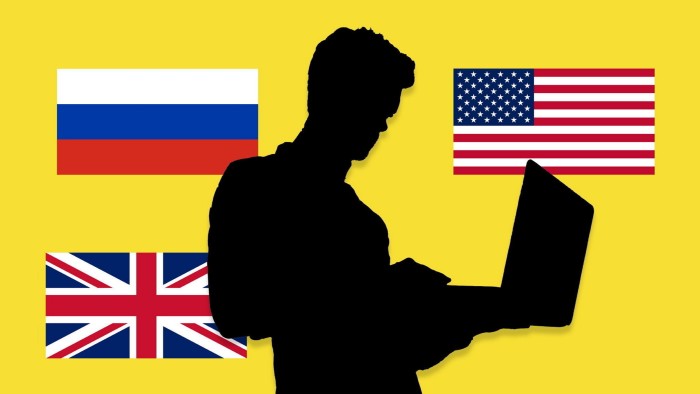
Russia, the US and UK are among the cheapest countries in the world to create fake online accounts, according to the first tool created to track a key component of the digital “manipulation economy”.
Scammers, hackers and those seeking to launch influence campaigns use specialist email verification vendors to sign up to multiple individual profiles on popular internet platforms such as Facebook and Telegram. These “bot” accounts are used to spread messages and achieve greater online prominence.
The Cambridge Online Trust and Safety Index, launched on Thursday, displays real-time prices charged by the verification companies for setting up a fake account, which in turn requires a one-time code to be sent by SMS text message to a valid phone number.
Analysis of Cotsi data over 12 months, published in the journal Science, showed that each SMS verification cost just $0.08 in Russia, $0.10 in the UK and $0.25 in the US.
This rises to as much as $4.93 in Japan and $3.24 in Australia where procedures for obtaining the phone SIM cards necessary for verification are far stricter.

“We find a thriving underground market through which inauthentic content, artificial popularity and political influence campaigns are readily and openly for sale,” said Jon Roozenbeek, co-leader of the study from the University of Cambridge. “Bots can be used to generate online attention for selling a product, a celebrity, a political candidate, or an idea.”
“All this activity requires fake accounts, and each one starts with a phone number and the SIM hardware to support it,” he continued. “That dependency creates a choke point we can target to gauge the hidden economics of online manipulation.”
The Cambridge researchers found the cost of setting up a fake account rose 15 per cent on WhatsApp and 12 per cent on Telegram in the month leading up to national elections in 61 countries around the world during the year to June 2025.
They believe demand for SMS verifications on these direct messaging apps, which have visible phone numbers, rose ahead of elections because operators wanted to register fake accounts locally.
But the study found no link between price and elections on social media platforms such as Facebook and Instagram where phone numbers are less apparent.
“A fake Facebook account registered in Russia can post about the US elections and most users will be none the wiser,” said Roozenbeek. “This isn’t true of apps like Telegram and WhatsApp.”
As a result, fake verification is much more expensive on Telegram — where the average cost is $0.89 — and WhatsApp ($1.02) than Facebook ($0.14) and Instagram ($0.10).

The researchers identified 17 companies providing SMS verification — many with customer bases in Russia and China — and selected four whose application programming interfaces (APIs) yielded the publicly accessible data on which Cotsi is based.
The index monitors not only prices but also the available stock of fake accounts listed by these vendors in different countries for 500 platforms including not only social media but also marketplaces, big brands, finance, travel, gaming and betting.
Recommended

The overall size of the fake SMS verification is estimated to be $1bn a year or more, drawing reasonable assumptions from the limited available evidence, said Cambridge’s Anton Dek, the study’s co-leader.
The researchers argue that policymakers should tackle the proliferation of fake accounts by tightening the criteria for buying SIM cards. They cite Japan’s requirement for proof of residency and Australia’s for photo identification.
Their paper in Science points out the risk that its publication “alerts SMS verification providers who might make access to their [data] more difficult” complicating further studies.
“Nonetheless we believe that our findings serve as a starting point for boosting trust and safety on online platforms,” it added.