

Last week, the AJ unveiled a new survey looking into how the profession is adapting to using AI and generative design. From those taking their first steps, to full AI adopters, the survey is seeking a snapshot of today’s business and design processes and the role played by ‘thinking’ computer systems.
The latest call for evidence follows on from our 2024 investigation, which revealed that nearly two-thirds of the 300 mainly UK-based architects and students polled were using AI in some way. Larger practices were revealed to be leading the way. The percentage of employees using AI at firms with more than 100 staff came closer to 70 per cent.
It also comes after a RIBA survey at the end of last month found that the number of architects using AI has risen to 59 per cent, compared with 41 per cent last year. That survey suggested architects were optimistic that AI might help the industry reach net zero targets, but they were increasingly concerned it might increase the risks of imitation.
To explore how architects are already using these technologies and highlight the views of today’s practitioners, we have rounded up some of the AJ’s most recent coverage of AI in architecture.
Architects voice copyright fears over government’s plans for AI
A virtual image of UK Parliament
In April, leading architects including David Chipperfield and Amanda Levete called on the government to protect the profession’s intellectual property rights from AI.
The call came as a response to the government’s proposals to allow AI firms to use the copyrighted work of creative industries including architecture, design, film and more without permission. In theory, this would allow AI firms such as ChatGPT and Midjourney to create new content based on existing intellectually protected work without breaking copyright law. However, the government said creative firms would have the choice to opt out.
Writing in a letter to technology secretary Peter Kyle, more than 30 high-profile names from the design world said the proposed law change risks ‘running roughshod’ over the design and creative industries.
The designers argued that their profession, like the music industry, is built on copyright, intellectual property and patents and that AI companies were being allowed flout copyright law.
In an age of dizzying speed, architects need to slow down
In an opinion piece last October, Toko Andrews argued that at the modern age of convenience, architecture’s value lies in slow, methodical work by expert humans.
He wrote: ‘Convenience is the new currency. It’s one of the main drivers of 20th and 21st-century economics and has helped create some of the wealthiest companies and people in history. Steve Jobs understood the benefits of a closed system designed for ultimate consumer convenience. Amazon tries to remove as many as many barriers as possible in order to get the money out of your wallet as quickly as possible.
‘Similarly, architecture now seems to be following suit, with AI and other smart technologies trying to take on as much work as possible to make our professional lives a little bit more convenient. The question is what is the cost of ever more convenient practice? Who truly benefits?’
Paul Morrell: AI will play increasing role in building-safety design
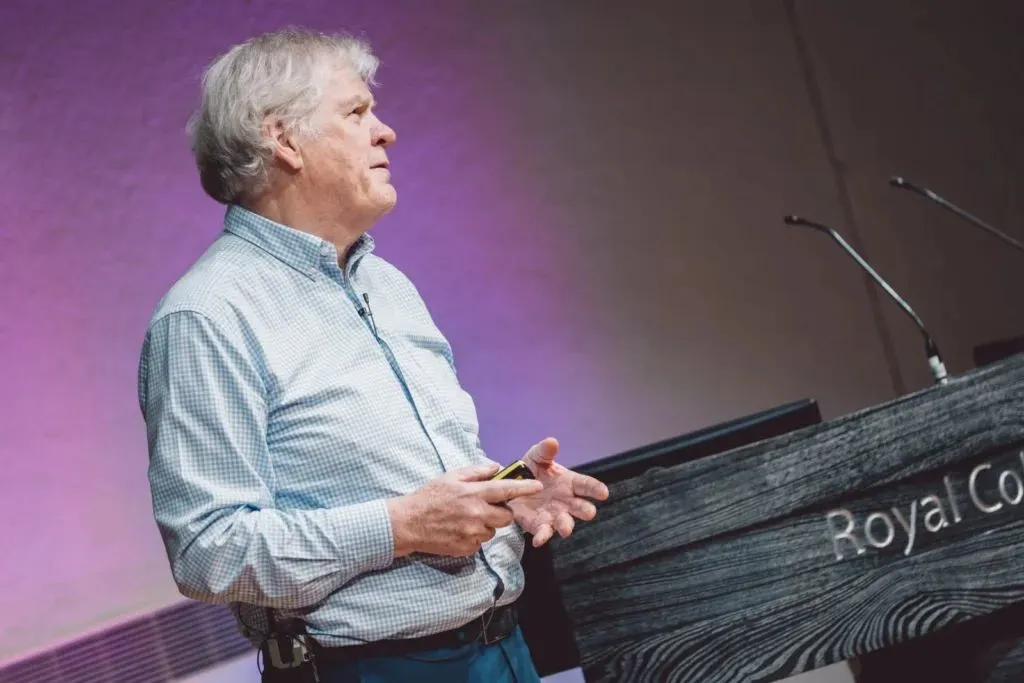
Paul Morrell Source: NBS
In September, the UK’s former chief construction adviser Paul Morrell said artificial intelligence (AI) would increasingly help architects in designing fire-safe buildings.
Speaking at the National Building Specification (NBS) Construction Leaders’ Summit, the chartered quantity surveyor said AI would help to make fire safety ‘desk studies’ more accurate – including improving stats on ‘the predictive behaviour of combinations of products and materials’.
Morrell later told the AJ that AI could also ‘start narrowing the decisions down for [architects] on some very high-level information’, such as navigating a complex flowchart to choose a fire damper.
But he said product-testing should fundamentally be the next key area of exploration for how AI can improve building safety.
Morrell explained: ‘If you go to the Building Research Establishment, they have a wind tunnel. It doesn’t do any work anymore, because it’s all done by computational fluid dynamics. And the main use of the wind tunnel they’ve got is for testing algorithms, not testing products.
‘We need to get to the same place. Scientists will tell you more it’s complicated, they’ll have the data. But the more complicated it is, the more variable it is, the more I wouldn’t trust a single human being making the decision.’
New practice Andrew Jackson Architects: ‘We’re making an AI app to counter D&B value engineering’
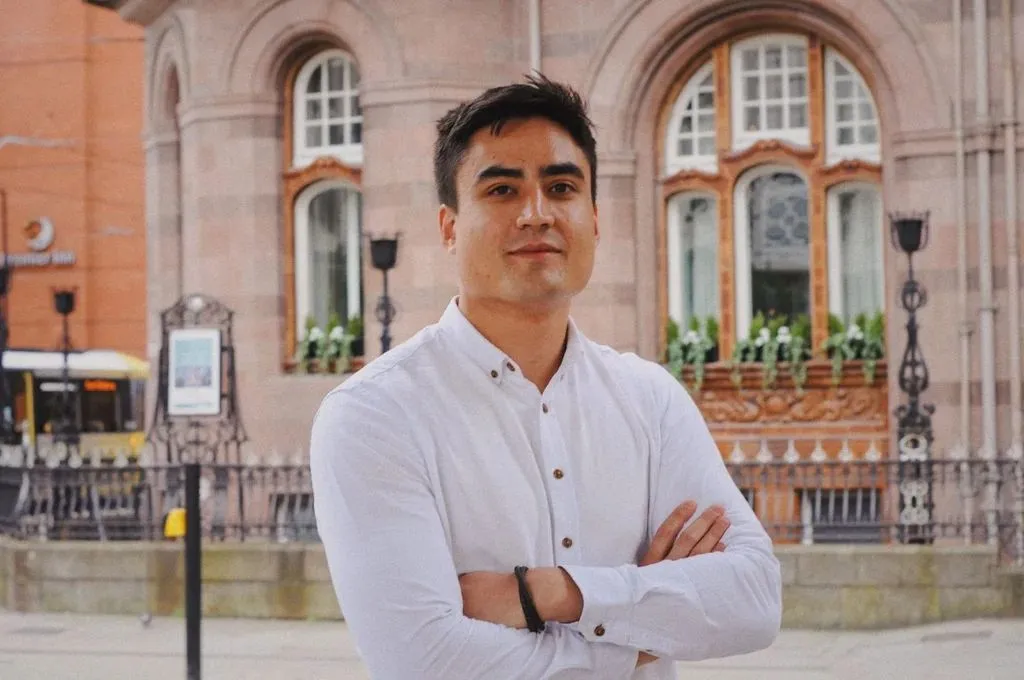
Andrew Jackson, founder of Andrew Jackson Architects Source: Liam Barnett
In an October interview, practice founder Andrew Jackson discussed the value of AI tools for small practices and introduced his own in-development AI application.
‘DesignBuildAI is a collaboration with a software developer and Innovate UK to create an AI application that mitigates the negative impacts of value engineering in construction [a minimal viable product is expected in February].
‘Our aim is to improve cost and carbon certainty during the early design stages, minimising the compromises often imposed by cost-cutting in design and build procurement – a well-documented source of frustration for clients, end-users and designers.’
Jackson also spoke aboutr his practice’s use of AI tools, revealing that he uses ChatGPT ‘almost daily’.
‘I always start every project with a sketch and would only use AI tools like Midjourney or RemodelAI for brainstorming ideas or ensuring I haven’t overlooked anything. The best designs are discovered through exploring a variety of media and it’s exciting to integrate these new technologies with more tactile, traditional approaches like sketching and model-making.
‘For administrative tasks, I use ChatGPT almost daily. While AI is a controversial topic, especially in creative industries, it’s been invaluable for processing data and drafting reports, schedules, emails, contracts, and applications. As a micro-practice, having that sounding board when writing important documents has been extremely helpful.’
PLP builds ‘world’s first’ AI research lab in Shanghai

PLP’s Shanghai WLA AI Lab – exterior Source: LinSong
In July 2024, the AJ reported that London-based architect PLP had built what it claimed to be the world’s first purpose-built artificial intelligence (AI) laboratory in China.
The 47,400m² World Laureates Association (WLA) lab, which opened in Shanghai on 2 July 2024, was described by PLP partner Andrei Martin as ‘a laboratory of possibilities, redefining our relationship with technology and blurring the line between human and machine’.
It was commissioned by Shenzhen-based property conglomerate Parkland Group and designed by PLP alongside a wider team including Arup, the Shanghai Institute for Architectural Design, Hassell, BAM, HDA, and the East China Architectural Design & Research Institute.
PLP said the building was designed ‘to meet the unique needs of machine and deep learning development’.
Find out more about the laboratory here.
AI will never replace the human creative spark

Source: Shutterstock
‘Ultimately, AI as a tool for design is inherently derivative,’ argued John Porter writing for the AJ last April. ‘The output is only as good as the input and, in architecture, there is no large-scale multidisciplinary collaborative approach to developing this (as far as we know). While artificial intelligence can help us to be more efficient, the creative and collaborative nature of architecture and design can never be replaced by a computer program.
‘AI is a promising tool which, I believe, will enhance human capabilities, but it can never replace the human creative spark.’
We need to take AI seriously, and skill up

Source: Maria Rodriguez
In April 2024, the AJ unveiled its special AI-themed edition.
‘Artificial intelligence manifestly does not have all the answers to myriad real-world challenges. But we need to take it seriously,’ wrote AJ Editor Emily Booth introducing the issue.
As part of the issue, architect and AI expert Keir Regan-Alexander offered a keen insight into how and why you need to get involved: ‘It’s not hyperbole to state that the physical environment of our future cities will be moulded largely by the work of computer scientists and the algorithms they’ll write in the next few years. With this as a backdrop, our best architects and place-makers must be more than part of the new conversation, they must also become active in the development of this consequential, software-driven shift.’
Who is using AI and how?

Designs by Built Works for prefabricated holiday homes to be built in the Sussex countryside. A CGI was produced from a 3D model and then PS Neural Engine was used to develop ‘wintry’ variations
As part of last year’s AI-themed issue, the AJ asked various built environment practitioners, ranging from architects to students, to provide examples of how they were using AI in practice.
For the image-led feature, the AJ spoke to a range of built environment practitioners, from large architecture practices to solo practitioners, and tutors to students, to collect examples of how they are using AI in their work. The results ranged from surrogate models to using Midjourney to create concept imagery for competition entries.