
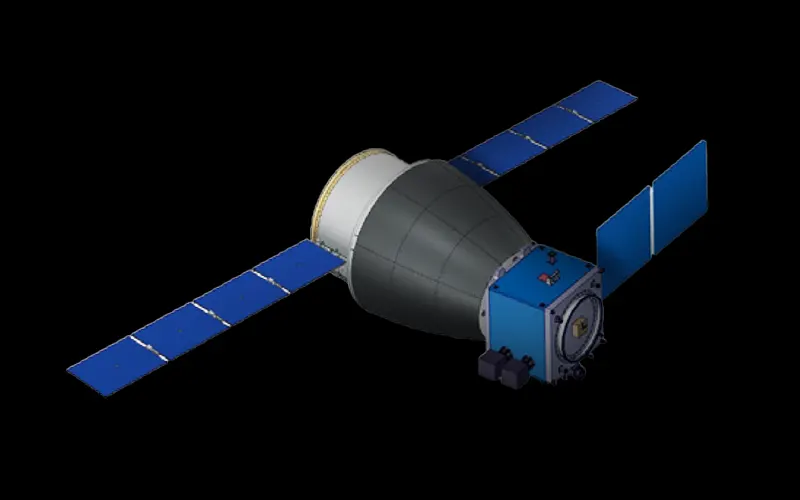
 Credit: ESA
The Exploration Company is developing a spacecraft designed to dock with and refuel satellites in orbit as part of the European Space Agency’s (ESA) In-Space Proof-of-Concepts (InSPoC) initiative.
Founded in 2021, The Exploration Company is primarily developing a modular capsule called Nyx, which will be capable of delivering cargo and, later, crew to and from destinations in low Earth orbit, lunar orbit, and the surface of the Moon. In a 25 November update on its progress with an ESA-funded project, the company revealed that it is also working on a spacecraft called Oura, designed to refuel satellites in orbit, thereby extending their operational lifespan.
The Exploration Company is leading a consortium that includes Thales Alenia Space, GMV, SENER, Almatech, and CDS as part of ESA’s InSPoC initiative to develop a system capable of docking with client spacecraft and refueling non-cryogenic propellants. Part of the agency’s Future Launchers Preparatory Programme, the InSPoC initiative is focused on developing, maturing, and demonstrating foundational technologies that will enable spacecraft to move, operate, service, refuel, and interact with other vehicles in orbit.
As part of the 25 November update, the company announced that it had been awarded a Phase B2 contract for the InSPoC-1 programme. The Phase B2 development of the project will include activities up to Technology Readiness Level 6, which represents the development of a prototype and its demonstration in a relevant environment.
The company will then start working toward an in-orbit demonstration, which is expected to be launched in 2028. This demonstration will see the Oura dock with a client satellite (built by Thales Alenia Space) in low Earth orbit and complete non-cryogenic propellant transfer, along with power and data transfer across the docked configuration.
Alongside demonstrating in-orbit refuelling, the InSPoC-1 initiative is also focused on working with industry to develop standardised docking interfaces and foster their adoption. By converging on shared standards early, ESA aims to reduce fragmentation across the European market and lay the groundwork for a sustainable in-orbit servicing and logistics ecosystem.
Keep European Spaceflight Independent
Your donation will help European Spaceflight to continue digging into the stories others miss. Every euro keeps our reporting alive.