
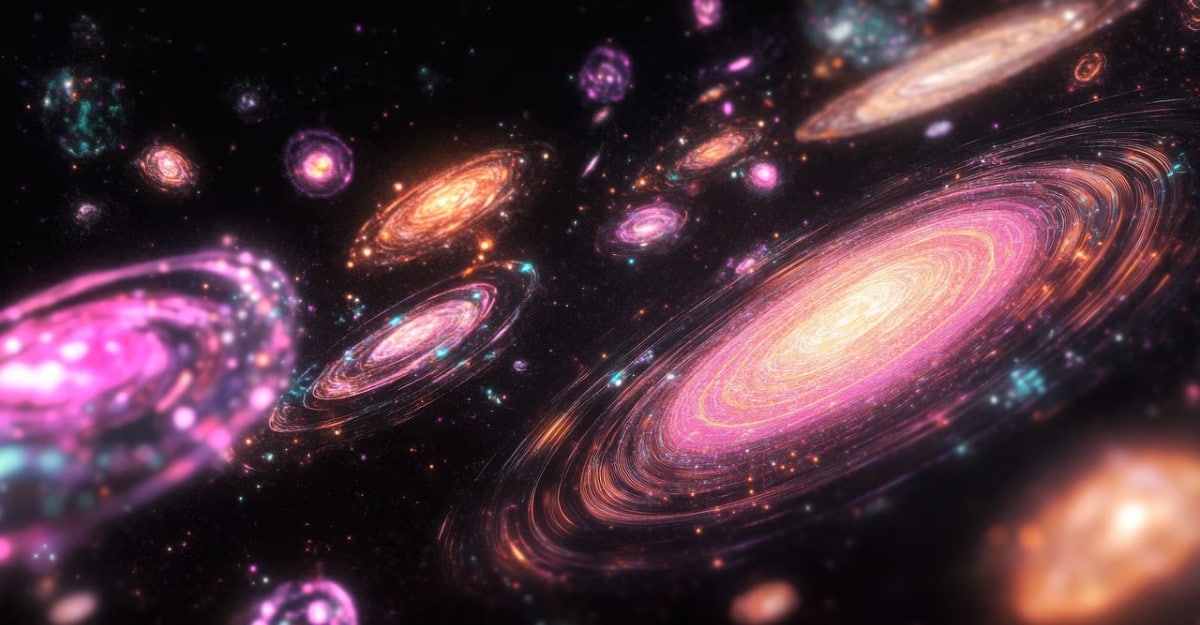
Everything in the Universe spins. Stars, planets, galaxies – all caught in a cosmic dance. Some whirl one way, some the other. For decades, astronomers assumed it all evened out. But new data from the James Webb Space Telescope is turning that assumption on its head.
One of the James Webb Telescope’s main missions is to peer deep into the cosmos, revealing how the first galaxies formed after the Big Bang. For nearly three years, its stunning images have sparked discovery after discovery – some fascinating, others downright baffling. The latest? A finding so unexpected it’s making scientists question one of their most basic assumptions about the early Universe.
Galaxies spinning in the same direction
A research team from Kansas State University has reported something astonishing in the Monthly Notices of the Royal Astronomical Society: most early galaxies appear to be spinning the same way. “It’s so obvious that anyone can see it in the data,” said Lior Shamir, a computer science professor and lead author of the study.
Astronomers long believed that the number of galaxies spinning clockwise versus counterclockwise should be roughly equal. But when the team analysed the James Webb data, they found that nearly two-thirds were rotating in a clockwise direction. In other words, the early Universe seems to have had a surprising sense of order – and no one saw it coming.
K-State researcher’s study makes puzzling observation about Milky Way, deep space galaxies’ rotations
Source: Kansas State University
https://t.co/n03uZw2S2V
— marylynnjuszczak (@marylynnjuszcza) March 12, 2025
Reality or illusion?
So what’s going on here? The researchers have two possible explanations. One is that the Universe itself may have been born in rotation. If that’s true, it should have left a detectable mark on cosmic background radiation – yet no such evidence has been found so far. This idea ties into some of the most dizzying theories in modern physics, including the possibility that our Universe exists inside an enormous black hole. “If the Universe truly began spinning, it means our current models are incomplete,” Shamir said.
The other explanation is a little less mind-blowing: it might all be an illusion. Because the Earth is also rotating around the center of the Milky Way, that motion could slightly brighten galaxies spinning in the opposite direction, skewing the data. Until now, astronomers dismissed the effect as negligible, but the new findings suggest they may need to reconsider.
“We might have to recalibrate our measurements of deep-space distances,” Shamir added. “That could even shed light on other unsolved mysteries in cosmology, like why the Universe seems to expand at different rates – or why some giant galaxies appear older than the Universe itself.”
Whether this discovery proves to be a cosmic illusion or a genuine clue to how everything began, one thing is clear: the James Webb Telescope has once again reminded us that the Universe still holds plenty of surprises.

Nathalie Mayer
Journalist
Born in Lorraine on a freezing winter night, storytelling has always inspired me, first through my grandmother’s tales and later Stephen King’s imagination. A physicist turned science communicator, I’ve collaborated with institutions like CEA, Total, Engie, and Futura. Today, I focus on unraveling Earth’s complex environmental and energy challenges, blending science with storytelling to illuminate solutions.