
(Credits: Far Out / John Mathew Smith / Alamy)
Fri 12 December 2025 18:00, UK
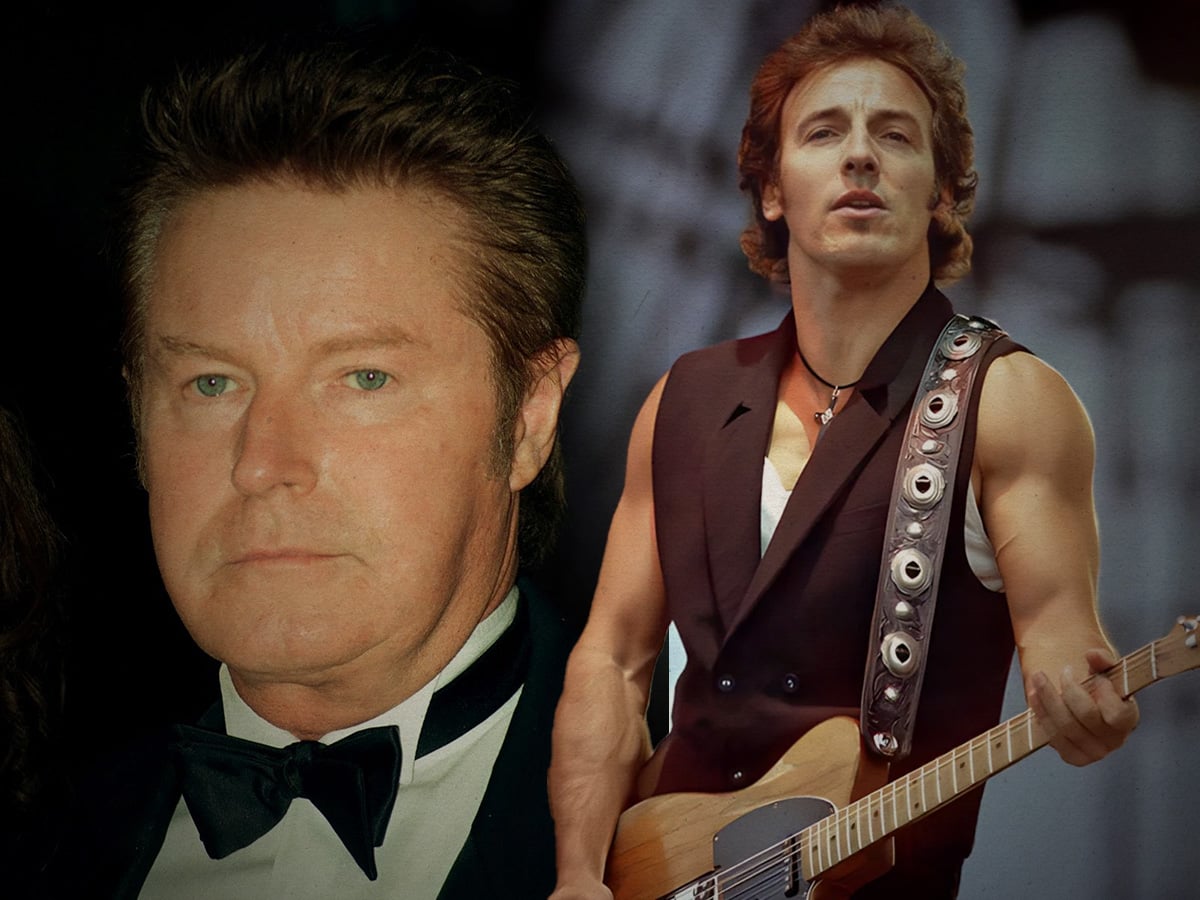
The writer James Baldwin once said, “I love America more than any other country in the world and, exactly for this reason, I insist on the right to criticise her perpetually.” Bruce Springsteen and Don Henley have certainly abided by that same ethos.
It’s all the more pertinent in the present political climate, too. Stretching back 50 years, Henley and Springsteen have embodied Baldwin’s quote with music that spears the fallacy of the great American Dream, while also proudly boasting an Americana sound that honours the nation’s culture.
As Henley said in the History of the Eagles, “We were always trying to make some sort of social commentary, and commentary on American culture in general. We think that it’s part of a tradition that dates back to medieval times.” That commentary encapsulated the great and the good in an earthy and honest manner that resonated on the same timeless level that Henley ascribed to the tradition in general.
Springsteen’s work sits in the same esteemed lineage. As he put it, his music probes at what it means to be American, something he alleges the current regime has “no concern” with. His tales may be about individuals, but these individuals present vignettes of universal life and reflections of society.
As the Boss recently quipped, “The America I love, the America I’ve written about that has been a beacon of hope and liberty for 250 years is currently in the hands of a corrupt, incompetent and treasonous administration.” That dichotomy of hope and hardship at the heart of America is placed in the amber of the fitting heartland rock sound of ‘Glory Days’ and ‘Take It Easy’.
In both Henley’s and Springsteen’s view, though, there’s been one singular voice in American musical history that embodies this all on its own. For the Eagles and the E Street man, you don’t get better than Ray Charles.
As Henley said of his footloose hero, “This man is my favourite singer of all time. He has never been known necessarily as a country artist, but he did a groundbreaking album back in the 1960s called Modern Sounds in Country and Western Music.”
 Ray Charles, photographed circa 1995 (Credits: Far Out / Alamy)
The ‘Desperado’ singer continued, “That album changed my life. I wore out at least two vinyl copies of it. It had some wonderful songs on it.” But beyond the songwriting, Charles’s addictive voice brought a wondrous weight to them that seemed to stir deeply.
Springsteen ratified this with his own glowing appraisal, placing Charles at the top of the tree for his favourite singers of all time. And when he covers his songs in concert, he’s never shy of showcasing his love for the late ‘What’d I Say’ star, joking about how he can’t quite play the tracks like the maestro who partly inspired him to embellish his rock with a smattering of soul in the first place.
Henley and Springsteen aren’t alone in placing him as the pinnacle of American singers either. Aretha Franklin, pretty much the only performer who can count themselves short changed when it comes to Charles taking poll position, said he was the only singer who “could make you cry and laugh in the same song”. And Willie Nelson said his genre-less style “broke the rules and opened the door for everyone in music.”
Charles had a voice that could haunt an empty house. With it, he sang lines that defined America that the world won’t forget. Whether it was in the vein of a jazz crooner, country hybridiser, brooding bluesman, or swaggering R&B pioneer, his timbre could do it all, and usually invented something new along the way. And he made this stirring, ingenious originality seem as natural as birdsong.
“It was so normal for me, so natural to me, even when I was three years old, I would jump on the piano stool and hit all the keys with my fingers and everything,” Ray Charles once said of his early start in music. Born in Georgia in 1930, Charles went blind at the age of seven owing to chronic glaucoma. Tragedy then struck again when his brother drowned at the age of four.
However, Charles refused to be dismayed, finding solace in music and protection in the love of his mother. These are qualities that cackle in the welter of his warts-n-all music. “I’ve always had this little thing in the back of my mind that I can do it, I can make,” he said. “It may take me a little time, and I might not do it today, but I can make it.” That emboldens his soulful singing with the unique transfiguration of defiance – something that America was practically built on.
Related Topics