
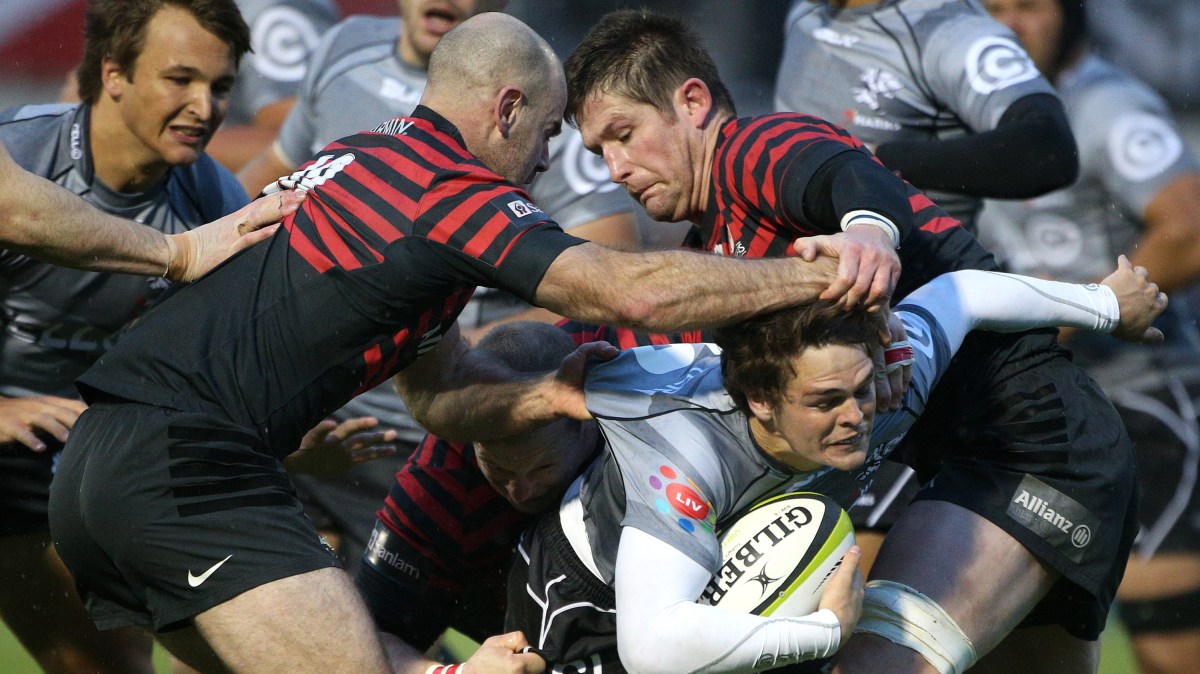
David Livingstone and James Livingstone were brothers whose sibling rivalry was pushed to extremes when they competed against each other — one for Oxford, the other for Cambridge — in the 2003 Boat Race. They had stopped talking in the long build-up. Christmas was frosty. Their relationship reached breaking point. “We are not brothers today, we are enemies,” David wrote in his diary.
The Livingstone story came to mind when Saracens arranged a pre-season trip to join the Sharks in Durban. The two clubs with strong ownership ties golfed together and played a match. But the talking was not as open between the brother clubs as had been intended because, a month earlier, they had been drawn to play each other for the first time in the pool stages of the Investec Champions Cup.
“Initially we had a lot of joint training sessions and coach interactions planned. Part of the idea is a sharing of ideas,” Shaun Bryans, the Sharks chief executive, said at the time. “But now we can’t do that to the same extent.”

Saracens players, now back in Durban for the Champions Cup tie, on safari during their September training camp in South Africa
This is a unique fixture. The off-field relationship between Saracens and the Sharks is as close as the rules permit. Marco Masotti is the principal owner of the Sharks and a minority investor in Saracens. Dominic Silvester is the opposite, having bought out Nigel Wray at Saracens in October 2021.
The ownership models were approved by the RFU and SA Rugby because Silvester is not on the Sharks board and Masotti is not on the Saracens board. The two men are great friends. They dined together on Thursday night and will sit together for the game at Kings Park on Saturday, with Masotti having flown in from New York. “It’s pretty exciting,” he says. “Although I would probably prefer that they weren’t playing each other.”
Despite his small financial interest in Saracens, there will be no questioning Masotti’s allegiances. He grew up just outside Durban and his WhatsApp profile picture is from the changing room at the Tottenham Hotspur Stadium, where the Sharks were celebrating their European Challenge Cup final victory over Gloucester in 2024.
It was South Africa’s switch from Super Rugby to the United Rugby Championship (URC) that persuaded Masotti to invest in the Sharks in 2021, with a vision to drive professional rugby into a new era. “I believe in the product of the sport. There is an opportunity,” he said at the time. “The snow globe has been shaken.”
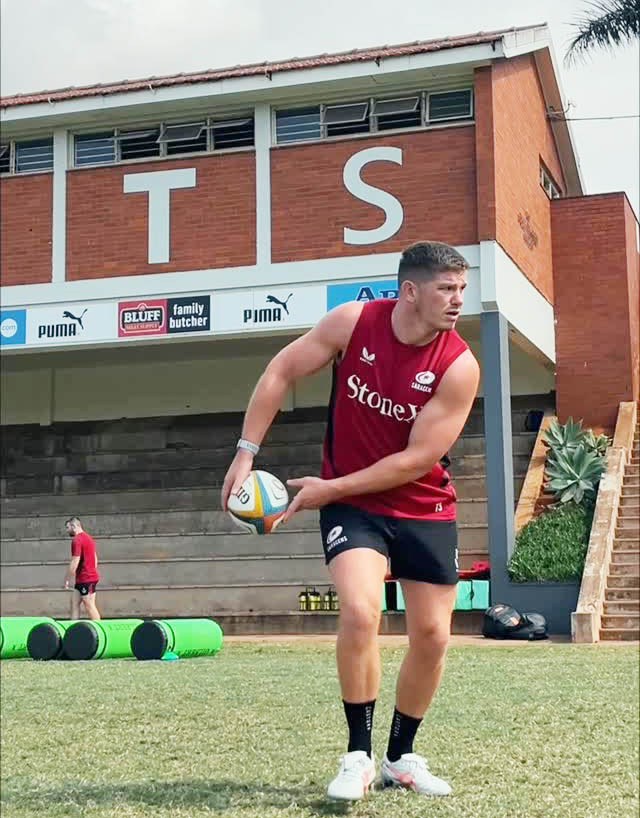
Farrell enjoys the Sharks facilities during a pre-season training camp in Durban in September
Four years on, Masotti has learned just how hard it is to achieve change in rugby, with so many ties to tradition and entrenched positions — but he still has that desire to shake the snow globe, he still sees the opportunity. If only rugby could be bold enough to grasp it.
The URC, Masotti says, has been “a revelation” for the Sharks and winning the Champions Cup is his personal goal. But he would super-charge the ailing competition by creating one international “mega league”. It would be the rugby version of the European Super League that the big football clubs tried to introduce.
Masotti sees the tangled mess of the global rugby calendar as a hindrance to progress. The Rugby Championship, he says, needs to be moved to the Six Nations window. Creating a Super League would then streamline a disjointed season in which clubs jump between competitions.
It is an idea from the same playbook as R360, whose attempts to build a new competition outside of the existing union structures were blocked by the establishment. Masotti believes their disruptor thinking was on the right lines. The club game, he says, remains ripe for revolution.
“It is going to need something,” he says. “I have relationships in sport [the owners of the Milwaukee Bucks and Florida Panthers are part of Masotti’s Sharks consortium] and in the private equity world that I can bring to rugby. But I don’t know yet what I am asking. I don’t know what the product is.
“If we had a big league in Europe, that would be a much better product. Maybe that is the way the Champions Cup could evolve. The game is vulnerable to a disruptor.
“The capital being raised for sport around the world will eventually arrive at rugby’s doorstep. You can see someone trying to Super League it, like soccer was trying to do.
“If we had a streamlined international calendar and a mega league with the major clubs, an NFL of sorts, that would be a product.
“All rugby’s attention and focus goes into that. All the best players play in it. Teams on the east coast of the United States. That would be a product.”
It may be revolutionary, it may be bold, it may ultimately be the right play for rugby but it is impossible to see the French agreeing for the Top 14 to be folded into a multi-national mega league. “If there is one thing I have learned over the last four years it is how conservative rugby is,” Masotti concedes. “Someone is always pushing against you when you try and move the needle a little.”
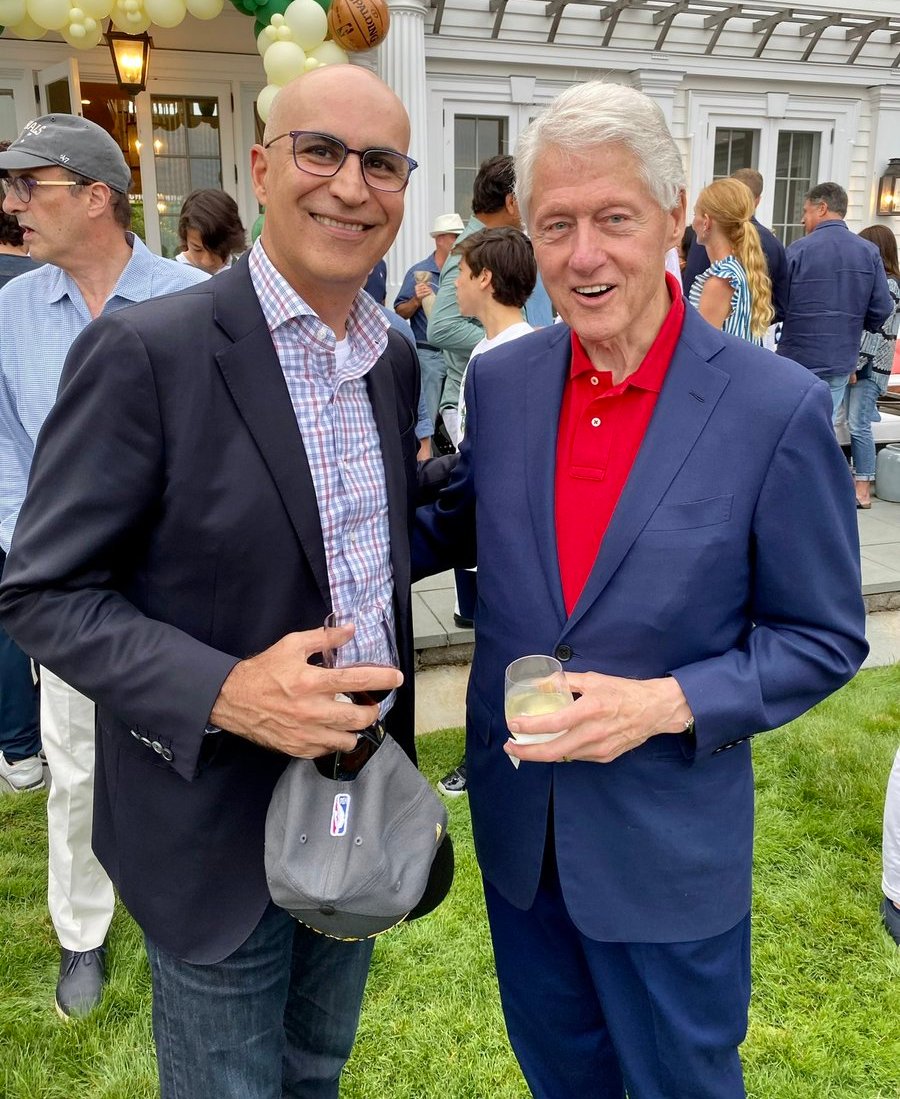
Masotti, pictured with Bill Clinton, will fly into Durban from New York for the contest between the two clubs in which he has a stake
Where Saracens and the Sharks have succeeded in moved the needle is with their collaboration off the field, particularly with the establishment of a joint media house. “One plus one equals three,” Masotti says. Its first big result has been the edgy, youthful, urban rebrand project at Saracens entitled ‘Beyond Rugby’.
The attitude is “anti-rugby” and deliberately provocative. But public indifference is the enemy. Charlie Beall, who took over as the chief executive of Saracens in June, learnt that from working in his previous job with the NFL and WWE. Beall’s recruitment coincided with Mike Leslie being appointed as chief growth officer for both clubs. Both men grew up in South Africa as Sharks fans.
If Masotti’s focus is on changing the structures of rugby, Leslie’s influence is on how people view the sport. He drove the ‘Beyond Rugby’ campaign. With use of music and fashion, it is designed to reflect the interests and character of the players and speak to non-traditional rugby fans. Again, it has the hallmarks of R360. And it is working. Saracens have enjoyed record ticket sales and year-on-year growth of 79 per cent in social media engagement since the start of the season.
“Both clubs, all the way up to the ownership, share a similar vision of what the opportunity for rugby is,” Leslie says. “That’s the basis of the brotherhood. We are trying to solve the same problems. Saracens have really understood what it means to win on the field but we haven’t been focused about winning off the field. Sports have moved on significantly. Rugby has been slow to get the memo. Rugby has traditionally spoken to rugby. To grow the game we need to speak to the next generation of fans.”
Saracens have leant into their reputation as the bad boys, the Prem club that others love to hate, an enmity founded in their on-field success or their salary cap management or both. “It is part of our identity,” Leslie says. “We have shied away from that. We went on a charm offensive for a couple of years. But it is unbelievable how authentic it is. It’s almost the character we play out on the field. That’s part of the power.”
The rugby synergy between the two clubs has taken longer to develop than Masotti would have liked. The vision has always been that each club could offer development opportunities for young players and coaches. “It will happen,” he says. “You can see a world where you are creating a pathway for coaches and players to go to another environment to learn and grow.”
It could be that Owen Farrell becomes one of the first beneficiaries of this rugby brotherhood. On his arrival in Durban this week, the Saracens fly half discussed his desire to become a coach once his playing days are over. “I have always found the sharing of information helpful, as much for your own development as the others around you,” he said.
As if to demonstrate Masotti’s point that the Champions Cup is in need of a major overhaul, Farrell will be in coach mode this weekend. Saracens, having opened their campaign with a comfortable win against Clermont Auvergne, will not be close to full strength in Durban.
The Sharks, who rested front-line players for their heavy defeat by Toulouse last weekend, have included the likes of Siya Kolisi, Andre Esterhuizen and Bongi Mbonambi. Winning at home is all that matters in the group stages. The Sharks also have a new head coach in JP Pietersen, the 2007 World Cup-winner.
It will be convivial in the stands between the club owners. Like the Livingstones, they are all pulling in the same direction, chasing this opportunity. But for 80 minutes on the field at Kings Park, sibling rivalry will replace brotherly love.
Sharks v Saracens
Champions Cup
Saturday, 3.15pm
TV Premier Sports 1