
(Credits: Far Out / Apple Corps / Raph_PH)
Sat 13 December 2025 10:02, UK
The Beatles have undeniably influenced almost every inch of the modern music sphere ever since they played their opening notes back in the early 1960s, but that lineage never seemed to be more prevalent than when the future of British rock came into force.
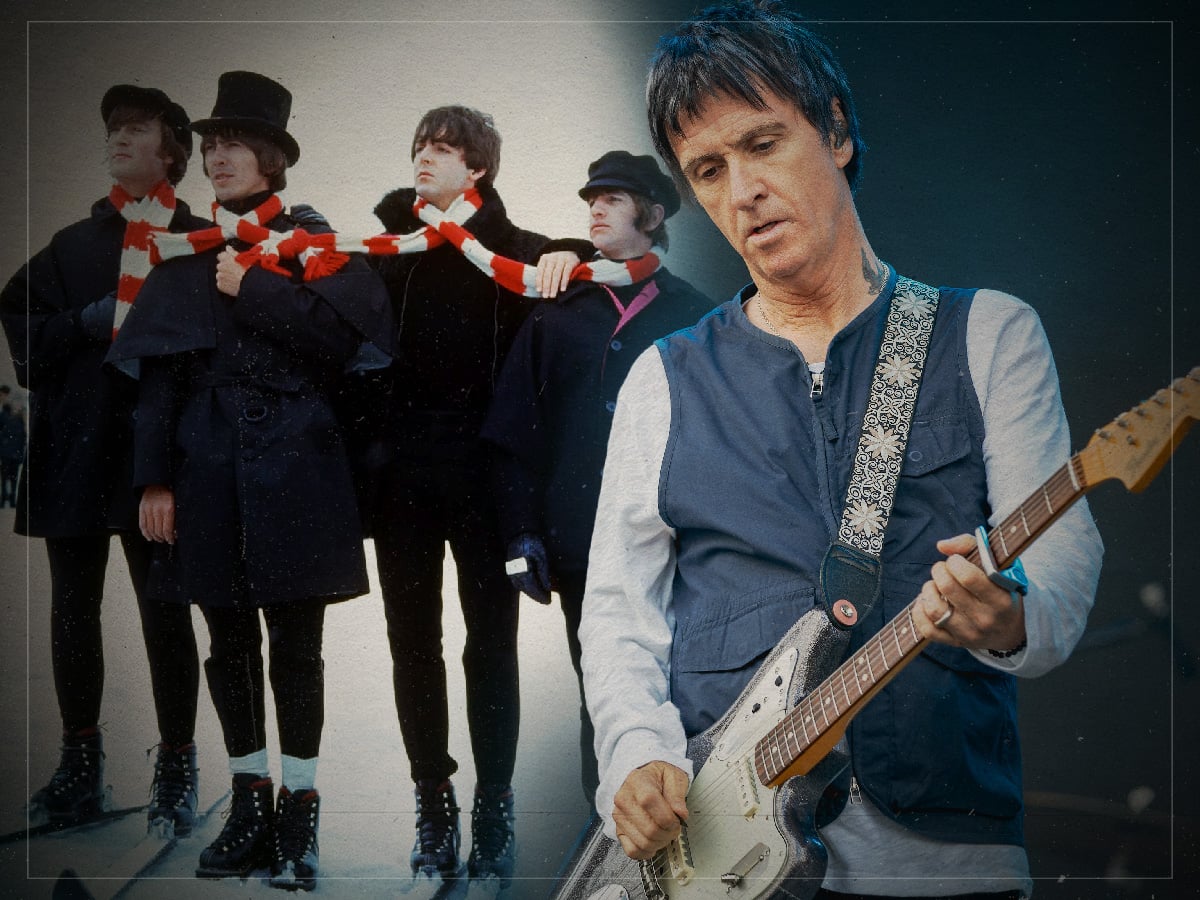
The likes of Oasis, The Stone Roses, and Black Sabbath were all hugely forthright in claiming that the Fabs were each of their ultimate guiding lights when leading them towards their respective rock destinies, and Johnny Marr is no different from the rest. The Smiths may have been a law unto themselves, but the wise words of The Beatles were never far from view.
It was clear from the very beginning that, despite being part of a close unit as a band, Marr always knew how to stand on his own two feet as far as the case for voicing his opinions went. In this sense, in his eyes, there was only ever one album by the Liverpudlian legends that soared down the decades still at the top of the tree – and he wanted that view to be shared by everyone.
The year was 1966, and although he was still so young at the time that he would have barely understood the world around him, from the second that Revolver hit the airwaves, Marr inherently knew that something had forever changed. “I got influenced by The Beatles in a big way – way, way after the event – through the advent of the VCR,” he told Uncut upon the album’s 55th anniversary. “For many years, I believed Revolver was everybody’s favourite Beatles record. I mean – it is, isn’t it?”
It may seem a bold statement to make, given the legions of Beatle maniacs and the scores of their vast back catalogue, but Marr was ready to come in clutch with his justifications. “By the time they made Revolver, they had been through A Hard Day’s Night, Please Please Me, Help! and everything – and they’re still their own entity. Of course, Revolver is influenced by all the things you hear on those records, particularly the soul records that are hip in the UK and London at the time, but it’s The Beatles.”
He added, “They didn’t need to look outwardly at other scenes to find a concept. In a way, Revolver is the culmination of an extremely mod phenomena.” This casting eye on the history of the moment makes Marr all the more correct in his assertions – often cited as The Beatles’ first dip into the intoxicating waters of psychedelia, it was a time that reaped untold consequences on the rest of their work.
In this sense, the guitarist is right to claim that Revolver is perhaps the most culturally significant of any Beatles output, and therefore, in his opinion, the ultimate favourite. As their spirits deepened, drug taking increased, and sonic innovation rose exponentially, that album symbolised a definitive turning point – indeed, the revolver had fired its shot, and everyone spun around to observe the spectacle.
There’s no doubt that the ability to turn heads with that velocity was something that was both envied and adored among bands everywhere, even decades down the line from the actual event itself. That’s exactly why Marr and the rest of The Smiths were so head over heels: because The Beatles created something that they could only replicate.
That’s not meant as an insult to any other band who came after the Fab Four, because their music is as influential in its own right, but when it really boils down to it, all roads lead back to that one infamous quartet. For Marr, Revolver may have represented the pinnacle, but in many ways, the climb to reach the top of that mountain was all the more important.
Related Topics