
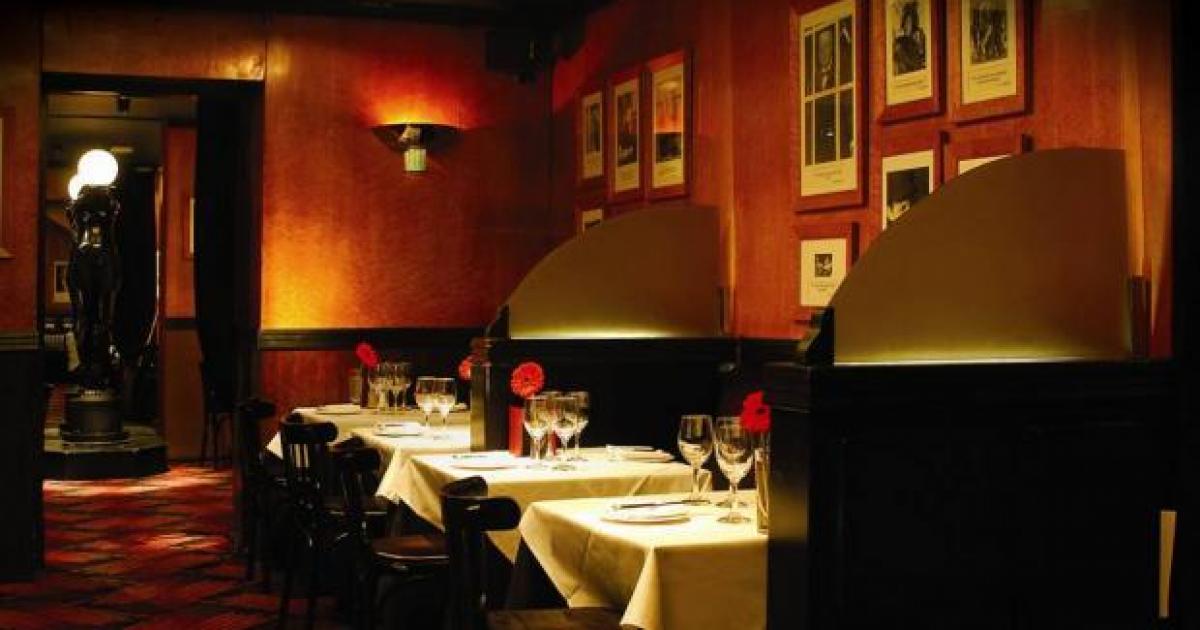
Martin Smith, the kenspeckle Glasgow media lawyer (of late renown) moved towards me and, barely breaking stride, whispered: “May I suggest, Mr McKenna that you direct your friend to Ralphie Slater’s and to meet you here later? This is Rogano; it’s not one of your usual newspaper drinking holes.”
Once, within days of taking charge, a new bar manager had foolishly opted to replace Ella Fitzgerald and Billie Holiday with some thin and insubstantial doggerel by The Beatles. After a firm but gentle rebuke, it was back to another informal house rule: nothing from beyond the 1950s gets played on these premises.
Read more:
London had the Ritz; New York had Delmonica’s and Glasgow had Rogano. If you didn’t know it was there, you’d think a tobacco shop or a gentleman’s outfitters lay behind its unemphatic façade down behind the stone archway on Royal Exchange Square.
In 1999, I’d spent four weeks at the bar of Rogano, trying to persuade William McIlvanney to ditch his regular Herald newspaper column and come write instead for Scotland on Sunday. I succeeded, but it cost me a year’s worth of expenses and half of my brain cells. The great novelist, a man of style, focus and commitment had insisted that all negotiations take place in Rogano.
It now sits forlorn and forgotten behind graffiti and chipboard. As pubs re-opened after Covid in 2021 Glasgow’s wilted demi-monde waited for Rogano, one of Europe’s finest fish restaurants, to re-open. Four years later, they’re still waiting. It had commonly been accepted that the premises would eventually be turned over to new owners and a bleak Deliveroo future.
The reasons why these premises have lain empty for so long are buried in a long-running stand-off between the owners and the building’s insurers following substantial water ingress caused by flooding in the basement.
Rogano in 1978 (Image: Newsquest)
Last week, The Herald reported that the dispute was heading for the UK Supreme Court. Glasgow’s street intelligence networks though, are reporting that, in any case, a substantial seven-figure sum has been set aside by new backers to repair the damage and re-open Rogano with its gilded fixtures and fittings untouched. We can only hope.
Rogano, though classy was always classless: politicians and accountants were also admitted.
The name ‘Rogano’ suggests its origins lie somewhere on the Mediterranean coastline, but it emerged from a more homespun confection. It was constructed from the first syllable of its co-founder, a Glasgow wine merchant named James Roger, and the first three letters of the word ‘anonymous’ which was how Roger’s business partner, a Mr Anderson preferred to be known.
Later, another city entrepreneur, Don Grant would provide the glamour. The oyster-bar’s famous art-deco interior is a replica to scale of the state-room of the Cunard liner, the Queen Mary, built in the Clyde shipyards a few miles west. Repairs to its seating and bar stools could only be carried out by designated craftsmen in the south of England.
Day-to-day Glaswegians loved this place. On Saturday afternoons it thrummed with ladies and gents of a certain age who simply wanted to return for a few hours to the faded glamour of their youth. These memories were bequeathed to younger generations who appreciated the sense of being treated like princes and princesses by seasoned professionals behind the bar.
During the city’s graduation season, students came to Rogano with parents and grandparents who had also celebrated their academic success here. It was also the favoured destination of any visiting stars from the arts and entertainment sectors. And it had Table 16, the most sought-after in Scotland.
Gordon Yuill, the former General Manager of Rogano had created the legend after telling a couple of journalists that this banquette, offering a universal view of the house and hidden from the gaze of drinkers at the bar, was where he positioned visiting entertainment royalty. It was also where several ‘off-book’ liaisons could be safely conducted.
This was where faltering young swains would hope to impress prospective fathers-in-law when the time came to seek their blessing on marriages to their daughters
Mr Yuill had arrived at Rogano in 1983 as the restaurateur, Ken McCulloch began working on his grand re-design of the premises. Before then, it had been shut for a year while urgent repairs were carried out.
Mr Yuill is now Director of the Glasgow Art Club on Bath Street now also experiencing a re-birth under his guidance. “I’m delighted at the prospect of Rogano’s re-emergence,” he said. “There was nowhere quite like it in Scotland and Glasgow has missed it badly.”
(Image: Rogano)
Round the corner, The Ivy has sought to fill the gap previously occupied by Rogano. It’s made a decent attempt, but whereas Rogano was elegant and andante, The Ivy is all brassy allegro, though cheery nonetheless. Yet, Glasgow’s turbid hospitality sector rests for no-one. Will there still be a place for Rogano, were it ever to re-open?
Gordon Yuill has no doubts. “The city will forget the fact that it was shut for so long,” he said. “When we got it in 1983, it had been a den of iniquity in the decade or so before that, a down-at-heel pub that didn’t serve food.
“When Ken McCullough arrived, the projected cost of repairs and re-design was around 250k, but it ended up being close to 400k. This basement was found to be lined with blue asbestos, which set us back a further year. Glasgow simply forgot the bad times.
“Generations of people had dined there in its golden, post-war years. You’d see grandparents and parents introducing their children to Rogano for their big life events. Glasgow is an optimistic city and has an amazing capacity for erasing negativity and bad memories.”
Read more:
He recalls some classic encounters when he ran the show. “I loved literature and the theatre,” he said, “so I’ll never forget greeting Alan Bleasdale and Alan Bennett popping in for dinner one night during a show-run. I can still remember those big stained glass doors opening one evening when Julien Spalding (former Director of Glasgow’s art galleries and museums) walked in with David Hockney.
“I remember Jim Kerr walking in with his then girlfriend, Patsy Kensit. She was wearing a mini-skirt so short that it had brought the place to a standstill. And then there was the night I tried to get Ronan Keating through the bar to his table in the restaurant.”
He tells me that he had to turn down Mick Jagger. I tell him to behave himself. It seems that Mr Jagger had wanted to book tables for him and his 12-strong entourage, but that this had occurred at the height of the graduation season. It was suggested instead that the wizened rock sprite come and wait at the bar and that they’d get them all fed and that he wouldn’t be harassed, as Glaswegians tend to affect insouciance in the presence of celebrity.
“There was no problem with the kids crowding him,” says Mr Yuill, “it was the mums and dads asking him to sign their menus. And when Rupert Everett was appearing at the Citizens, he would bring his parents for lunch and dinner every day of the run and treated it as his own. Gillian Anderson was a permanent feature for the three weeks or so she was filming House of Mirth.”
In a changing gastronomic environment in which artisan street food is dressed up and re-imagined so that it can be offered at prices that would choke a horse, it remains to be seen if any of the old Rogano classics will beguile the louche and the wasted.
Its signature fare included a legendary fish soup whose original ingredients are said to be sealed in an iron casket, buried in the vaults of what was the old Bank of Scotland on St Vincent Street. This could be followed with pan-seared scallops, sliced smoked Marberry salmon, langoustine en croute and half-lobster salad. A tidy but unostentatious Chablis was always its favoured partner.
Kevin McKenna is Scotland’s Feature Writer of the Year