
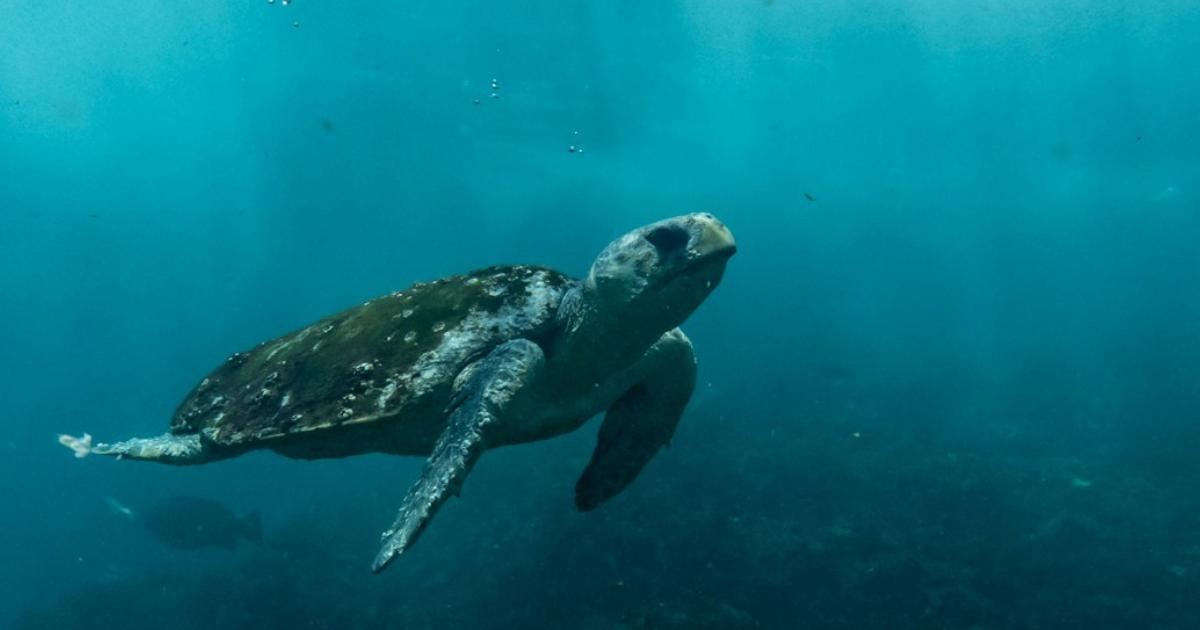
The loggerhead turtle was discovered lying next to a beached buoy near to the Southerness Golf Club by a walker on Thursday evening.
The SSPCA, who arrived within an hour of the discovery, said it was the third loggerhead found this week, with experts believing they have been swept off track while migrating to Portugal.
This may have been caused by a small pocket of colder water which could have caused cold-stunning, which may lead to turtles entering a similar physical state to hibernation, making them prone to being swept off their path.
READ MORE: This bird species is found only in Scotland – and may ‘have a Scottish accent’
Valerie Smith Lang, the walker who discovered the reptile, called SSPCA after making the discovery and followed the organisation’s advice to wrap it in a sea water-soaked towel in order to keep it hydrated.
The BBC reported that after the SSPCA arrived, the turtle was taken to Fife where it will be rehabilitated for up to one year before being released back into the sea.
Loggerheads can weigh up to 450kg and grow to between 3-6 feet, making them the largest hard-shelled turtles in the world.
According to the World Wildlife Fund (WWF), they are also the most common turtle in the Mediterranean, commonly seen nesting on beaches across its coastline from Southern Europe to North Africa.
READ MORE: Incredible video shows sea eagle taking live lamb from Scottish island flock
They are now a vulnerable species in part due to a number of their nesting beaches being disrupted by tourism developments.
The Marine Conservation Society (MCA) advises that if you find another stranded turtle, do not put it back in the sea, instead wrap it in a damp towel and set it on its belly somewhere safe and sheltered, raising its back end slightly to allow water to drain from its lungs.
They also suggest that if you need to move a turtle for any reason, to use its shell to manoeuvre it rather than the flippers.
Any further sightings of turtles should also be reported to experts like those at the MCS or SSPCA.