
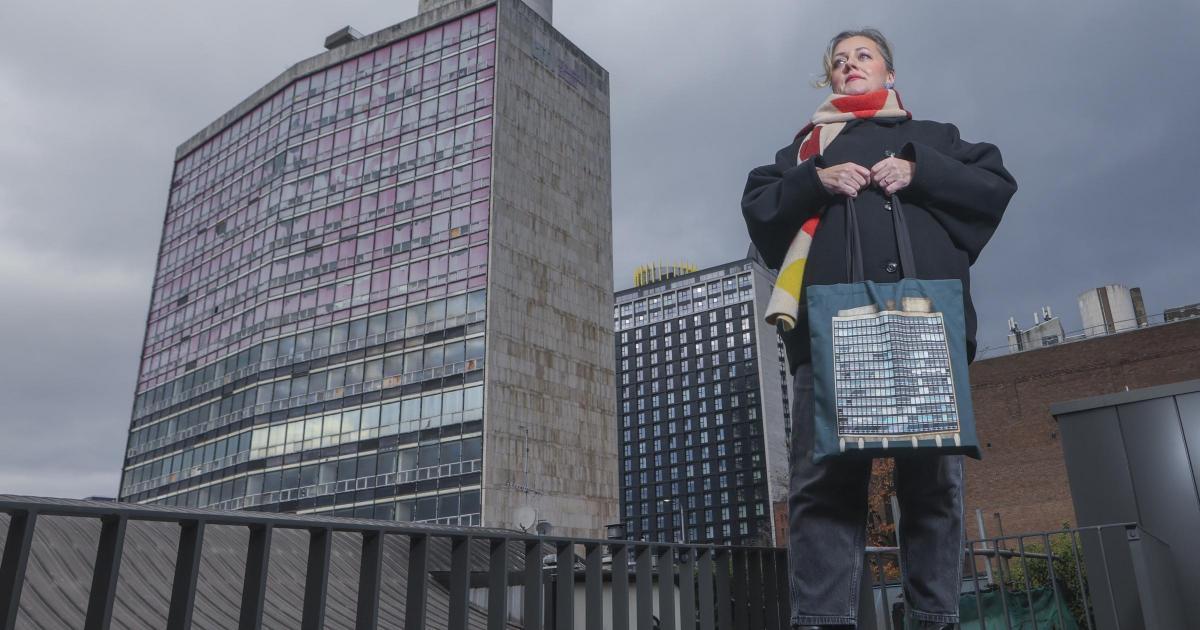
We’re here to give it some love though, and not just the Met Tower. Right across Scotland, buildings like this one – modernist, brutalist, call it what you will – attract love and hate. Many of the big housing developments that went up in the 50s and 60s as part of the movement have been pulled down or blown up. But brutal architecture – concrete, utilitarian, some would say utopian – is also being reappraised, reassessed, and in some cases reborn. Lovers of brutal say: give it another chance.
So that’s what we’re here to do. To mark the publication of two new books on brutalism, The Herald has asked prominent admirers of the style to choose a brutalist building they love and tell us why. Some might say these buildings are among the ugliest in Scotland. But here’s a chance to give them another look, from a different angle, and maybe think again.
The Met Tower from the roof of the Martha Street flats (Image: Newsquest)
The Met Tower, Glasgow
Standing on the roof of the Martha Street flats, Natalie Tweedie points at the Met Tower, the College of Building and Printing as was, and tells me why we should love it. Natalie is an artist and started out drawing and painting Glasgow’s fine red-brick Victorian buildings before turning her attention to the city’s brutalist architecture, including the Met Tower. “Look at it,” she says. “It’s just as beautiful as some of the great Victorian buildings.”
She realises not everyone will agree. “A lot of people hate it and think it’s a concrete box, but if you actually look at it, it’s angled at the front, there’s beautiful detailing at the side – it’s not concrete, it’s a form of marble – and you have the Le Corbusier-inspired sculptural forms on the top which are brutalist. I’m a big fan.”
Natalie believes buildings like the Met are symbols of a more positive, progressive age. It was opened by the Labour leader Harold Wilson in 1964 not long after his famous “white heat” speech, in which he promised a scientific revolution to modernise industry and drive economic progress; it was also a time when there was a great expansion in municipal buildings and social housing, often designed and created by modernist architects and designers. “A lot of the brutalist architecture was utopian,” says Natalie. “It was aspirational and hopeful and was rooted in trying to give people a better place to live. It’s a vision of the future from the past.”
Read more
The problem in many cases, of course, is that the utopia didn’t come to pass: Basil Spence’s famous/notorious flats in the Gorbals for example. But even there, Natalie says the failures were often down to other factors: housing policy, poverty, even the climate (brutalism works better in sunny places). “Brutalist buildings are an easy target because they have an association with failed social housing,” she says. “But that doesn’t apply to the Met Tower.”
As it happens, it now looks like the future of the tower is going to be housing too. It was still a college until 2014 but has been unused since and a number of possibilities have been mooted, including a hub for science and tech. However, it’s now been acquired by a developer who has plans to turn it into, no prizes for guessing, student accommodation, and Natalie says if it saves the building, why not.
“If the Met Tower was in somewhere like Berlin,” she says, surveying it from 20 storeys up, “it would be restored and celebrated and it makes me sad that Glasgow doesn’t do that.” But Natalie is also hopeful we’re witnessing the beginnings of a turnaround, a greater appreciation of the modernist legacy. “Brutalist is a term that allows people to write these buildings off, but I think they should sit alongside the Victorian buildings; they are beautiful in their own right. So why erase that and demolish it? Why not value it instead?”
The Lang Stracht Hotel (Image: Simon Phipps)
The Lang Stracht Hotel, Aberdeen
Even by brutalist standards, the Lang Stracht Hotel in Aberdeen is an extraordinary building. Designed in the 60s by architects Baxter Clark & Paul as part of the expansion of the Mastrick area of the city, it’s a place that, like a lot of brutalist design, shows off its inner workings: the stairs, the corridors, the pipes, the vents. The bulging windows and buttresses give it an organic quality too, like a creature crouching. And like all brutalism, some’ll love it, some’ll hate it.
Simon Phipps loves it. Simon is an artist and photographer who’s documented many of Scotland’s brutalist buildings in his new book Brutal Scotland. “The Lang Stracht Hotel is a remarkable building,” he says. “And the fact they’ve painted the rear black makes it even more monumental. It’s the dynamism of the form that I particularly like: the building is the sum of its parts, the stairwells are pushed out, the entrance ramps, it’s showing what’s going on inside.”
For Simon, who trained as a sculptor, the hotel and other buildings like it represent buildings as sculptures and the best of the modernist ethos. “I find it incredibly powerful and beautiful and sculptural and I know there are many other people who appreciate its qualities,” he says. “It’s my personal passion to record and exemplify what this period of architecture represented, not just for its artistic and architectural qualities that are there for all to see, but I’m also interested in the societal impact it had – all these radical new ideas about building a new Jerusalem almost, almost utopian thinking: we can build a better world.”
Simon Phipps (Image: Simon Phipps)
Simon is aware there are risks here, in artists, writers and photographers waxing lyrical about modernist buildings on the one hand and leaving other people to live in them on the other. “I do feel that sometimes,” he says. “I live in an Edwardian house, that’s the way it’s worked out, but I’ve lived in modern houses on and off throughout my life. My parents were architects and most of my growing up was in Milton Keynes where they were part of the design team so we lived in a modern house there. My dad still does. He lives in a small really nice brick modernist house from the mid-70s. He loves it and I love it too. But I take the criticism.”
Simon accepts too that the brutalist legacy, particularly in housing, is mixed to say the least. “Clearly, they didn’t all work,” he says, “possibly due to some of the architectural decisions that were made; also they were reflecting what was going on throughout society, a decline in industry and wealth.
“But people have also been too quick to demolish rather than look at reappraising what’s there – essentially, the layout of a lot of these places works very well, particularly residential. There were far better space standards in a lot of those blocks than you would ever get now. We also forget that a lot of what went before were virtual slums and completely inadequate for people to live in.”
Simon essentially believes brutalist architecture often gets the blame for problems caused by other factors. “A lot of people blame the architecture but it has a hell of a lot more to do with what was going on in society, particularly in the Thatcher period when public housing was allowed to be sold off without any replacement. There was a period when the state looked after you in a better way than it seems to these days and all of it was represented by modernist architecture. And if we could do it then, why can’t we do it now?”
Bruce Peter on the Dundasvale estate (Image: Newsquest)
Dundasvale, Glasgow
Bruce Peter remembers coming to the Dundasvale estate when he was a boy. The professor of design history at Glasgow School of Art and author of new book Modernist Scotland is in his fifties now so we’re talking more than 30 years ago and it was a different time in some ways.
“I remember you had that notion that high-rise is awful and you’d come here and find it vandalised,” he says, “but I found an earlier version of what you see today: an extremely well-maintained, highly sought-after estate and people were very proud of their homes. And it’s in good condition.” He tells me if he were younger and single, he’d happily live here.
And I see what he means. This has always been one of my favourite pieces of brutalist planning: six five-storey blocks and two high rises, all arranged around large, traffic-free green spaces. It was the work of Walter Underwood and Partners, who also did the Queen Margaret Union at Glasgow Uni and the Fulton Building in Dundee (more of which later) and, as Bruce explains, the idea was great sweeping horizontal lines, corridors in the sky, a bit like the Barbican in London.
The problem is what has been done to it since. “When people talk about beautiful or ugly,” says Bruce, “they’re often confusing the condition a building is in with its underlying design. Looking at pictures of a lot of these buildings when they were brand new, you realise they are very beautiful.”
The issue now is that ugly wind-shields have been stuck on to the Dundasvale buildings, the whole thing’s been painted magnolia and the original multi-coloured doors have been replaced with neo-Georgian wood-effect ones. “What’s happened here,” says Bruce, “is there’s been an attempt to superimpose a language of an inter-war suburban bungalow on a building that’s more like the Barbican Centre in London and it completely ignores what this is. So it ends up looking a bit of a hotchpotch.”
For the people who actually live in the flats, the picture is mixed. I speak to a few and they tell me the flats themselves are good but other issues are a problem: cuts to the concierge service, not enough maintenance by the housing association, and undesirables including drug dealers hanging about the carpark. A couple of people also mention the policy of housing refugees in the flats; one female resident says she can often come across groups of young men in the corridors and it can be scary. In other words, it’s still buildings like this one that become the centre of bigger social issues and it’s a familiar story. Is it really the building’s fault?
The Nuffield Centre (Image: Simon Phipps)
The Nuffield Unit, Edinburgh
If you want to know what brutalism is really all about, check out the Nuffield Transplantation Unit at the Western General Hospital in Edinburgh: the vaulted roof, the ochre-coloured concrete, and a bridge over the road connecting different parts of the building. The point is that the Nuffield was designed in the 60s for a specific purpose – the emerging science of organ transplantation – and the purpose dictated the look, which is often how brutalist buildings work: they don’t hide their function, they show it off.
A big fan of the building is Robbie Macfarlane, senior course tutor in architectural history and heritage at Edinburgh University and a member of the Architectural Heritage Society of Scotland. “The Nuffield unit very much typifies what brutalism actually is,” he says, “which is usually buildings that were very forward looking, municipal in nature, that were using the cheapness of energy and the abundance of concrete post-war. It was very forward-looking and connected to a hopeful future.”
Robbie McFarlane (Image: Robbie Macfarlane)
The Nuffield is also by an architect, Peter Womersley, who’s particularly hot property in brutalism just now. The studio he designed for the textile designer Bernat Klein in the Borders has just been saved by a consortium of heritage groups and will be restored from its dilapidated state. And the architect’s extraordinary football stadium for Gala Fairydean FC in Galashiels, comprising great triangular planes of concrete defying the usual angles, has benefited from a £1.45m renovation and is looking better than it’s ever done. Robbie believes Womersley is grossly under-rated but is now attracting more of the attention he deserves.
Robbie does have a couple of issues with brutalism however – for a start, the name. “The name started as a joke, because it’s a continuation of modernism,” he says. “But brutalism has nothing to do with brutality or buildings being foreboding or scary or anything like that.”
The other issue is how we look after the buildings. As happens in hospitals, the Nuffield has been repurposed and reconfigured, which means it’s lost much of its original appearance, but the real issue for Robbie is maintenance. “People are happy to pay for maintenance for an old church roof perhaps,” he says, “but when it comes to modern buildings, they’re just left. And when things aren’t new and shiny anymore, we very quickly lost interest.”
The Fulton Building (Image: Simon Phipps)
The Fulton Building, Dundee
The last building is another choice of the photographer Simon Phipps and it has a rather special place in his memory. He photographed the Fulton Building at Dundee University for his book, Brutal Scotland, and as he did so, he started to realise the building was familiar to him. Eventually, he worked out that he’d photographed it some 30 years ago when he was working as a sculptor and was taking pictures of buildings as inspiration for his work.
It isn’t a surprise to Simon that he should have seen the Fulton in this way because for him the building, like a lot of brutalist architecture, has sculptural qualities. “I was particularly interested in the concrete frames of these buildings and it’s part of the appeal of brutalism, the structure, you can see exactly how it’s made and how it supports itself. It illustrates its construction and I found that very exciting. It invites you into the inside, it displays exactly what it does – the form is defined by its function and I love that idea.”
And Simon can’t help returning to what he believes brutalism once represented and can again: aspiration towards something better. “Mistakes were obviously made,” he says, “and there’s that isolation factor, the sense of unease and danger that some of these places can foster. But people are attracted to the boldness and the ideals that went along with it. It’s not just the visual allure, it’s about what it represents: a vision of society that’s better.”
Brutal Scotland by Simon Phipps and Modernist Scotland by Bruce Peter are available now. For Natalie Tweedie’s work, visit nebo-peklo.co.uk