
Bangladesh holds significant potential, and sustainable development today is closely linked to space technology.
TBS Report
15 December, 2025, 11:05 am
Last modified: 15 December, 2025, 01:27 pm
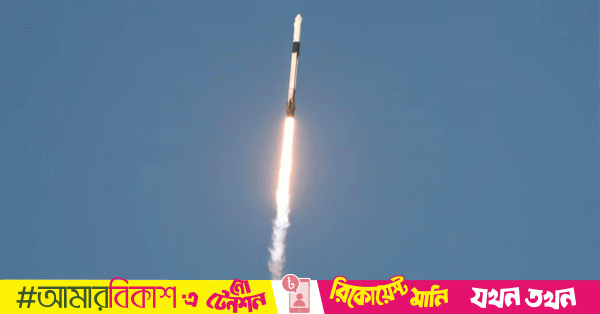
SpaceX’s Falcon 9 rocket lifts off, carrying NASA’s Crew-10 astronauts to the International Space Station at the Kennedy Space Center in Cape Canaveral, Florida on 14 March 2025. Photo: Reuters
“>
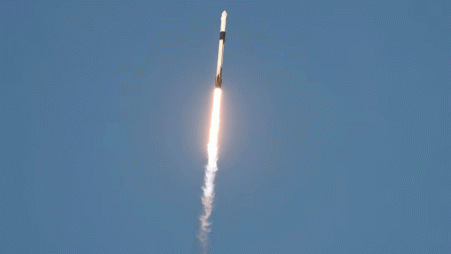
SpaceX’s Falcon 9 rocket lifts off, carrying NASA’s Crew-10 astronauts to the International Space Station at the Kennedy Space Center in Cape Canaveral, Florida on 14 March 2025. Photo: Reuters
The global space industry has grown into a trillion-dollar market, with over 11,000 satellites in orbit, said Bangladesh Space Research and Remote Sensing Organisation (Sparrso) officials.
Bangladesh holds significant potential, and sustainable development today is closely linked to space technology.
Sparrso officials noted that establishing a space industrial park faces challenges, mainly skilled manpower, funding, and foreign investment, but said the project is achievable. The park could attract investors to produce satellites and components, as the country already has a pool of university graduates.

Keep updated, follow The Business Standard’s Google news channel

Bangladesh has moved a step closer to entering the global space economy, commissioning a feasibility study on whether the country can build its own rockets, satellites, and even a dedicated space industrial park.
According to Sparrso, the agency signed an agreement last month with Development Design Consultants Limited to conduct the study at a cost of about Tk1.35 crore.
Experts said satellites are essential for modern communication, information gathering, research, and national security. Orbiting Earth, they collect signals, images, and data for diverse applications, including telecommunications, weather forecasting, agricultural monitoring, navigation, scientific research, and national security.
Bangladesh Satellite-1, launched on 11 May 2018, is currently used for television broadcasting.
Nur Hossain Sharifee, chief scientific officer at Sparrso, said Bangladesh currently relies on global satellites to monitor agriculture, disasters, floods, vehicle and aircraft movements, and changes in forests, rivers, and land.
“Free satellite data is available, but the limited budget restricts access to high-quality, real-time information. Low-cost data cannot support timely disaster preparedness, as detailed data can take seven to 15 days to obtain. This makes domestic satellites essential for national and commercial use,” he said.
Sharifee added that a single set of high-resolution data costs around Tk40 crore. The lack of real-time weather data has often caused significant losses. Owning domestic satellites would allow Bangladesh to access such data more affordably and efficiently.
A Sparrso official added that launching a satellite from Europe costs about Tk2,000 crore, whereas building and launching one domestically could cost less than half. Rockets are needed to place satellites into orbit, and initially, components will be imported and assembled locally to produce launch vehicles.
Currently, the US, Russia, France, Japan, China, UK, India, Israel, Iran, Canada, Italy, South Korea, and the European Union have both rocket and satellite manufacturing capability.
Officials said the initiative was first proposed by the current Sparrso chairman, Md Rashedul Islam, and was taken forward after Md Ashraf Uddin, secretary of the defence ministry, expressed interest and support.
They said the feasibility work was awarded to Development Design Consultants Limited, a firm with experienced international advisers in space research. The company was selected from seven bidders, they added.
The goal is to develop indigenous launch vehicles capable of placing local and foreign satellites into orbit at lower cost. The initiative aims to reduce reliance on foreign suppliers, lower procurement costs, and create opportunities for export-oriented production of space-grade components.