
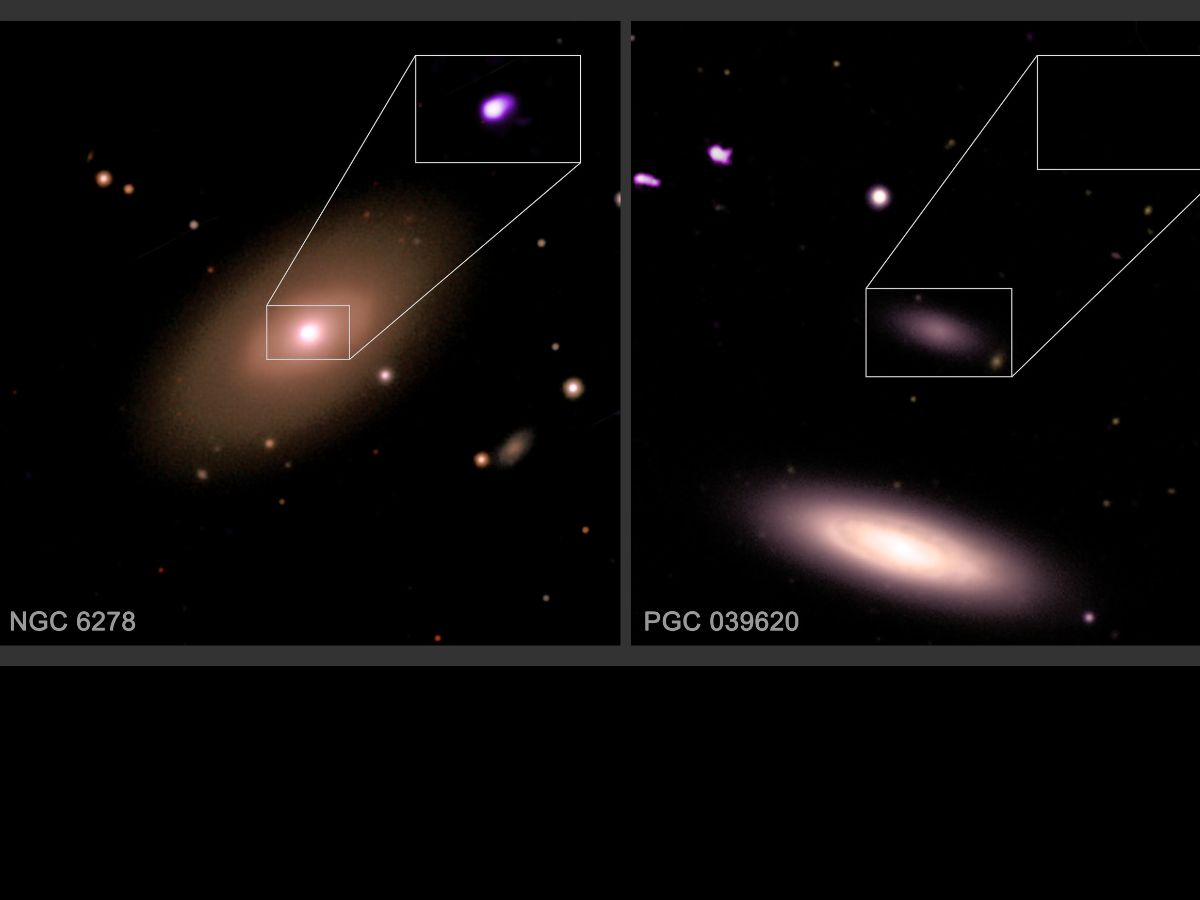
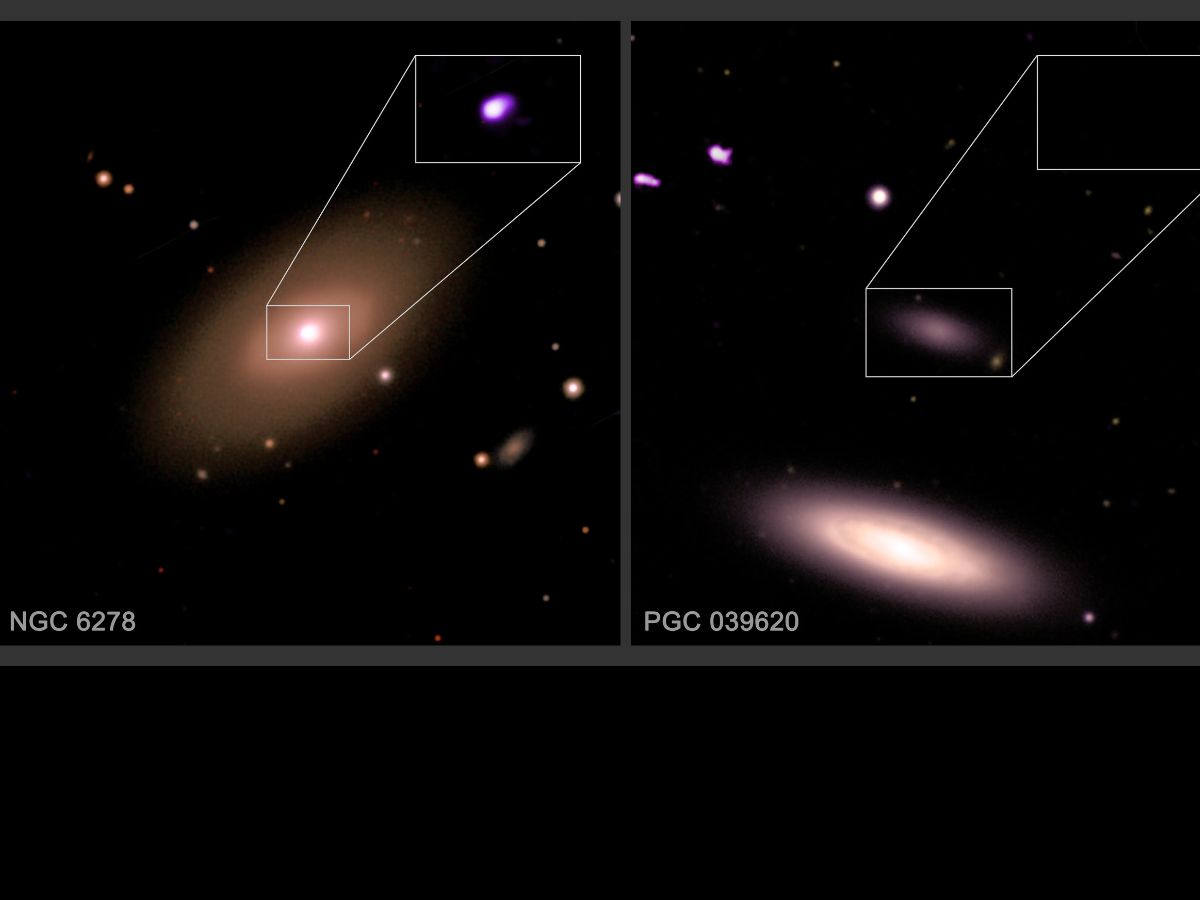
 Side-by-side images of two small galaxies: NGC 6278 and PGC 039620 (Image source: several; see sources)
A recent study suggests that most smaller galaxies may not have supermassive black holes in their center. This new finding goes against what scientists have previously known about galaxies and black holes. If proven to be true, it could reshape our understanding of how black holes form and even affect future space missions.
For so long, scientists have believed that nearly every galaxy contains a supermassive black hole at its center. But a group of astronomers has challenged that with a study they published in the Astrophysical Journal. They carried out the study using data from the Chandra X-ray Observatory.
Chandra has been observing galaxies for two decades. Within that time, it has observed 1,600 of them, from those more than 10 times more massive than our Milky Way to those much smaller. The astronomers analyzed the data and discovered that many smaller galaxies didn’t show signs of having a supermassive black hole in their center.
When matter falls into supermassive black holes, X-rays are produced. This is what Chandra detects. But when the astronomers analyzed Chandra’s data, they discovered that Chandra had returned fewer signals from the smaller galaxies. They believe this deficit is due to the absence of supermassive black holes in these smaller galaxies.
From the study, the astronomers reported that only about 30% of small galaxies likely contain supermassive black holes. If this is true, it could provide some insight into understanding how supermassive black holes form. The findings from this study support the idea that supermassive black holes were born massive. That is, they were not formed from the merging of smaller black holes.
The study could also impact the future Laser Interferometer Space Antenna (LISA) mission. The mission is set to detect gravitational waves, and black hole mergers produce gravitational waves. If there are fewer supermassive black holes in smaller galaxies, then there are fewer mergers and fewer gravitational waves for LISA to detect.
Buy the NASA Lunar Telescope for Kids for $44.99 on Amazon.
Image source: X-ray – NASA, CXC, SAO, F. Zou et al.; Optical – SDSS; Image Processing – NASA/CXC/SAO/N. Wolk
 Chibuike Okpara – Tech Writer – 320 articles published on Notebookcheck since 2024
I have always been fascinated by technology and digital devices my entire life and even got addicted to it. I have always marveled at the intricacy of even the simplest digital devices and systems around us. I have been writing and publishing articles online for about 6 years now, just about a year ago, I found myself lost in the marvel of smartphones and laptops we have in our hands every day. I developed a passion for learning about new devices and technologies that come with them and at some point, I asked myself, “Why not get into writing tech articles?” It is useless to say I followed up the idea — it is evident. I am an open-minded individual who derives an infinite amount of joy from researching and discovering new information, I believe there is so much to learn and such a short life to live, so I put my time to good use — learning new things. I am a ‘bookworm’ of the internet and digital devices. When I am not writing, you will find me on my devices still, I do explore and admire the beauty of nature and creatures. I am a fast learner and quickly adapt to changes, always looking forward to new adventures.