
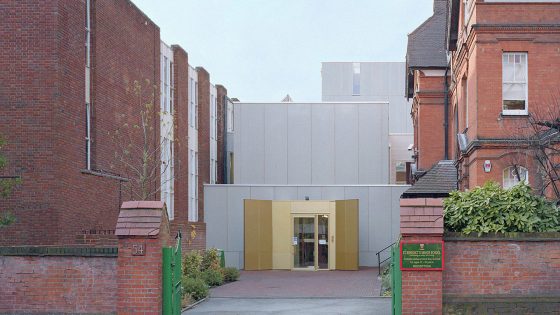
At its 30th anniversary celebration in Shoreditch in September, Henley Halebrown directors Simon Henley and Gavin Hale-Brown arrived in matching terracotta suits. It was a wry nod to the earth-toned buildings that have become a hallmark of their Hackney-based practice – from Wilmott Court to Hackney New Primary School.
Henley Halebrown, which has just completed Barge Crescent, a five-storey office building in Southwark, is publishing its most extensive monograph to date this month – Building for Society 2010-2022, also sporting a terracotta cover. Here, Fran Williams speaks to founders Henley and Hale-Brown about their achievements, plans for the future and the colour terracotta.
What has been your biggest achievement so far?
SH: We are both very fond of four projects: Talkback (2001), St Benedict’s School (2008), Chadwick Hall (2016) and Hackney New Primary School (2020). We’re also simply proud that we’ve been doing it for 30 years. We have known each other since 1986 and we’ve had people working with us for almost 30 years, and many for at least 15.
GHB: We’ve made two Stirling Prize shortlists (2018 for Chadwick Hall and 2022 for Hackney New Primary School and 333 Kingsland Road). And we’re proud we’ve done a wide breadth of work – which people don’t often realise – from healthcare to education, housing and workspace.
It’s a proud thing to have a legacy in public work. We are delivering a lot of social housing, but we did a lot of NHS estate work as well. It is very pleasing to have done buildings which matter. Managing to do it for this long and not fall out is also quite a feat!
You work a lot locally in London, but also in Europe. How do these projects complement each other? What have you learnt from working abroad?
SH: Over the years we’ve done a bit of work abroad but recently we have just one ongoing project in Belgium (Lange Dreef Beveren). We’re doing a lot of competitions however: in Germany, Belgium, Switzerland and the Czech Republic. Again, it is about working in lots of different ways. Working in other countries adds an extra cultural difference, which is refreshing: from the uses buildings are put to, to the places which they are.
As you know, a bizarrely large amount of our work has not just been in London but, specifically, Hackney.
GHB: One huge difference working abroad is the respect people give to architects. You realise how far down the pecking order the profession in this country has fallen. UK architects need to remember that we are valued, are of value, and are valued elsewhere.
SH: I’m reminded of the work we were doing 20 years ago with a series of think-tanks. We were with the IPPR (Institute for Public Policy Research) and Demos, working on model prisons, model town halls, model schools, where you go back to first principles – looking at policy and social outcomes in a way that people don’t nowadays. It is unfortunate that central government just thinks it knows the answer to a school or prison.
Recently, judging this year’s RIBA Awards, I went to visit the women’s prison HMP and YOI Stirling by Holmes Miller for the Scottish Prison Service. That was a completely radical version. Its characteristics, properties and physicality were totally fresh. That is quite unique in the UK.
You have become known for incorporating terracotta and terracotta-pigmented materials into your projects. Why do you think this has happened?
GHB: Our buildings are contextual. The colour comes from looking at what’s around them. It isn’t ‘our favourite colour’. It wasn’t a random decision to make those reddish buildings.
SH: The consistent characteristic is that they’re monochrome: either very pale, or reddish. Ten to 20 years ago, a lot of buildings were being built out of wood, zinc, render and brick. It looked like what is left in the fridge on a Sunday night. That really struck a chord with us. London has lots of this legacy and it’s not great.
We were also interested in the work of Louis Kahn and James Stirling, among others – architects creating buildings where the material is the construction. Of course, that eludes us now, because of the way buildings are built. I guess we explore a couple of things. One is this notion of something that feels like it is ‘built’. Therefore, its material needs to seem plausible. Then there’s consistency. If you’re going to make a brick-faced building, make one that looks like a brick-built building.
For us, if you draw everything together, subtle differences become much more interesting. By placing red acid-etched concrete next to red brick next to red mortar, the subtleties of the pointing, mortar colour and brick bonds become acutely more present. You can see that on Chadwick Hall and Hackney New Primary School. But also on Barge Crescent, although that is yellow and white. It’s a building where hue, not tone, is creating the difference.
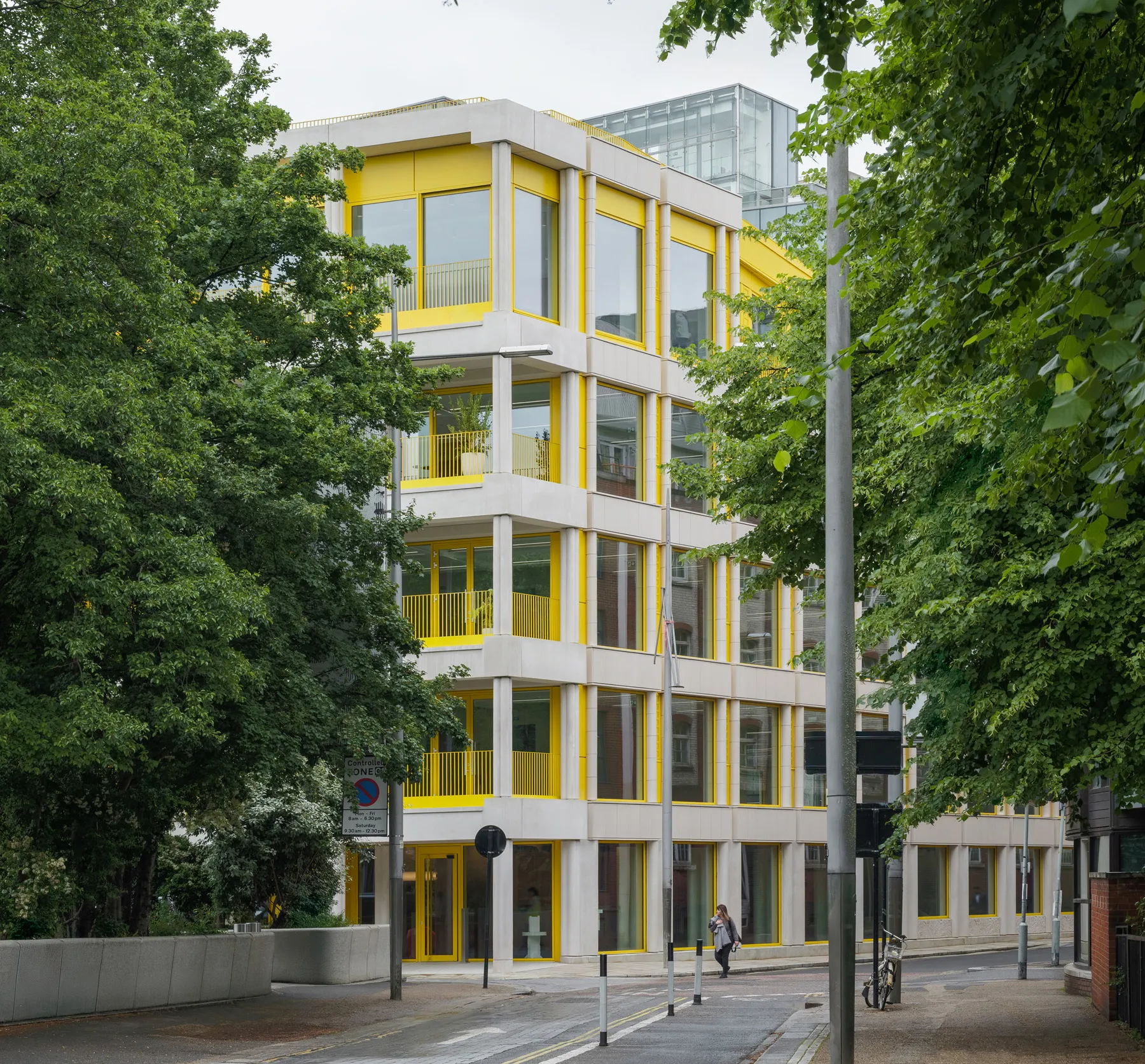
Barge Crescent, 2025
Your new-build projects often contain references to architectural history in their façades and detailing. How do you see the relationship to architectural history in your work?
GHB: Is it not foundational in everything everybody does? I think you’d be a strange architect if you didn’t know where architecture comes from. You must understand history to be able to design buildings. Without it, there’s no authenticity to what you’re doing.
What do you think is distinctive about the Henley Halebrown way of working?
GHB: We’re deeply involved in the procurement and design of all our buildings. Even though we’ve been doing this for 30 years, we still have energy. And enough interest to want to be involved. The two of us meet every Thursday to go through every single scheme in the office. We’re not just interested in what it looks like, or how much money it is going to make, but how it’s going to be put together, why it’s being designed in that way, how the form works. We are not siloed. We’ve shared a lot through our lives – both the good and the bad.
SH: We live in an age where social value is talked about a lot and is often seen to have greater value in the design process. We think that social value should be embedded in the building.
So, how do you bake social value into a plan? For example, on Hackney New Primary School, nobody asked for its built-in bench, but it is literally the foundation of that school’s community. Parents sit on the bench waiting to pick up their children, talk to each other, make friends. It’s a positive, circular process.
GHB: It’s the things you think are obvious but aren’t so. It’s understanding basic human behaviour.
SH: Often, we talk about meta-function. The brief for a building is often very tight and the tighter it is, the faster it becomes obsolete. That’s another failing of our regulatory systems and the policies that lead to briefs. We think about how buildings can be used in a multitude of ways. A building isn’t just a school or a block of flats; it’s a building.
What is your approach to sustainability?
GHB: We make robust and flexible buildings. We’re really concerned about the movement to make things taped, sealed and airtight. We see sustainability as making buildings that will last at least 80 years. We’re so old, we have designed buildings that have gone past their sell-by dates! The requirements for some of our NHS buildings was only 20 years, a ridiculously short time to build for.
We have also been reusing buildings for 27 years. Those big Victorian buildings we have redesigned work well because they were built robustly.
SH: Our intuition is that sustainable buildings are intuitively, tangibly, palpably sustainable. We live in an age now where orientation, fabric, section have given way to discussions about systems. It doesn’t really matter what the architecture is, it is an engineered solution. On Hackney New Primary School, the head teacher uses the building to teach the kids about the environment because they understand sun, shade, heat and rain by looking out of the window and knowing which direction they are facing. And that school always stays open during heat waves because it’s naturally ventilated.
GHB: We always start from natural ventilation. Some of our old healthcare projects were naturally ventilated with internal courtyards. It’s about starting from first principles. It’s quite shocking how few buildings start from those now. It’s the simple things that matter.
How do you see the practice developing in the future?
SH: We have a strong group of associate directors and associates – a lot in their 30s. There will be a time when we’re not there. So, who knows quite where it goes. For now, our ambition is to continue doing the things we care about.
It would be nice to design some health centres again. But, whatever we’re designing – housing, workplace – we’re always building buildings for people.
What piece of advice would you give to emerging architects just starting out in the industry or to those starting their own practices today?
GHB: It’s difficult to be an architect. More so than when we started. But the main thing is to remain interested. Go to exhibitions and talks; talk to people and keep humility.
It is important that young architects realise how much critical thinking they learn in training which is often not used or encouraged in professional life. If we were more bullish as a profession, we would know that. In Europe and the rest of the world, it is more recognised.
SH: Architecture is a job, but it’s also a culture. Whether by consuming or creating the culture, everyone contributes. Keep the discussions alive and don’t see leaving university as the end of something, but the beginning.
GHB: That’s a useful thing to understand as an architect. You want to carry on learning. That’s why we do our Dialogue series. It brings together an interesting group of people who all have common ground, common interests, are inquisitive and energetic.
Keep that interest up because you’re not going to be the richest person in the world!