

A large mass of granite, located beneath the Compton and Belkovich craters on the Moon, has been slowly emitting heat for billions of years. The heat detected is not from an active volcanic eruption but from the remnants of ancient volcanism. Using data from lunar orbiters, researchers discovered a temperature anomaly that points to the presence of a deep-seated heat source, likely linked to radiogenic decay of elements within granite rocks. The findings, published in Nature, are groundbreaking, showing that the Moon’s interior is still releasing heat long after its volcanic activity ceased.
A Lunar First: Discovering Granite on the Moon
Granite, a rock commonly found beneath volcanoes on Earth, is rarely seen on other planetary bodies. Its discovery on the Moon is a rare and exciting finding. According to Dr. Matt Siegler, co-lead researcher from the Planetary Science Institute, the heat emitted from this granite mass beneath the craters is due to radioactive decay.
Unlike Earth, where granite forms through active tectonic processes, the granite on the Moon likely cooled and solidified in a very different way, millions of years ago.
“Using an instrument looking at microwave wavelengths – longer than infrared – sent to the Moon on both the Chinese Chang’E 1 and 2 orbiters, we have been able to map temperatures below the surface. What we found was that one of these suspected volcanoes, known as Compton-Belkovich, was absolutely glowing at microwave wavelengths,” as explained by Dr. Matt Siegler in a statement from the Planetary Science Institute.
They found a 10 °C (18 °F) temperature difference between the area under the craters and its surroundings. This heat anomaly isn’t the result of recent volcanic activity but stems from deep within the crust, revealing that the Moon’s volcanic processes may have been more complex than previously thought.
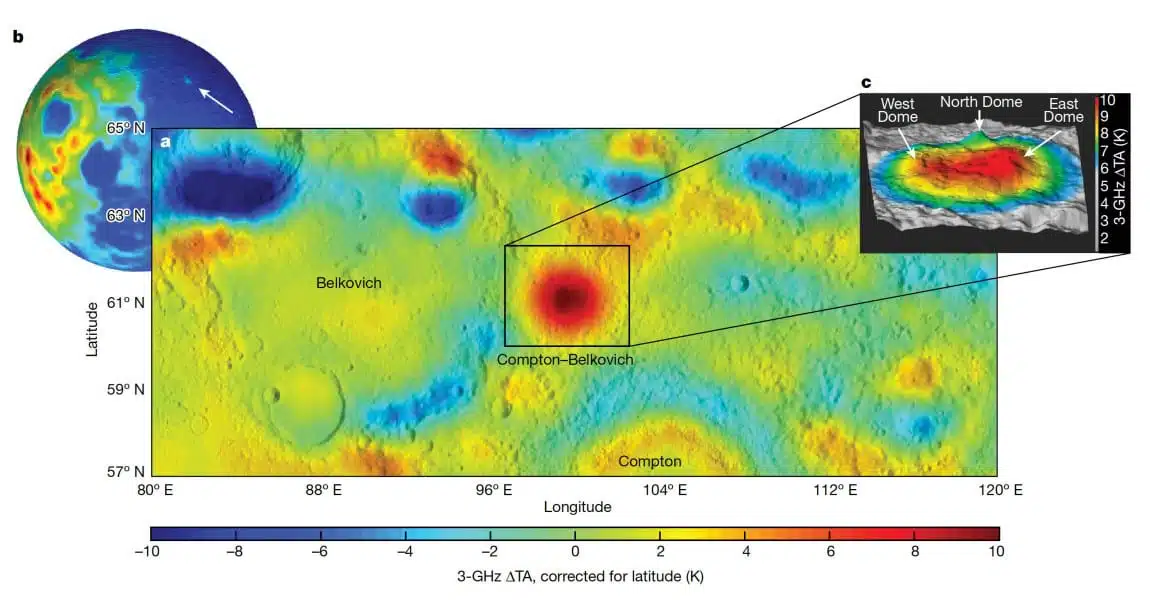 Thermal map of the Moon’s surface showing the Compton-Belkovich region (center), with heat anomalies indicated by the red and orange areas. Credit: Nature.
A New Type of Lunar Volcano
As noted by the research published in Nature, the Compton-Belkovich region, where the heat anomaly was found, was previously believed to be a volcanic site. Now, it appears to be the location of an ancient volcanic caldera that has left behind traces of deep volcanic activity.
While the area doesn’t show signs of recent eruptions, the presence of heat under the surface suggests a different kind of volcanic process than scientists expected. According to Dr. Siegler, the temperature readings in microwave wavelengths indicated that the heat is coming from below the surface, possibly from a deep, radiogenic granite body.
“To tell the truth, we were a bit puzzled when we found it: fortunately, my wife, Dr. Rita Economos, is the geochemist in the family, so with her guidance, we were able to piece together the probable geologic cause of the heat anomaly.”
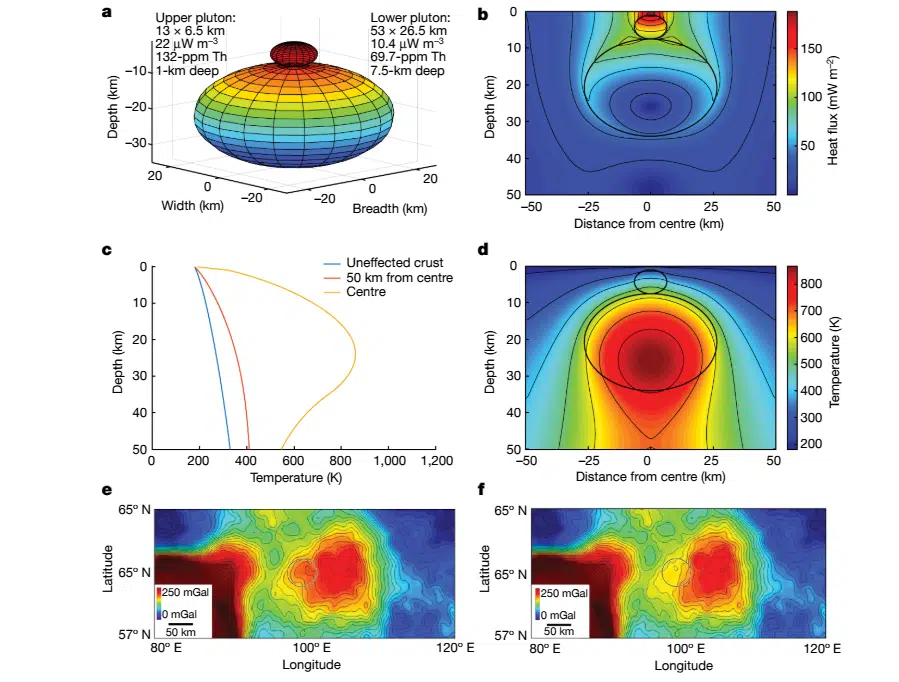 Geophysical Modeling of the Compton-Belkovich Batholith. Credit: Nature
The region, spanning about 50 kilometers, holds evidence of a volcanic rock formation known as a batholith, which forms when magma rises within the Earth’s crust but never erupts to the surface, as Dr. Economos points out.
If similar deposits of granite are found in other areas of the Moon, it could mean that ancient volcanic activity was much more widespread than previously believed.