
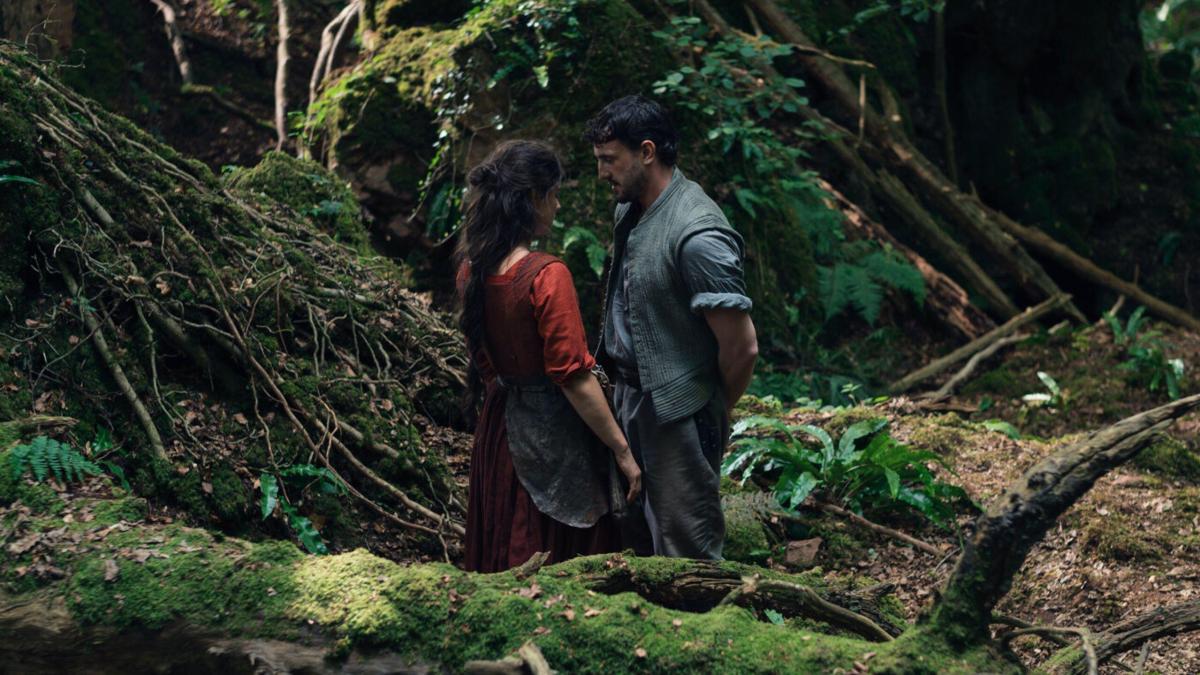
The Oscar-winning director Chloé Zhao has admitted that she understood “only a third” of Shakespeare’s language when she began work on Hamnet, her forthcoming film adaptation of Maggie O’Farrell’s bestselling novel.
Zhao, who won the award for best director for Nomadland in 2021, said that despite Shakespeare being central to the project, she struggled with the playwright’s language and relied heavily on Paul Mescal to guide her understanding of the text.
The Chinese-born director told the New Yorker Radio Hour podcast: “I didn’t speak English [at school], so when you don’t speak English and you have Romeo and Juliet in front of you in the equivalent of the ninth grade… still when I was on set of Hamnet, when Paul was delivering his speech I only understand a third of it, technically, because I don’t understand what those words mean.”

Chloé Zhao
BEN KRIEMANN/GETTY IMAGES
Zhao, who was born and raised in Beijing and studied in the US and UK, said: “I can study it and translate it and understand what it all means, but Paul said to me, ‘Listen, if Shakespeare is performed right, you don’t have to understand what they’re saying. You feel it in the body, the language is written like that.’
“So in a way, me and Lukasz [Zal, the film’s cinematographer] — who also doesn’t speak much English — we sat there and we watched Paul’s performance and in a way we kind of embodied Agnes, who doesn’t quite understand everything, but we feel it.”
Hamnet tells the story of the death of Shakespeare’s 11-year-old son and imagines the emotional impact of that loss on his parents. The film is based on O’Farrell’s 2020 novel, which centres on Shakespeare’s wife Agnes rather than on the playwright himself. Mescal plays Shakespeare, while Jessie Buckley stars as Agnes. O’Farrell discovered that Shakespeare’s wife, commonly known as Anne, had been referred to as Agnes in her father’s will and so used this name.
• Paul Mescal: Much ado about an Irishman as the Bard in Hamnet
Zhao, who co-wrote the screenplay with O’Farrell, said that the film deliberately avoids treating Shakespeare as a distant literary figure, instead presenting him as a husband and father shaped by grief. The director explained that she did not come to the project “feeling that he’s any different than a man who fell in love with a woman and couldn’t quite express his feelings”.
She suggested that her own distance from Shakespeare’s language may have helped her approach the story in a more instinctive way.
She said: “I think the reason why the producers and also Maggie [O’Farrell] chose me is because I don’t feel that way about William Shakespeare — I don’t have the same reverence. I do have reverence intellectually, but I don’t have the burden on my shoulders as many people in the West do.”
She added that the pressure of performing Shakespeare is on the actors, explaining: “It’s on Paul, who does have a lot of reverence.”

Part of the film was shot at the Globe theatre in London
AGATA GRZYBOWSKA/AP
Zhao said that she made Mescal’s depiction of the playwright “less expressive” and talkative than the one portrayed in O’Farrell’s novel.
The director added that her and Zal’s reactions to Mescal’s performance helped inform their decisions on which take had been successful. She said: “So in those days [filming] in the Globe, I’m judging by me and Lukasz’s physical reaction.
“We start crying or we go ‘ugh’ or our throat is tight, our stomach turns. Then we know it’s the right take. We didn’t even have to understand every word, which is really magical. It’s made me think about Shakespeare completely different [sic].”
Rather than aiming to reproduce Elizabethan language or theatrical convention, she focused on the emotional experience of loss, which is universal and recognisable.
Zhao said that the film does not attempt to present a definitive account of Shakespeare’s life. Instead, it uses the limited historical record as a starting point for a story about family, creativity and mourning. She said that she was more interested in how grief might shape a person than in literary history.
Zhao suggested that audiences often feel excluded by Shakespeare because they believe that full comprehension is required. This comes as the film and theatre world aims to make Shakespeare more accessible, particularly to younger audiences. Zhao said that if viewers feel the emotional truth of a scene, an exact comprehension of every word is not essential.
Hamnet premiered at the BFI London Film Festival in October this year and will be released in cinemas in January. Zhao said that she hoped the film would allow audiences to engage with Shakespeare’s world without feeling intimidated and recognise that his work continues to speak to modern experiences of love and loss.