
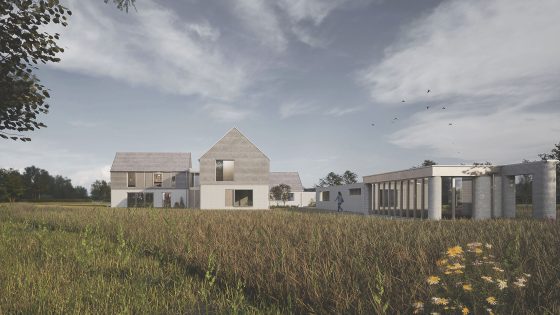
The Manchester practice’s proposal, recently submitted to East Riding of Yorkshire Council, features four bedrooms in a two-storey house on a former agricultural plot near the village of Bielby, plus landscaping and a gravel access path.
Planning documents say the home, dubbed Speckled Wood, would become the first private residential dwelling in the UK to be built from 3D-printed low-carbon concrete and could be built in a fortnight, if consented to.
Define says the home ‘presents an exciting and sustainable approach to new build design, raising the standard in increasing construction precision and reducing waste while ensuring longevity with the ease of recycling in the future if ever required’.
The project would be delivered on site with Harcourt Technologies Ltd (HTL), which used 3D printing earlier this year on a social housing scheme in Dundalk, Ireland.
A bespoke printhead has been developed by Define and HTL to create a ‘distinctive and characterful surface texture’. Initial analysis indicates the superstructure will be fully printed in just two print cycles, taking a total of 14 days. This includes load-bearing internal walls.
The scheme would be hidden from the road by a fruit tree and wild flower meadow that includes a pond, while its gable roof forms reference those of agricultural buildings in the area, Define said in the planning documents.
Outbuildings such as garage, plant, store and glasshouse would sit in front of the dwelling, further concealing its massing. The flat-roof of this wing of additions provides opportunity for biodiversity gain.
The practice is seeking consent under paragraph 84e of the National Planning Policy Framework, which allows isolated homes to be built in the open countryside if they are deemed of ‘exceptional design quality’ and ‘would significantly enhance [the] immediate setting’.
It claims the scheme would create ‘one of very few dwellings of exceptional design quality […] within the Yorkshire and Humber region’.
A minimal materials palette is being proposed which is ‘neutral and earthy in tone’, according to the practice, while timber cedar shingle cladding is specified for the first floor level and gable roofs.
Glazing frames and capping trims are powder-coated in grey/brown aluminium that Define said picks up on the tones of timber shingle and native woodland tree species growing around the dwelling.
Practice founder Gavin Watts added: ‘In recent years, concrete has faced increasing scrutiny over its sustainability credentials. However, when approached innovatively by considering its recycled aggregate content, long-lifespan performance and rapid low-waste production, it can outperform other contemporary construction methods.
‘Speckled Wood aims to demonstrate the positive role concrete can play as our industry continues its transition toward more sustainable practices.’
A planning decision is expected in the new year.