
A new genus and species of nimravid from the middle Oligocene epoch has been identified from the fossilized remains found in northern China. The discovery fills a gap in knowledge about the Nimravidae family in the eastern part of Eurasia.
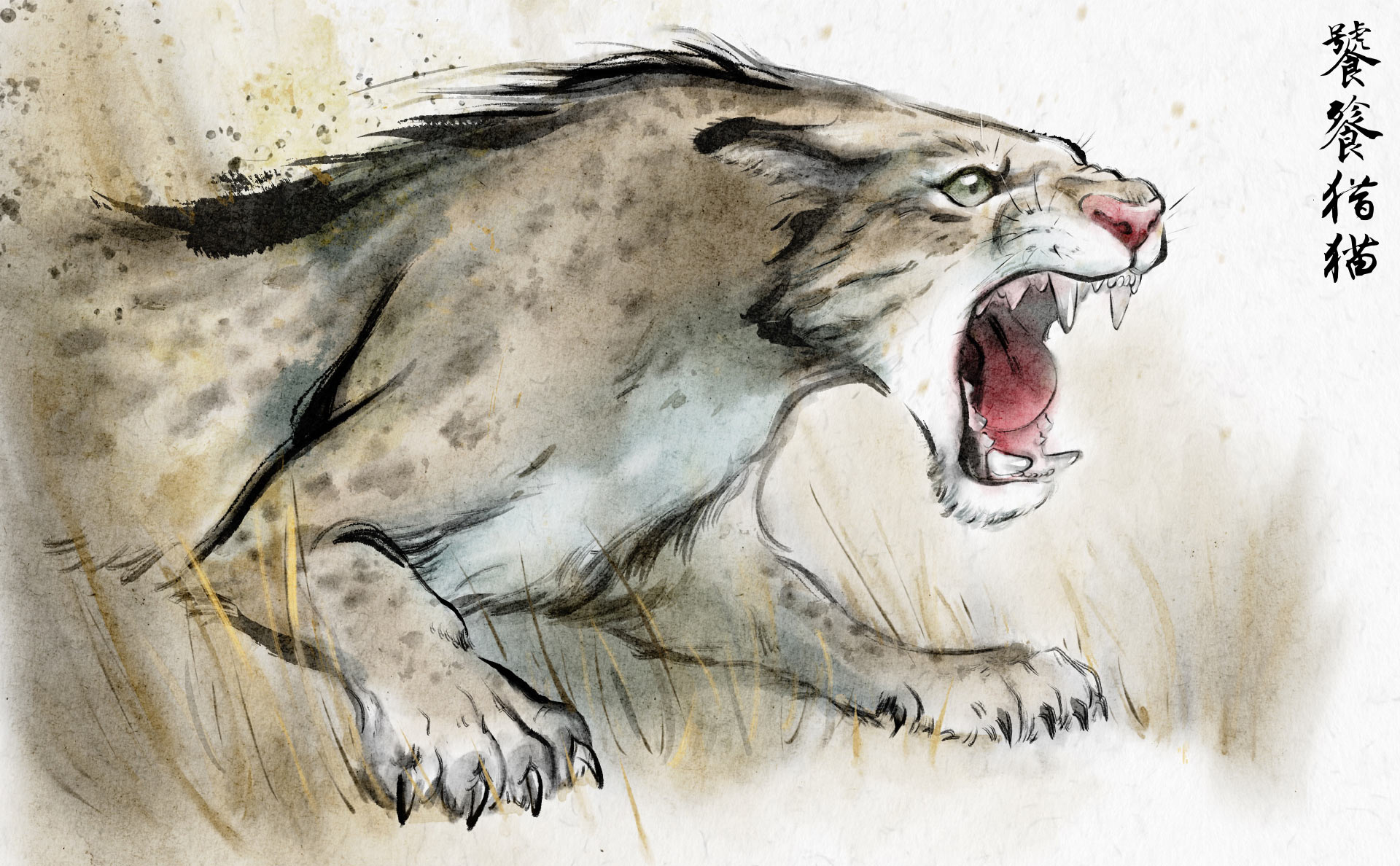
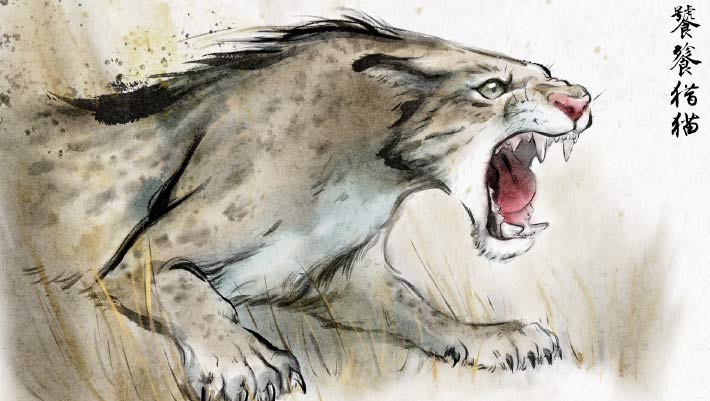
Life reconstruction of Taotienimravus songi in Chinese painting style. Image credit: Yuefeng Song.
Taotienimravus songi lived in what is now China during the middle Oligocene, approximately 28 million years ago.
The ancient species belongs to Nimravidae, an extinct family of saber-toothed hypercarnivores, sometimes known as false saber-toothed cats.
“The order Carnivora exhibits one of the widest ranges of body size diversity within Mammalia, spanning from approximately 50 g for the least weasel Mustela nivalis to an average of over three tons in the pinniped Mirounga,” said Dr. Qigao Jiangzuo from the Institute of Vertebrate Paleontology and Paleoanthropology at the Chinese Academy of Sciences and colleagues.
“With few exceptions such as Ursidae, large-bodied terrestrial carnivores — particularly those exceeding 20 kg — typically adopt a macrocarnivorous diet, preying on large animals of comparable or greater size.”
“The family Nimravidae, commonly referred to as false sabertooths, represents one of the earliest diverging lineages of Carnivora, characterized by large body size, hypercarnivorous craniodental morphology and presumably a macrocarnivorous diet,” they added.
“The earliest confirmed fossil records of the family in the middle Eocene belong to already highly specialized species with felid-like craniodental morphology.”
“Nimravidae underwent a radiation during the Eocene-Oligocene, with the best-preserved records found in North America, where numerous skulls and complete skeletons have been discovered.”
“Fossil remains are also abundant in Eurasia but are less well preserved.”
“As the first lineage of Carnivora to evolve large body size, Nimravidae is an ideal group to study exploration of the early macrocarnivorous niche by Carnivora in an environmental context vastly different from that of the modern world.”
The skeletal remains of Taotienimravus songi were discovered in the Qingshuiying Formation in northern China.
The analysis of the specimens shows that the new species represents a non-sabertooth ecomorph form with initial bone-cracking adaptation — a unique form among the Nimravidae gamily.
The animal probably had a killing behavior that was different from any other felid-like carnivores but probably used a tearing bite as seen in hyenas.
“The most distinctive characters of the new nimravid are the very short and robust upper canine and the overall broad palatal region,” the paleontologists said.
“The rostrum is very wide, probably one of the widest among the known nimravids.”
“Unlike in many other felid-like carnivores, the premolars are not reduced in size but instead enlarged, leaving no diastema between the canine and the cheek teeth.”
“This contrasts with the condition in most felid-like carnivorans, where a diastema is almost invariably present.”
“We interpret this gap as correlated with a strong canine bite and using canines to deeply puncture into the prey.”
The team’s phylogenetic analysis places Taotienimravus songi within Nimravinae, where it forms the sister lineage to European and North American Nimravus and Dinaelurus.
This clade is sister to the European lineage Eofelis + Dinailurictis + Quercylurus.
“An increase in body size among Nimravidae appears to have coincided with the demise of Oxyaenidae, another carnivorous clade in the Paleogene,” the researchers said.
“The initial emergence of macrocarnivorous adaptation of Carnivora by a felid-like ecomorph probably reflects competition dynamics.”
“Nimravidae successfully occupied several ecological niches that were not exploited by Felidae, probably owing to the lack of competition within Carnivora during much of their evolutionary history.”
“Our study underscores the role of both abiotic and biotic factors in shaping niche availability for these animals, emphasizing the need for discussions on niche change and evolution to be grounded in these considerations.”
A paper describing this discovery was published on November 26, 2025 in the Proceedings of the Royal Society B.
_____
Qigao Jiangzuo et al. 2025. A new ecomorph of Nimravidae, and the early macrocarnivorous niche exploration in Carnivora. Proc Biol Sci 292 (2059): 20251686; doi: 10.1098/rspb.2025.1686