
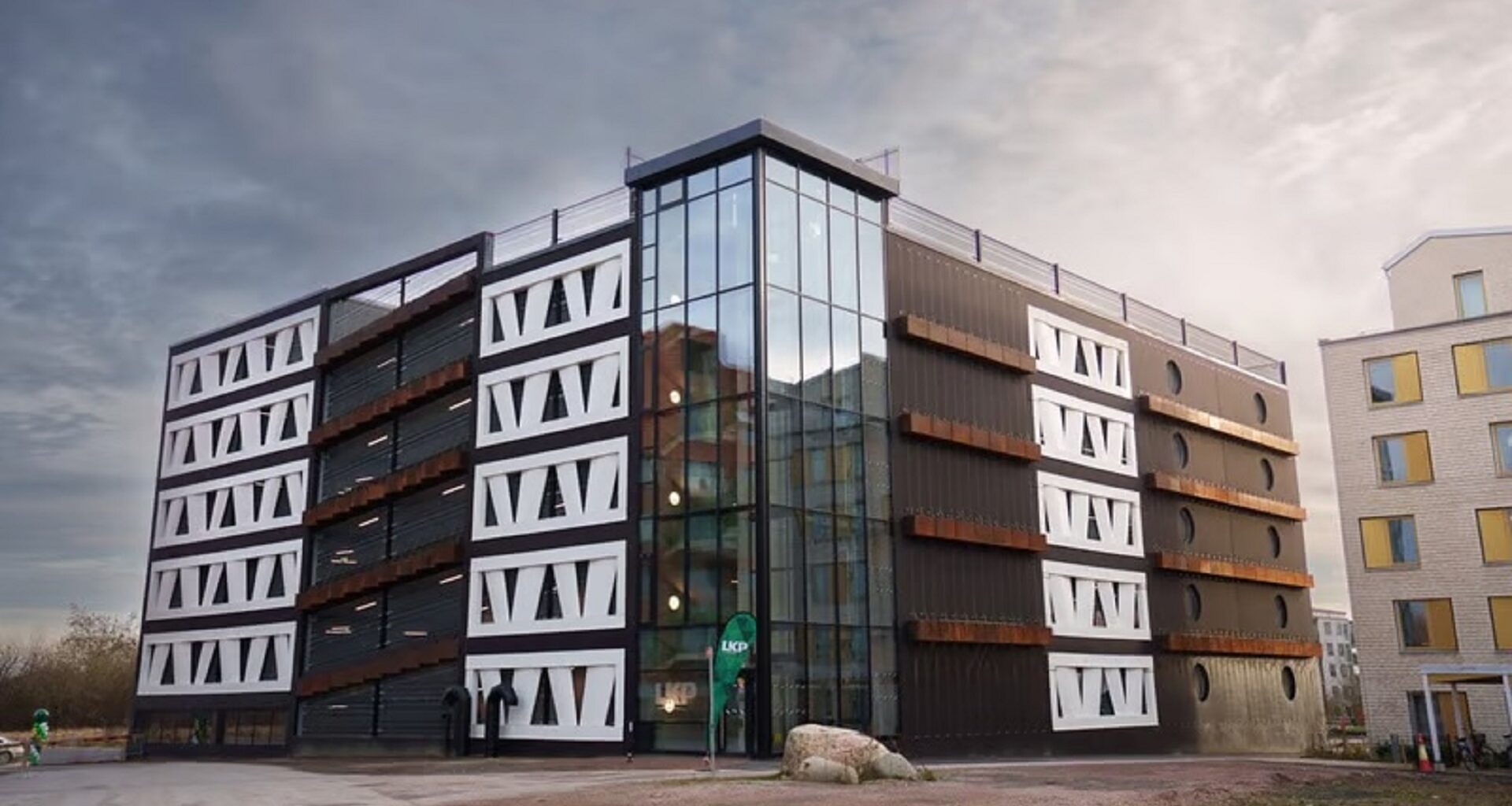
Sweden has made great progress on its long-standing renewable energy waste issue after recently launching a car park constructed using wind turbine blades.
Located in Lund’s fast-growing Brunnshög district, the new Niels Bohr car park is said to be the first facility of its kind in Europe to incorporate old recycled turbine blades into its structure.
The 57 rotor blades came from the now-decommissioned Nørre Økse Sø wind farm run by the energy firm Vattenfall.
They were repurposed to create ‘curtain walls’, non-load-bearing panels that cover large parts of the building’s façade.
“It’s a very smart idea and a really nice building,” Anne Mette Traberg, Vattenfall’s country manager for Denmark, said. The car park is owned by Lunds kommunala parkeringsbolag (LKP), the city’s municipal parking company.
From waste to walls
Rotor blades are among the most difficult parts of wind turbines to recycle. Built to withstand decades of extreme weather, these turbine parts are typically made from composite materials such as glass and carbon fiber.
These materials are strong, lightweight, and notoriously difficult to break down. In many countries, old blades still end up buried in landfills. This caught the attention of architect Jonas Lloyd after he read an article about the US wind industry and its challenges in recycling disused blades.
“I read that in the US, many of the blades are buried, and I thought they could be put to better use,” Lloyd elaborated. “It’s not just an environmental problem, but also a waste.”
 The inauguration of the new Niels Bohr car park in Lund.
Credit: Vattenfall
That’s why when LKP commissioned a new multi-storey car park, Lloyd and his team proposed using old blades as architectural elements rather than treating them as waste.
Their idea resulted in a five-storey parking facility with 365 spaces, including 40 electric vehicle charging points and a storage battery. Despite the rotor blades, the façade also consists of pollinator-friendly plants.
The roof is covered with solar panels, connected to a battery for charging cars at night. “Above all, I am pleased that we are promoting sustainability and that the building has become a symbol of sustainability,” Lloyd said. “It should serve as an eye-opener.”
Parking meets sustainability
For Vattenfall, one of Europe’s largest wind developers that operates more than 1,400 turbines across multiple countries, the project provides clear, real-world proof that circular solutions are viable on a large scale.
“This is visible and concrete proof that sustainability can meet the cost, schedule and safety requirements of a project,” Traberg noted.
Vattenfall has committed to recycling 100 percent of its blades by 2030. It even introduced a ban on sending used blades to landfills. Meanwhile, the company is already repurposing used blades into products such as insulation materials, solar panel frames, and even skis.
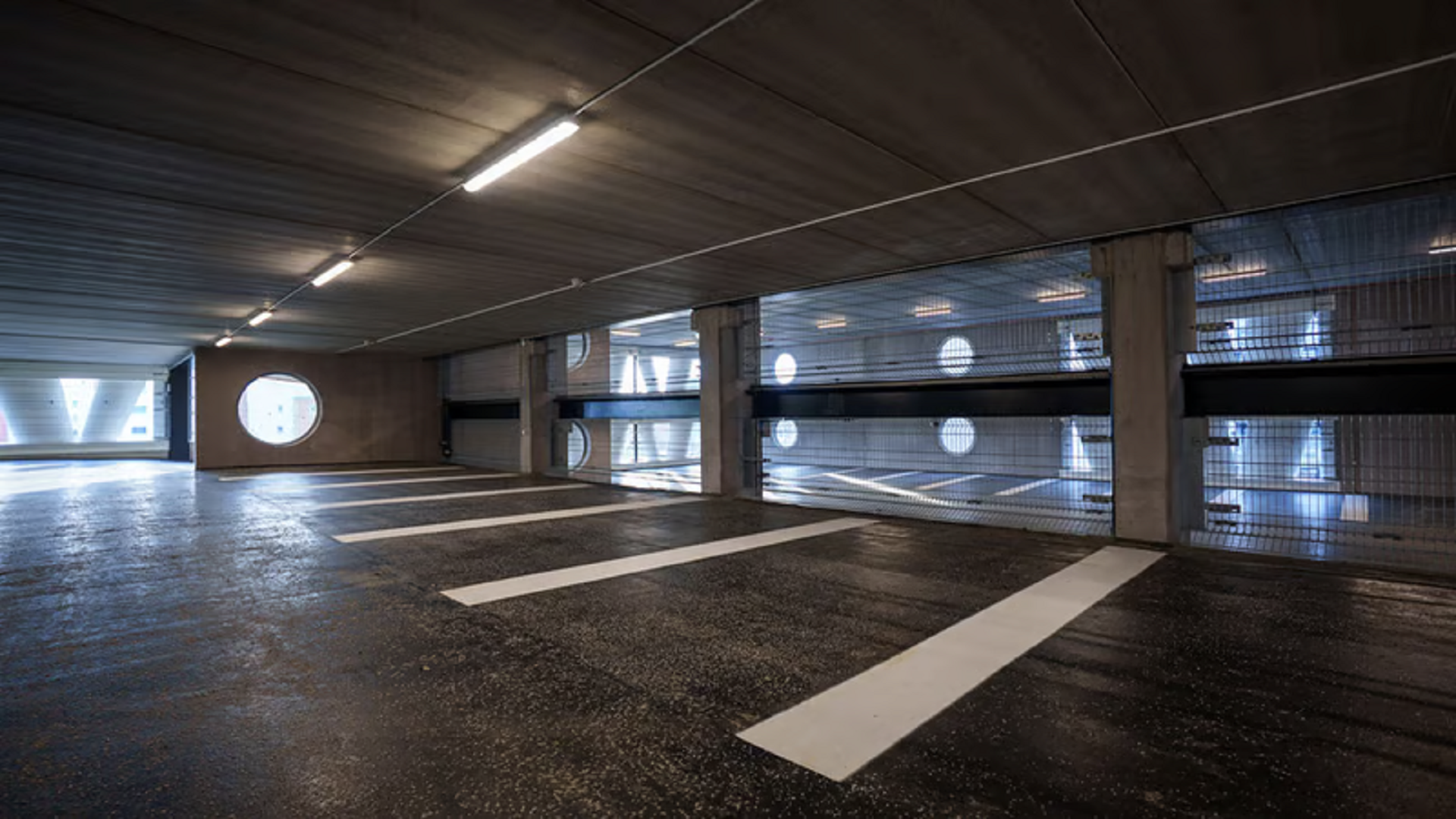 The car park consists of 365 parking spaces on five floors.
Credit: Vattenfall
LKP, which manages around 28,000 parking spaces across the municipality, said it is pleased with the new car park. Paul Myllenberg, LKP CEO, said the idea initially raised eyebrows, but praised the board for backing its bold design.
With several of the 57 rotor blades donated by Vattenfall still without a clear use, LKP has not ruled out incorporating them into future projects.
“We have launched a competition where people can submit suggestions on how the blades can be used,” Myllenberg concluded in a press release.” The best suggestion will win a month’s free parking in our car parks!”