
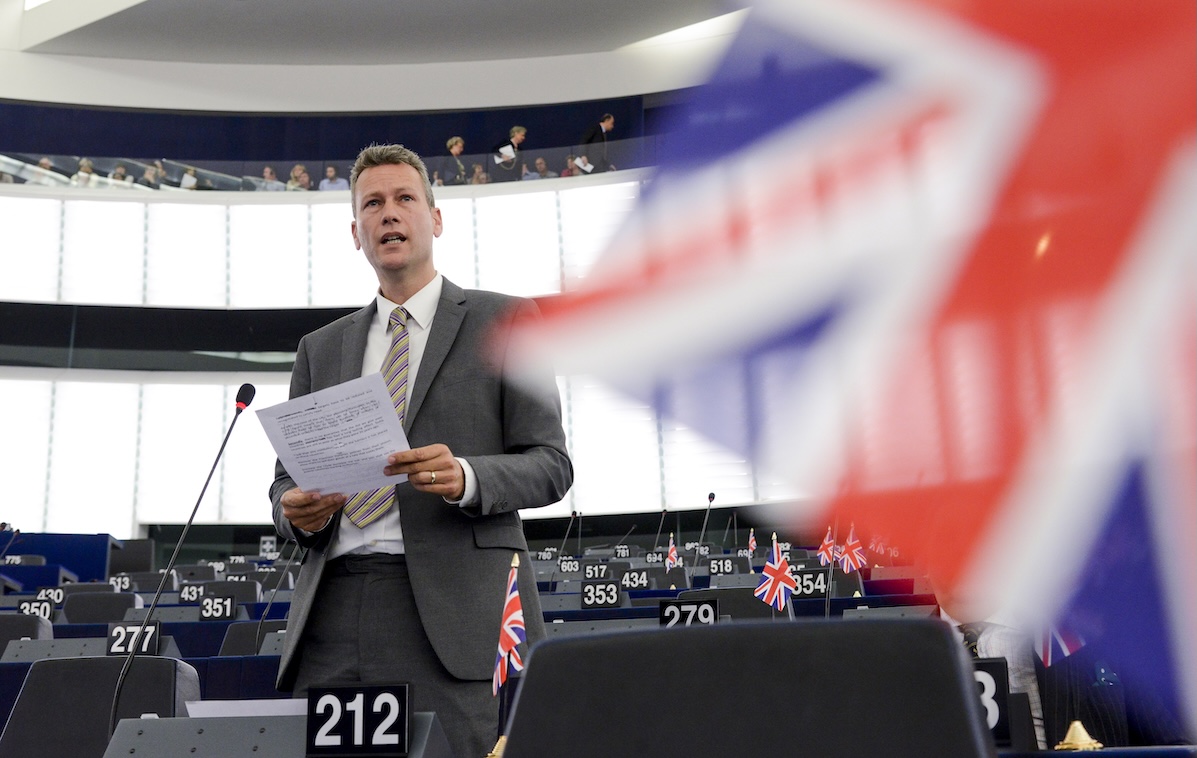
Britain’s government launched an investigation into foreign interference in UK politics Tuesday after an ex-member of the hard-right Reform UK party was jailed for taking Russian bribes.
Nathan Gill was sentenced to 10 years in prison last month after admitting having been paid around £40,000 (€47,000) to make pro-Russian statements in the European Parliament.
“This conduct is a stain on our democracy. The independent review will work to remove that stain,” local government minister Steve Reed told parliament as he announced the probe.
Gill was an MEP from 2014 to 2020. He was a member of the Eurosceptic UKIP party, including when it was led by current Reform UK leader Nigel Farage.
Gill was also briefly leader of Reform UK Wales in 2021.
The anti-immigrant Reform party presently leads Prime Minister Keir Starmer’s ruling Labour party in opinion polls, although the next general election is not expected until 2029.
Reed said the review would be led by a former senior civil servant, who is expected to report his findings by March next year.
The minister added that cryptocurrency donations and attempted Chinese influence would both be in the probe’s “scope”.
Foreign Secretary Yvette Cooper told MPs that Russian-backed groups were disseminating disinformation internationally “on an industrial scale”.
She cited “fake websites for political parties” in Moldova “deliberately trying to increase hostility towards candidates that frankly Russia didn’t like”.
Gill pleaded guilty to eight counts of accepting bribes between December 2018 and July 2019 from Ukrainian politician Oleg Voloshyn, who was later sanctioned by the United States and indicted for treason in Ukraine.
A Reform spokesperson “welcomed” his sentencing and Farage has said he did not know about his former colleague’s wrongdoing. Gill is no longer a Reform UK member.
However, the case is somewhat of a headache for Farage, who has been criticised as being too soft in his stance on Russian President Vladimir Putin.
UK electoral law tries to restrict the foreign funding of British political parties by requiring that donors must be registered to vote in Britain.
Companies can only donate if they are licensed to operate in the country.
Before winning power in July last year, Prime Minister Keir Starmer’s Labour party pledged to strengthen rules around donations.