
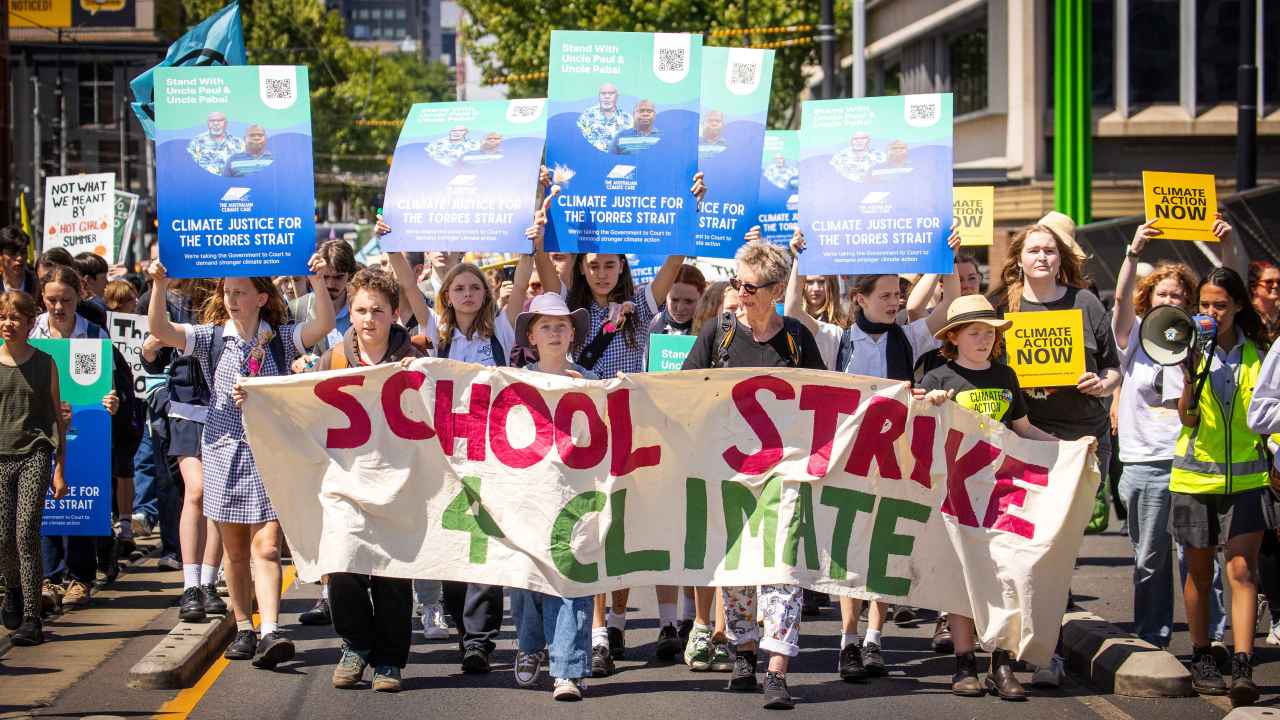
Australia risks creating a generation of “chronically anxious” young people unless limits are placed on the teaching of “alarmist and emotionally charged” climate messaging in schools, a leading psychologist has warned.
Education and development psychologist Clare Rowe has called for age-based “guardrails” to be imposed on how climate change is taught to Australian children, warning that constantly telling primary school aged kids that the planet is dying causes genuine harm.
Ms Rowe made the comments following the release of a new report about how Australia’s National Curriculum is increasing rates of climate anxiety among young people.
The new report, published by the Institute of Public Affairs, shows the National Curriculum is skewed towards climate alarmism, with the cross-curriculum priority of “Sustainability” ensuring climate change education is present across all subject areas.
It shows how the cross-curriculum priority is resulting in third-party groups – such as Cool.org, the World Wildlife Fund, and the ABC’s Behind The News – providing resources to schools, with kids as young as five fed what the report calls emotionally charged messaging before they possess the cognitive or emotional maturity to understand or put the claims in context.
Examples cited in the report include a video, created by ABC’s Behind the News and shown in classrooms, in which children are warned they are facing “global boiling”.
The video shows footage of smoking landscapes, bushfires and melting icecaps, before warning that “we need to do something quickly to avoid an average temperature increase that many say would be disastrous”.
Other resources include lesson plans, created by the World Wildlife Fund, where students write down a pledge to save energy and reduce.
A similar plan, designed for students in grade one, shows a large image of a hand with a globe in the middle, with the instructions telling students to write an Earth Day pledge about how they can live more sustainably on each of the five fingers.
Ms Rowe, who is an adjunct fellow at the IPA, said she was “deeply concerned by how early and how frequently children are being exposed to alarmist and emotionally charged climate messaging in primary schools.”
“We now have five-, six- and seven-year-olds being told the planet is dying, that animals are becoming extinct because of human behaviour, and that their own actions are contributing to global catastrophe. That is developmentally inappropriate, and for some children it is genuinely harmful,” Ms Rowe said in comments provided to SkyNews.com.au.
“Primary-aged children simply do not have the cognitive machinery to process global, abstract threats like climate change. Their thinking is concrete, literal, and egocentric.
“When they are repeatedly told that the Earth ‘may no longer sustain life’ or that certain species are dying because of ‘what humans are doing’, they internalise this in a very personal way.”
The developmental and educational psychologist said her colleagues were already seeing more and more kids with issues related to climate anxiety.
“We are seeing real cases of guilt, fear, sleep disturbance, and helplessness, symptoms consistent with anxiety disorders,” she said.
Ms Rowe said that a part of the problem was the fact the issue was not merely limited to science classes but embedded across the curriculum, including in “art, humanities, English, and even early literacy tasks”.
“This constant exposure trains a child’s brain to be vigilant and fearful,” she said.
“We would never expose a child to graphic violence or adult-level medical information in this way, yet we allow intense climate messaging to be threaded through their entire school experience.”
The IPA adjunct fellow said that just as there are restrictions around screen time, online safety, playground equipment and explicit content, there needs to be “guardrails” around the teaching of climate change to young minds.
“We delay teaching children about war, terrorism, cancer, or adult political issues for a reason,” she said.
“Children cannot emotionally regulate when exposed to threats they cannot understand and cannot control.
“Climate change should be no different. Introducing existential fear before a child has the cognitive capacity to contextualise it is irresponsible.”
The IPA’s report calls for climate change education to be delayed until secondary school, with lessons confined to the science classes at the appropriate year level.
The report also calls for national guidelines on age-appropriate environmental education, and for the Sustainability cross-curriculum priority to be scrapped.
According to Ms Rowe, continuing on the current path risks creating “a generation of young people who are environmentally conscious but chronically anxious”.
“Our education system has a duty of care to avoid avoidable psychological harm, and right now that duty is being breached,” she said.