
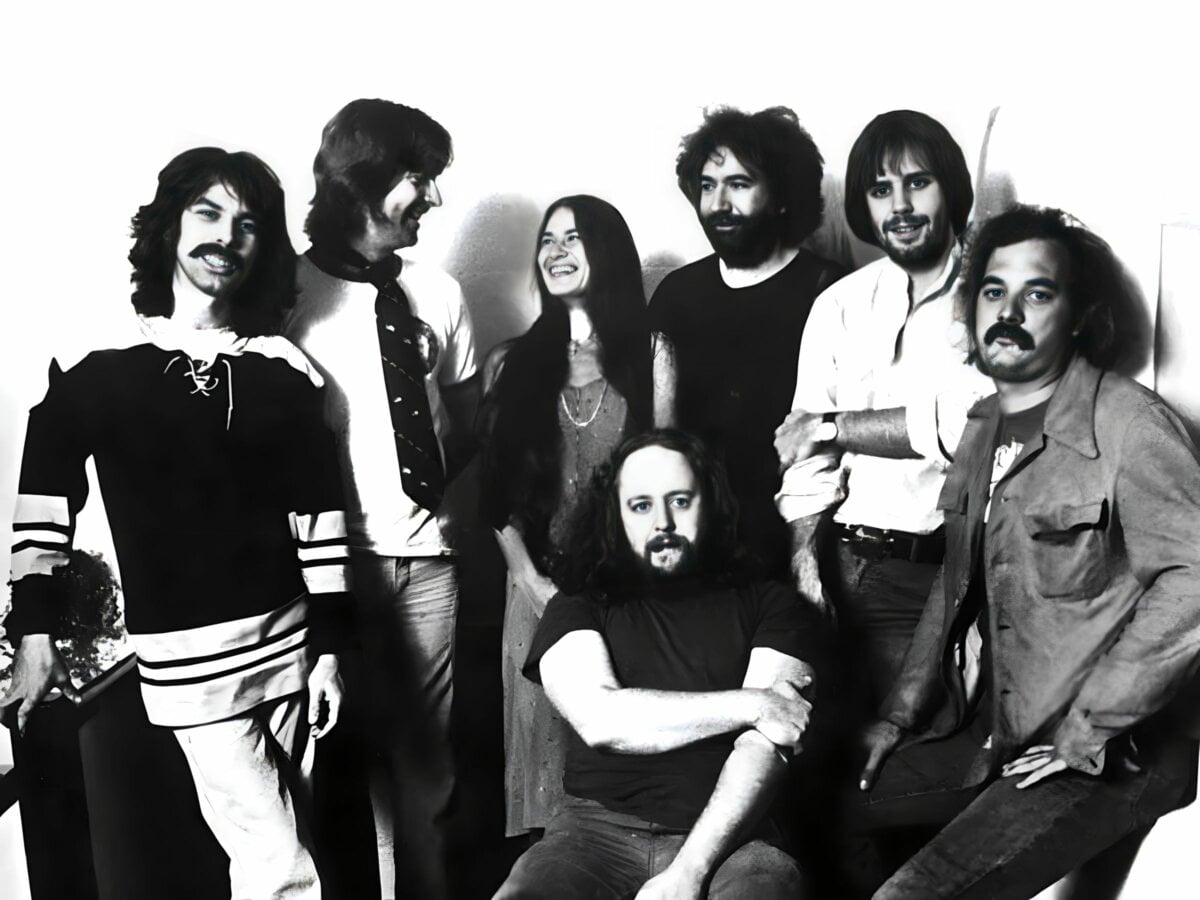
(Credit: Alamy)
Wed 17 December 2025 21:26, UK
‘Dark Star’ made the Grateful Dead who they were.
Before getting their signature song in their repertoire, the Dead were a former jug band who were playing R&B covers and trying to find their own sound. Ron ‘Pigpen’ McKernan was still largely steering the ship, although his health problems were already starting to become evident by 1967. The Dead wanted to spread out, but jam vehicles like ‘Viola Lee Blues’ and ‘Alligator’ were starting to wear out their welcome.
Then came ‘Dark Star’, a nebulous two-chord vamp that could take just about any shape that the band formed it into. With only a basic structure holding it together, the Dead could escape the confines of the composition and explore the outer edges of sonic improvisation while having something to return to when they were done. ‘Dark Star’ was less of a song and more of a framework that let the Dead indulge in all their finest musical and psychedelic ideas.
But it was a song, first and foremost. In fact, it was a single: a less than three-minute jaunt that didn’t actually go anywhere. It had some nifty Jerry Garcia banjo at the end, playing over what would be the one and only appearance on record for lyricist Robert Hunter. In many ways, ‘Dark Star’ represented Hunter’s acceptance into the Grateful Dead. Although he had sent over lyrics like ‘China Cat Sunflower’ from New Mexico, ‘Dark Star’ would be the first song that Hunter composed while living communally with the band.
“[I had] a case of walking pneumonia and the clothes on [my] back,” Hunter writes about his entry into San Francisco in his lyrical collection A Box of Rain. “The next day, I was writing ‘Dark Star’, feeling pretty much as the lyric suggests.”
 The magentic Robert Hunter. (Credits: Far Out / David Saddler)
Although Hunter would be famously reticent to explain the song’s lyrics, including dodging any real interpretation during his sole appearance in the documentary Long Strange Trip, there are some antecedents to the ‘Dark Star’ lyrics.
Notably, Hunter was inspired by TS Eliot’s The Love Song of J. Alfred Prufrock, which contains the line: “Let us go then, you and I, when the evening is spread out against the sky.”
Hunter would channel that same feeling on the line: “Shall we go, you and I, while we can, through the transitive nightfall of diamonds. “That’s just my kind of imagery,” Hunter later said. “I don’t have any idea what the ‘transitive nightfall of diamonds’ means. It sounded good at the time. It brings up something you can see.”
While on stage, Jerry Garcia and Bob Weir were held together by Bill Kreutzman to avoid them floating off into space; Robert Hunter had no such restrictions on paper and was allowed to wander where his imagination mapped. It meant the songwriter could allow his poetic imagery to run wild.
On ‘Dark Star’, arguably the band’s most famous song, Hunter does just that, conjuring up imagery of a fallible universe that is only ever a good tug away from falling in on itself. The song would go on to define the band, not only their mercurial ways, but the reality that though their sound was sprawling, it was neatly rooted in the subversive nature of art itself.
Check out the original single version of ‘Dark Star’ down below.
Related Topics