
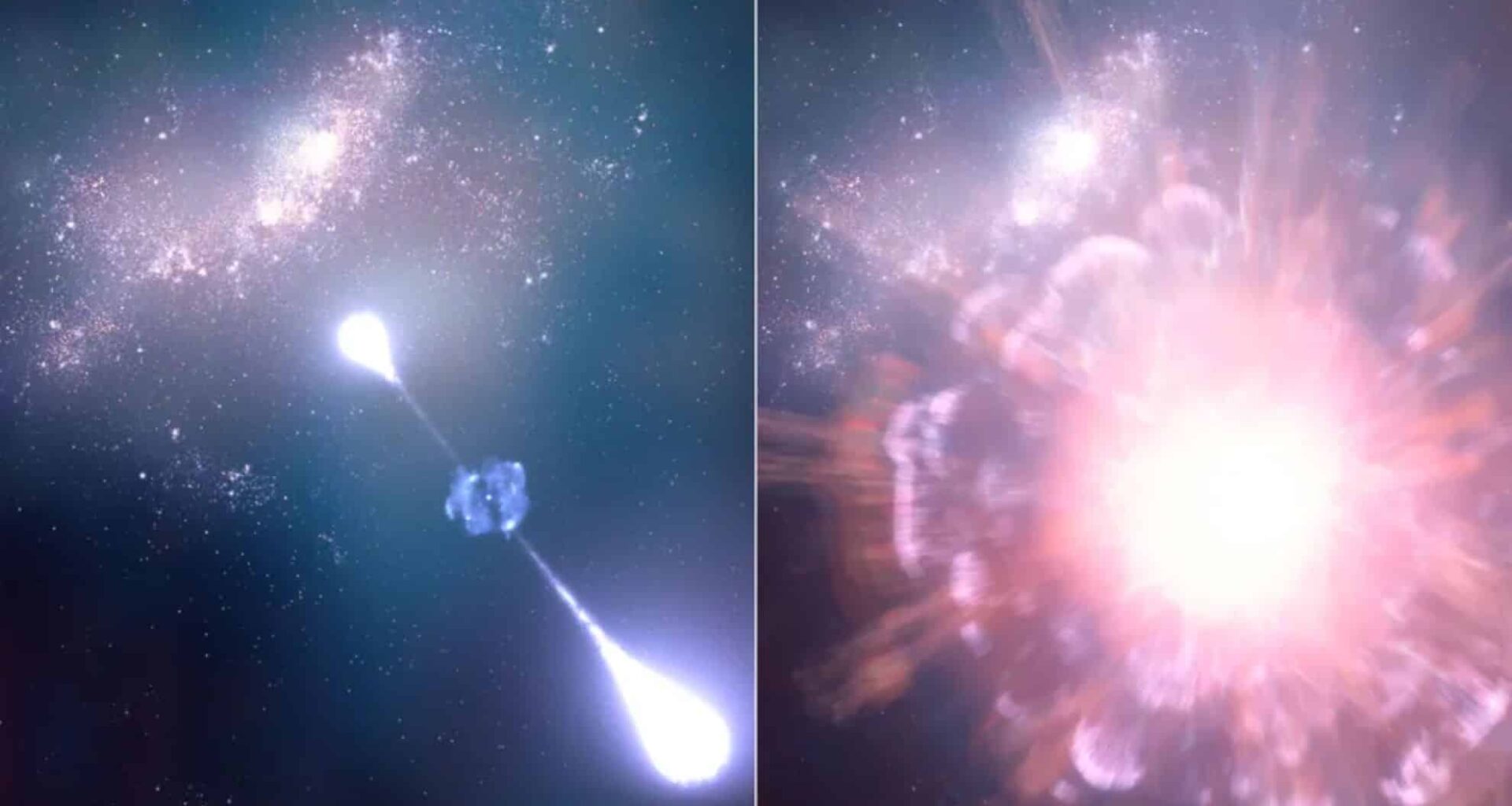
This discovery is significant for several reasons. It marks the first time that a supernova has been detected from such an early stage in cosmic history, allowing scientists to study how the first generations of stars exploded and contributed to the evolution of the universe.
The supernova was identified following a gamma-ray burst (GRB), a brief and extremely powerful flash of gamma radiation. As the light from this explosion traveled across space for billions of years, it allowed scientists to learn more about the conditions that existed when the universe was still in its infancy.
A Rare Opportunity to Study the Early Universe
GRB 250314A was first detected on March 14, 2025, by the Space Variable Objects Monitor (SVOM), a Franco-Chinese space mission. The initial gamma-ray burst lasted about 10 seconds, fitting into the long-duration GRB category, which typically originates from the collapse of massive stars. Scientists were particularly eager to study whether the gamma-ray burst could be linked to a supernova, providing direct evidence of a stellar explosion in the distant universe.
According to A.J. Levan, lead author of one of the papers on the discovery, JWST’s sharp infrared capabilities enabled them to distinguish the supernova from the afterglow of the burst and the host galaxy’s light. “We were amazed that our predictions worked so well,” Levan said.
The light from GRB 250314A arrived at Earth in a unique, complex form. First, it appeared as a short, intense gamma-ray burst, followed by a slower, more gradual glow. The detailed observations from JWST, made about three and a half months after the burst, were crucial in identifying the supernova’s faint host galaxy and understanding the nature of the explosion.
This was the first time such detailed information had been gathered about a supernova from the early universe, as previous supernova observations from that period were limited to just a few faint bursts.
Unexpected Similarities to Modern Supernovae
Despite being observed in a time long before modern stars existed, the supernova associated with GRB 250314A displayed unexpected similarities to those in the local universe. Early stars were thought to be quite different from those today, likely more massive and with different chemical compositions. However, the explosion seen in this case followed a similar pattern to supernovae observed closer to home.
Nial Tanvir, co-author of the study that is published in Astronomy & Astrophysics, noted that this similarity was surprising. “We went in with open minds, and lo and behold, Webb showed that this supernova looks exactly like modern supernovae,” he said. This finding suggests that the nature of stellar explosions may have remained consistent across much of cosmic history.
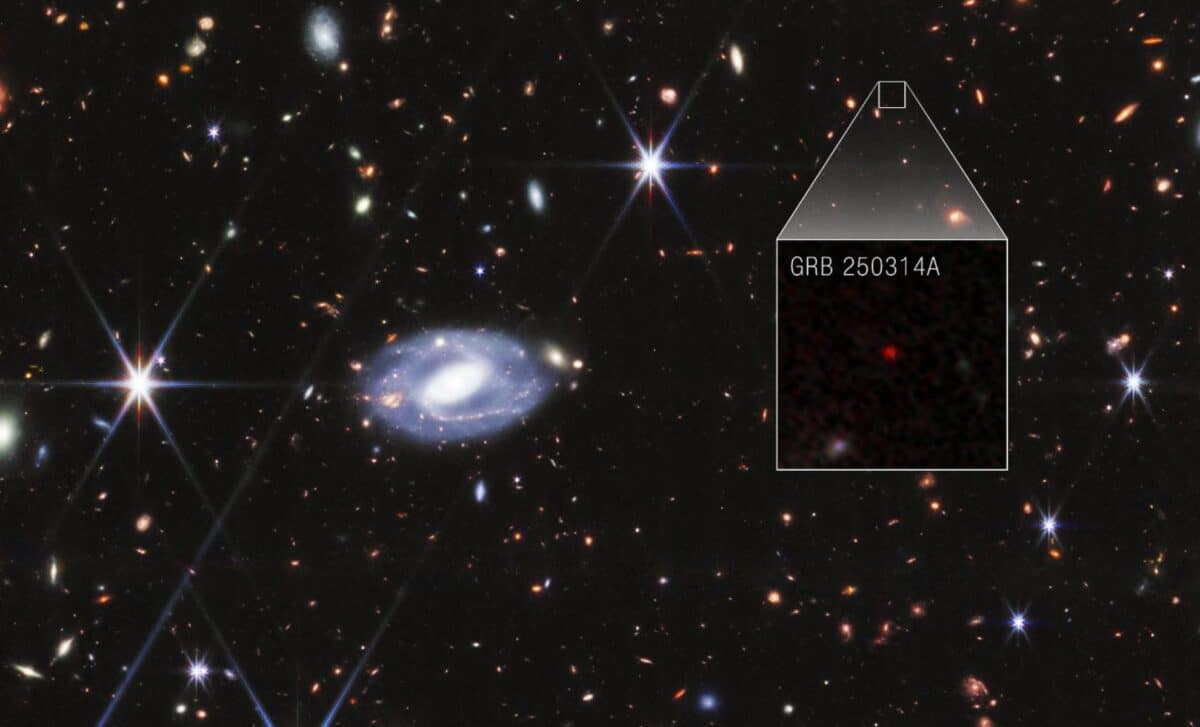 GRB 250314A, the most distant supernova spotted ©A. Pagan (STScI))
The supernova’s brightness, which initially increased and then slowly faded over several months, is typical of this type of event. However, the fact that it brightened over such a long period was likely due to the distance and cosmic expansion, which stretched the light’s wavelengths. This phenomenon also caused time itself to appear stretched, making the event seem to unfold more slowly than it would in a nearby galaxy.
A Glimpse Into the Early Universe’s Galaxies
In addition to identifying the supernova, JWST also helped locate its host galaxy, which was incredibly faint and compact, typical of galaxies from the early universe. The galaxy was so distant that it appeared as just a tiny smudge of light in JWST’s infrared images.
Emeric Le Floc’h, co-author of the study, explained that the faint nature of the galaxy was expected. “Webb’s observations indicate that this distant galaxy is similar to other galaxies that existed at the same time,” he said. Although scientists could not yet study the galaxy in detail, this detection opens up new opportunities to learn about the conditions in the early universe and how galaxies evolved.
The host galaxy’s faintness makes it difficult to study directly, but it serves as an important reference point for understanding the processes that led to the formation of stars and galaxies at such an early stage in cosmic history.
The findings also suggest that future observations of supernovae and their host galaxies could help astronomers better understand how the first stars formed and exploded in the early universe, and how they contributed to the cosmic environment that eventually gave rise to the stars, planets, and galaxies we see today.