
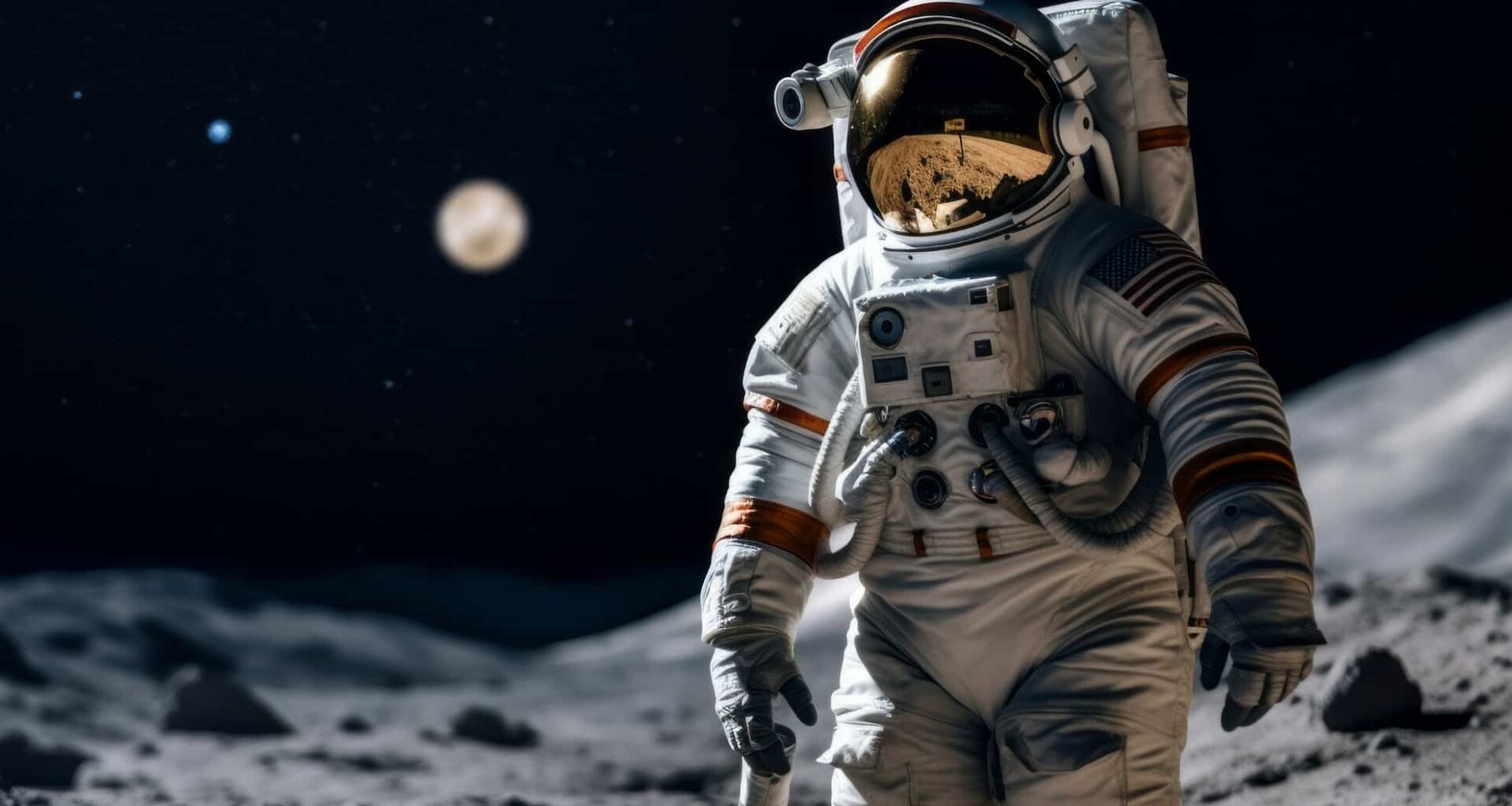
The proposal, published in Nature Geoscience, argues that this epoch began in 1959 with the arrival of the first human-made spacecraft and has since evolved through more than 100 missions that have left their mark on Earth’s only natural satellite.
The concept mirrors the ongoing debate surrounding the Anthropocene on Earth—the era in which human activity has become the dominant influence on the planet’s geology and ecosystems. Lead researcher Justin Holcomb and his team believe similar patterns are now evident on the Moon. With every spacecraft crash, crewed landing, and trace of human activity, the lunar environment is being changed, sometimes irreversibly. And unlike Earth, the Moon has no environmental laws or policies in place to protect it.
For decades, the Moon has symbolized pristine desolation, a place barely touched by human presence except during brief moments of exploration. But Holcomb’s team warns that this perception is outdated. They argue that what’s already been left behind—from spacecraft wreckage to human waste—is enough to justify the formal recognition of a new epoch, not as a warning of what might come, but as an acknowledgment of what’s already there.
More Than 100 Missions Mark The Moon’s Transformation
The Lunar Anthropocene, according to the study, began with the Soviet Union’s Luna 2 spacecraft, which impacted the lunar surface in September 1959. Since then, over 100 spacecraft have made contact with the Moon—some deliberately, others by accident—contributing to an escalating human imprint. These missions include not only robotic explorers but also crewed landings, each altering the lunar terrain in various ways.
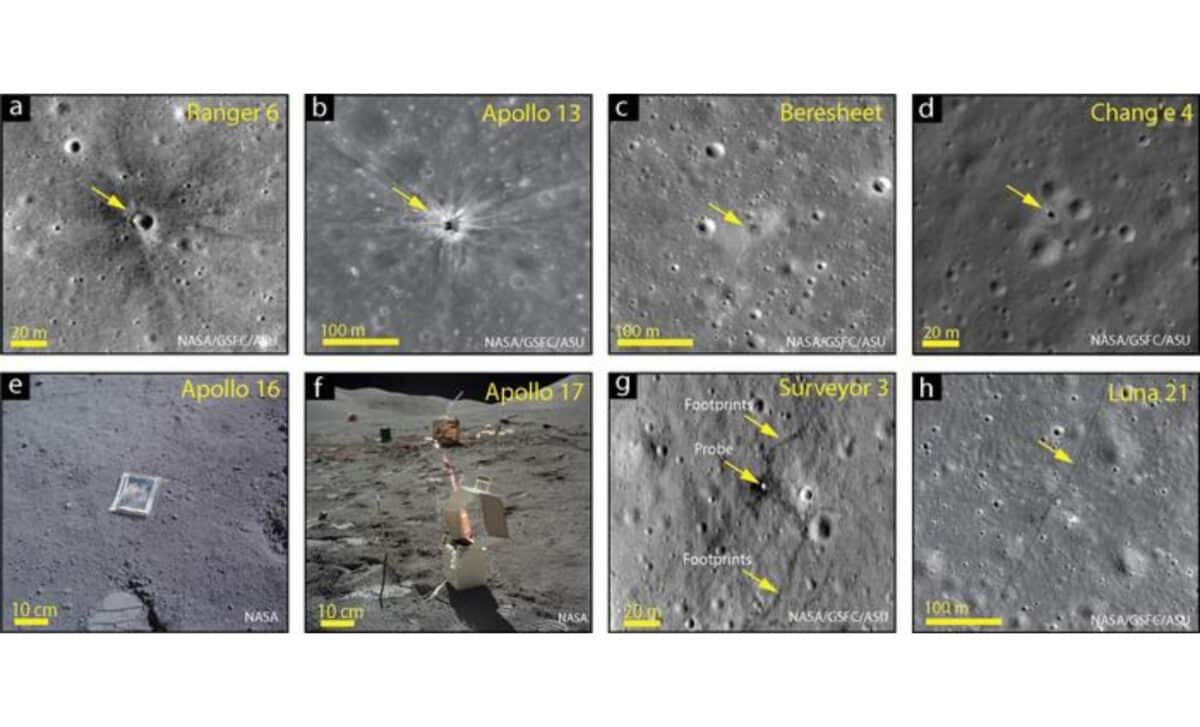 Examples of archaeological artifacts and features on the Moon – © Holcomb et al
Speaking to the accumulation of human influence, Holcomb notes that we are already “moving sediments and significantly disturbing the surface.” The researchers believe the level of impact is sufficient to constitute a geological shift. In this view, the Moon has become a dynamic landscape shaped by human hands, even if unintentionally. As reported by Popular Mechanics, Holcomb warned that “in the context of the new space race, the lunar landscape will be entirely different in 50 years.”
Environmental Disruption Poses Growing Risks
Beyond visible disruptions, the study also points to less obvious forms of environmental interference. One major concern involves the Moon’s delicate exosphere, a sparse layer composed of dust and gas. The researchers emphasize that this exosphere, along with ice deposits in permanently shadowed regions, is especially vulnerable to contamination from exhaust gases generated by visiting spacecraft.
The authors urge future missions to take these vulnerabilities into account. “Future missions must consider mitigating deleterious effects on lunar environments,” the paper states. The concern is not only about surface-level pollution but also about the potential for more widespread and permanent atmospheric changes. The absence of a protective legal framework makes the situation more precarious, with no formal barriers to prevent irreversible damage.
Tracking Human Presence Through Lunar Archaeology
Another major goal of declaring the Lunar Anthropocene is record-keeping. Holcomb and his colleagues propose the systematic cataloging of every human interaction with the Moon, from spacecraft to golf balls, footprints, human waste, and other left-behind objects. This effort, they argue, would allow future researchers to trace the history of humanity’s off-world presence with greater precision.
Holcomb explains this through an archaeological lens: “As archaeologists, we perceive footprints on the Moon as an extension of humanity’s journey out of Africa, a pivotal milestone in our species’ existence.” The team aims to work with archaeologists and anthropologists to ensure that this documentation is handled with scientific care. They believe that every artifact left on the Moon tells a story and should be preserved as part of a broader human narrative.