
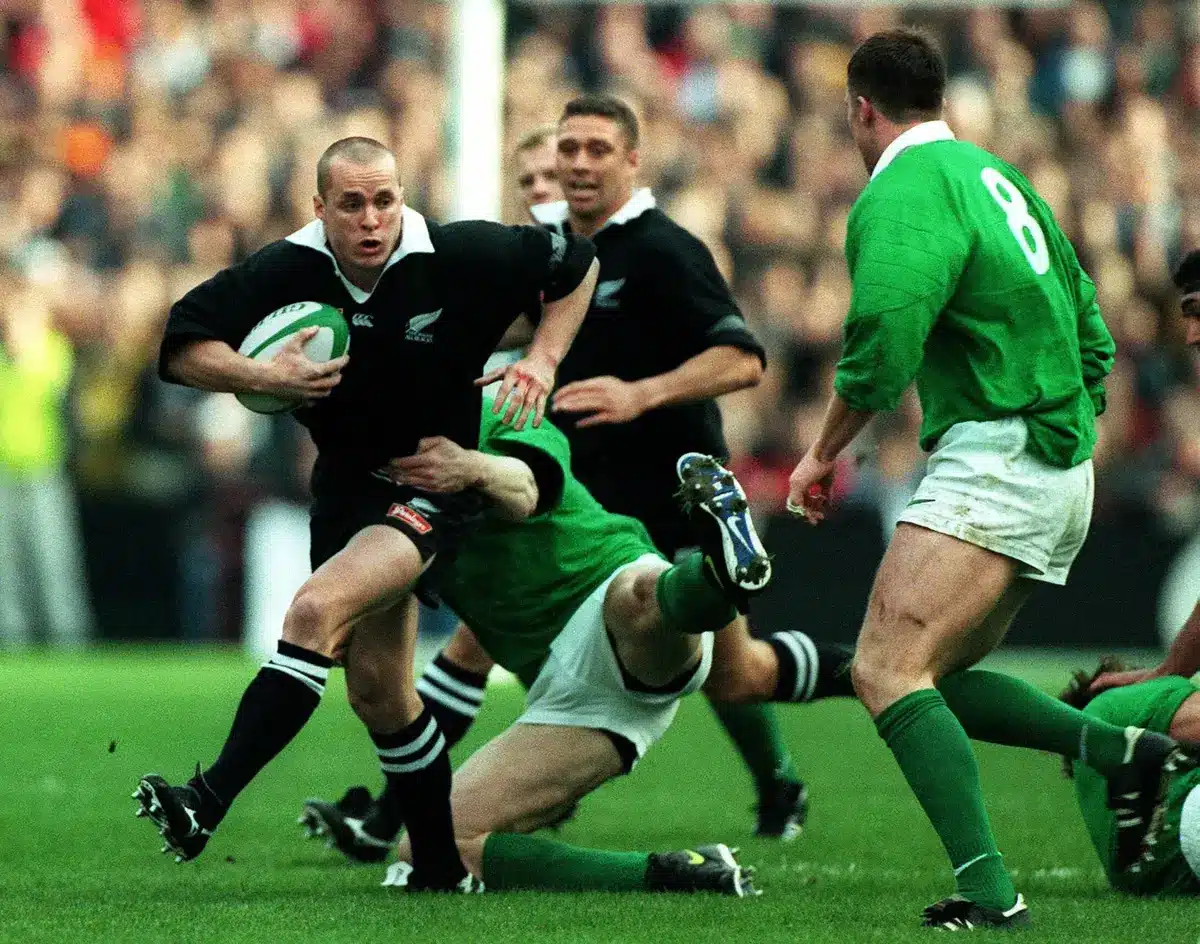
5 John Gallagher (New Zealand)
A flawless international record is rare, but it defines the All Blacks career of John Gallagher. Qualifying through residency, he became New Zealand’s first-choice fullback in the late 1980s and never lost a Test match. Calm under the high ball and tactically astute, Gallagher was a key figure in the 1987 Rugby World Cup triumph, playing every game of the tournament.
Though his Test career was relatively short, his impact was lasting, earning him International Player of the Year honours in 1990. Gallagher’s journey also spanned rugby league and policing, adding to his unique story. Efficient, reliable and composed, he remains one of the most quietly successful fullbacks in rugby history.
4 Ben Smith (New Zealand)
Intelligence and subtlety defined the approach of one of New Zealand’s most reliable modern fullbacks. Across 84 Tests, Ben Smith became a cornerstone of an era of All Blacks dominance, including the 2015 World Cup victory. Renowned for his ability to read space, he glided into gaps and finished with clinical precision.
His versatility across the backline and his calm leadership saw him serve as vice-captain during an unbeaten period in New Zealand rugby. Rarely flashy and never wasteful, Smith thrived on timing and decision-making rather than raw speed. His legacy is one of consistency, trust and rugby intelligence, qualities that made him indispensable in a historic team.
3 Jason Robinson (England)
Few players arrived in rugby union with such immediate impact after switching codes. Jason Robinson’s pace, footwork and explosive acceleration instantly transformed England’s attacking threat. Scoring 30 tries in 56 Tests, his defining moment came with a try in the 2003 World Cup final, sealing a place in English sporting history.
Comfortable on the wing or at fullback, Robinson was at his best in broken play, where his league-honed instincts thrived. He also broke barriers as England’s first Black captain and the first former professional league player to lead the side. For club, country and Lions, Robinson brought unpredictability, courage and game-changing brilliance.
2 Serge Blanco (France)
Rugby as spectacle found its purest expression in one of France’s most celebrated backs. Serge Blanco played with freedom, instinct and flair, earning the nickname the “Pelé of Rugby.” Winning 93 caps, a record at the time, he remains France’s leading try scorer with 38. His most iconic moment came at the 1987 World Cup, where his late try against Australia carried France into the final.
A Grand Slam winner and national captain, Blanco thrived on big occasions and counter-attacking opportunities. Though club titles eluded him, his influence on French rugby was profound. His inductions into multiple halls of fame reflect a legacy built on creativity and courage.
1 Christian Cullen (New Zealand)
Counter-attack was transformed into a lethal weapon by one of the most natural runners the game has known. Christian Cullen’s speed, balance and instinct made him devastating from deep, often turning defensive situations into instant tries. With 46 tries in just 58 Tests, his strike rate remains extraordinary. Operating at the peak of New Zealand’s late-1990s dominance, Cullen regularly dismantled elite defences with minimal support.
Though injuries curtailed his career, his highlight reel remains unmatched among fullbacks. At his best, he embodied attacking freedom and ruthless efficiency. For many, he remains the benchmark by which all attacking fullbacks are judged.
EDITORS PICKS:
Like this:
Like Loading…