
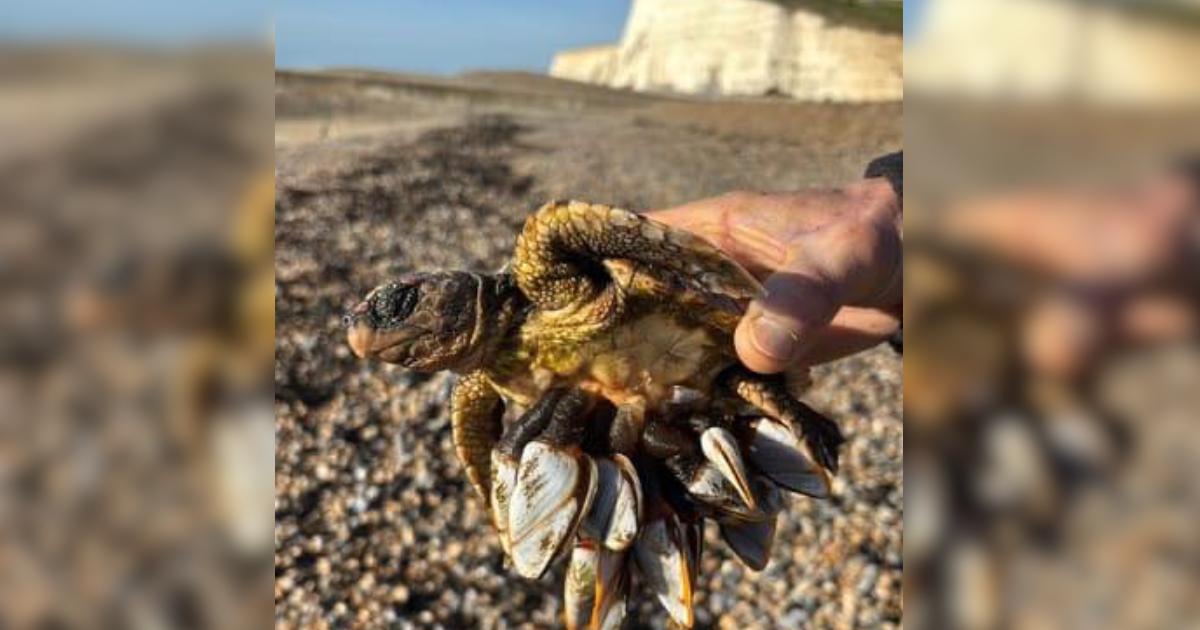
A member of the public discovered the small turtle on the beach by Whitecliffs café in Saltdean.
The animal was covered in goose barnacles: crustaceans which attach to rocks, ship or floating debris using a fleshy stalk (peduncle), resembling a goose’s neck, with a hard shell on top.
The person who discovered the creature reported their find to a turtle expert in the evening, but the email was not picked up until the next morning.
The expert then contacted the British Divers Marine Life Rescue (BDMLR) to see if someone could be sent out to search for the turtle.
One of BDMLR’s marine mammal medics was sent out to try and locate the turtle but it was unfortunately not found.
BDMLR covers all of the UK and has a 24-hour hotline which people can ring so that a medic can be sent out to rescue marine life.
Turtles are not native to the English coast because they cannot tolerate the cold waters.
Most turtles, like this one, which are found on the English coast have been caught in storms and carried on the tide from warmer waters further afield, such as around Portugal and beyond.
They are often in cold shock which means their bodies have shut down. They are therefore unable to swim and float to the surface. Their lack of movement allows barnacles to attach.
Turtles found in English waters need to be taken to a nearby specialist, which in this case would have been Brighton Sealife. Brighton Sealife is an approved turtle rehabilitation centre.
The team will increase the turtle’s temperature very slowly in a controlled tank, and “hope it will pull through”. A turtle can spend as long as 12 to 18 months in rehab before being returned to warmer waters.
Director of operations Julia Cable of BDMLR, explains that while some turtles “make it through, some don’t”.
A turtle being found on the English coast is a relatively rare occurrence with BDMLR generally recording a dozen or fewer a year.
“Some years we don’t get any,” she said.