
Scientists have been baffled by a bizarre lemon–shaped planet that ‘defies explanation’.
The Jupiter–size planet was discovered by NASA‘s James Webb Space Telescope (JWST) and is so strange that it challenges everything we know about how planets form.
Dubbed PSR J2322–2650b, the gas giant has an exotic carbon and helium atmosphere that is unlike any other known exoplanet.
Soot clouds float through the super–heated reaches of its upper atmosphere and condense into diamonds deep in the planet’s heart.
This unusual composition is made even stranger by the fact that this planet doesn’t orbit a star like our sun.
Instead, this world orbits a type of neutron star known as a pulsar – the ultra–dense core of a dead star that compresses the mass of the sun into something the size of a city.
Located 750 light–years from Earth, this pulsar is constantly bombarding its captive planet with gamma rays and stretching it under gravity into a unique ‘lemon’ shape.
This produces some of the most extreme temperature differences ever seen on a planet, with temperatures ranging from 650°C (1,200°F) at night to 2,030°C (3,700°F) in the day.
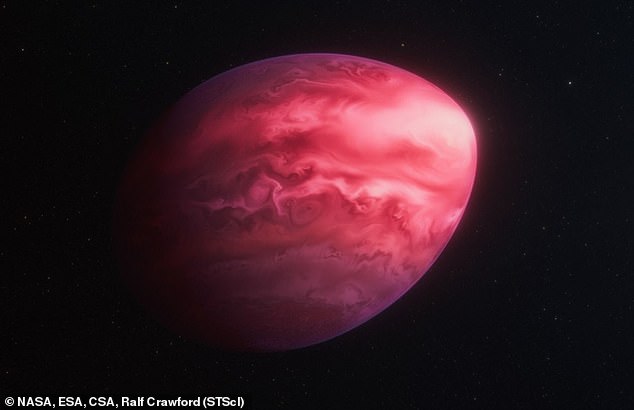
Scientists have been baffled to discover a bizarre lemon–shaped planet that defies everything we know about planetary formation
Even by the standards of exotic exoplanets, PSR J2322–2650b stands out as exceptionally odd.
And, in a new paper, accepted for publication in The Astrophysical Journal Letters, researchers used the JWST to reveal that the planet is even stranger.
Co–author of the study Dr Peter Gao, of the Carnegie Earth and Planets Laboratory, says: ‘I remember after we got the data down, our collective reaction was “What the heck is this?”
‘It’s extremely different from what we expected.’
Of the 6,000 or so known exoplanets, this is the only gas giant that orbits a neutron star.
This is hardly surprising given that neutron stars tend to tear their neighbours apart with gravity or evaporate them with a bombardment of powerful radiation.
PSR J2322–2650b is also extraordinarily close to its star at just one million miles (1.6 million km) away, compared to the distance of 100 million miles (160 million km) between Earth and the Sun.
That means a year on this strange world takes just 7.8 hours as it whizzes around the neutron star at incredible speed.

The planet, dubbed PSR J2322–2650b, orbits a type of neutron star called a pulsar – the ultra–dense core of a dead star that compresses the mass of the sun into something the size of a city
What are neutron stars?
When a star eight or more times larger than our sun runs out of fuel, it collapses into an enormous explosion called a supernova.
When this happens, the core is crushed under immense pressure until it collapses into something called a neutron star.
Due to extreme pressure, the electrons and protons in normal matter fuse into pure neutrons.
These are so dense that they may be up to 2.5 times more massive than the sun but less than 10 miles in diameter.
Neutron stars often have extremely powerful magnetic fields and blast electromagnetic radiation out from their poles.
<!- – ad: https://mads.dailymail.co.uk/v8/us/sciencetech/none/article/other/mpu_factbox.html?id=mpu_factbox_1 – ->
Advertisement
But what really makes the planet a total anomaly is the composition of its atmosphere.
Co–author Dr Michael Zhang, of the University of Chicago, says: ‘This is a new type of planet atmosphere that nobody has ever seen before.
‘Instead of finding the normal molecules we expect to see on an exoplanet — like water, methane, and carbon dioxide — we saw molecular carbon, specifically C3 and C2.’
This is really weird because, at temperatures as high as they are on the planet, carbon should bond with any other atoms in the atmosphere.
That means molecular carbon can only be dominant when there is almost no oxygen or nitrogen present.
Out of the roughly 150 planets that scientists have analysed in depth, not a single one has molecular carbon in its atmosphere.
However, scientists still genuinely have no idea how such a weird planet could have formed.
‘Did this thing form like a normal planet? No, because the composition is entirely different,’ says Dr Zhang.
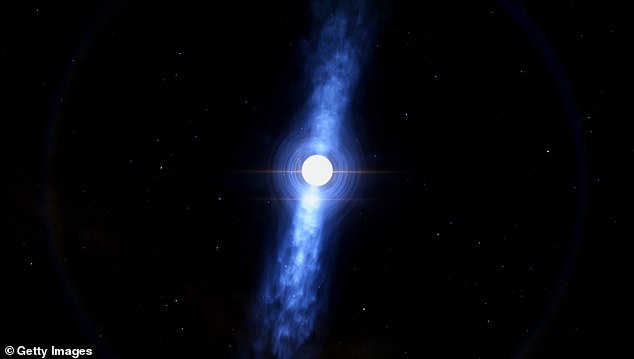
This pulsar is constantly bombarding its captive planet with gamma rays and stretching it under gravity into a unique ‘lemon’ shape (artist’s impression)
Likewise, the planet couldn’t have formed by stripping the outer layers of a star since the nuclear reactions in stellar cores don’t make pure carbon.
Dr Zhang adds: ‘It’s very hard to imagine how you get this extremely carbon–enriched composition. It seems to rule out every known formation mechanism.’
Currently, the researchers’ best theory is that carbon and oxygen crystallised in the planet’s interior as it cooled.
The pure carbon crystals might have then floated to the top and mixed with helium, which is what the scientists would be seeing in their data.
However, co–author Professor Roger Romani, of Stamford University, says that this doesn’t solve all the problems.
He says: ‘Something has to happen to keep the oxygen and nitrogen away. And that’s where the mystery comes in.
‘But it’s nice not to know everything. I’m looking forward to learning more about the weirdness of this atmosphere. It’s great to have a puzzle to go after.’
Scientists study the atmosphere of distant exoplanets using enormous space satellites like Hubble
Distant stars and their orbiting planets often have conditions unlike anything we see in our atmosphere.
To understand these new world’s, and what they are made of, scientists need to be able to detect what their atmospheres consist of.
They often do this by using a telescope similar to Nasa’s Hubble Telescope.
These enormous satellites scan the sky and lock on to exoplanets that Nasa think may be of interest.
Here, the sensors on board perform different forms of analysis.
One of the most important and useful is called absorption spectroscopy.
This form of analysis measures the light that is coming out of a planet’s atmosphere.
Every gas absorbs a slightly different wavelength of light, and when this happens a black line appears on a complete spectrum.
These lines correspond to a very specific molecule, which indicates it’s presence on the planet.
They are often called Fraunhofer lines after the German astronomer and physicist that first discovered them in 1814.
By combining all the different wavelengths of lights, scientists can determine all the chemicals that make up the atmosphere of a planet.
The key is that what is missing, provides the clues to find out what is present.
It is vitally important that this is done by space telescopes, as the atmosphere of Earth would then interfere.
Absorption from chemicals in our atmosphere would skew the sample, which is why it is important to study the light before it has had chance to reach Earth.
This is often used to look for helium, sodium and even oxygen in alien atmospheres.
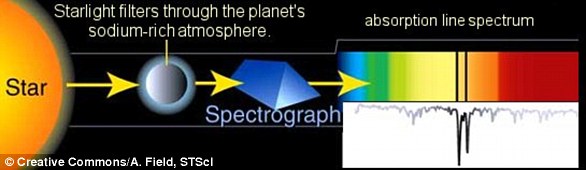
This diagram shows how light passing from a star and through the atmosphere of an exoplanet produces Fraunhofer lines indicating the presence of key compounds such as sodium or helium