
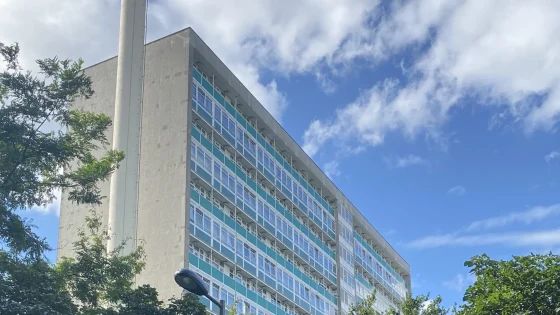
At a meeting last week (2 December), Southwark Council’s cabinet agreed to flatten the 16-storey Marie Curie House in Camberwell following a recent structural and fire risk assessment.
Six households still live in the council-owned building, which contains 98 homes. It was built almost identically to Lakanal House as part of the Sceaux Gardens Estate by former Southwark Council architect FO Hayes.
The Lakanal House fire occurred in July 2009, spreading through several flats in the 12-storey building and killing six people.
The final report into the Grenfell Tower fire, which killed 72 people in 2o17, found that lessons had not been learnt by the government over the Lakanal House fire and that the government’s response to regulation post Lakanal had been ‘inadequate’.
A report on Marie Curie House said the 1960s block was ‘high-risk’ and had presented signs of ‘significant structural degradation, compromised fire resistance, and risk of building failure in the event of a fire incident’.
The report blamed the introduction of the Building Safety Act 2022, a post-Grenfell piece of legislation, on ‘significantly’ increasing the cost of refurbishing the building, and went on to recommend demolition as ‘a definitive and permanent solution to the building’s safety and compliance challenges’.
It will now be demolished at a cost of £3 million. The cost of refurbishing and retrofitting the building was put at £23 million.
Four years ago, Marie Curie House residents were told they would be relocated to make way for major building refurbishment, but this was later scrapped. Instead, both Lakanal and Marie Curie were fitted with new internal and external fire-resistant doors and extensive fire-stopping works.
However, Lakanal House was fully refurbished in the wake of the 2009 tragedy. It now has a different fire safety rating to Marie Curie House and is not proposed for demolition.
Marie Curie has had a ‘waking watch’ – 24-hour wardens – to keep residents safe in the event of fire since 2020, Southwark Council told the AJ.
Cabinet member for housing Helen Dennis said: ‘The safety of people living in our homes and estates is our top priority as a landlord.
‘A specialist assessment has found Marie Curie House is a substantial fire risk, and as the building is near the end of its lifespan and beyond economical repair, we propose to empty the building and demolish it. We do not take this decision lightly and have thoroughly investigated the refurbishment option.
‘Everyone in Southwark deserves a decent home to live and we will look at all options for building more council homes on the site and nearby. We are proud that Southwark has built more council homes than any other local authority landlord, with over 3,000 council homes started or completed across the borough.’
The wider Sceaux site was not long ago tipped for a WW+P-designed infill-led redevelopment, but those plans were later shelved.
Liberal Democrat councillor Jane Salmon, who sits on Southwark’s Housing Scrutiny Commission, told the AJ that demolition of Marie Curie was ‘shameful’.
She said: ‘It’s shameful that another Southwark Council tower block is being demolished after years of Labour’s underinvestment and mismanagement. Just like the Maydew House saga in Bermondsey, years of dither and delay have left residents in limbo, with many still hoping they’d one day return home.
‘Now the council faces an impossible choice: spend £23 million it can’t afford, or demolish nearly 100 desperately needed council homes. It’s yet another example of what MPs challenged Southwark’s Labour leader on in Parliament in October. Why do we always wait until we’re forced by regulation or tragedy before acting?’
Last November, demolition work finally began on the 1960s-built Maydew House, another Southwark Council-owned block, after a Haworth Tompkins-designed extension and retrofit was scrapped as costs reached £70 million.
Demolition work is expected to begin late next year.