
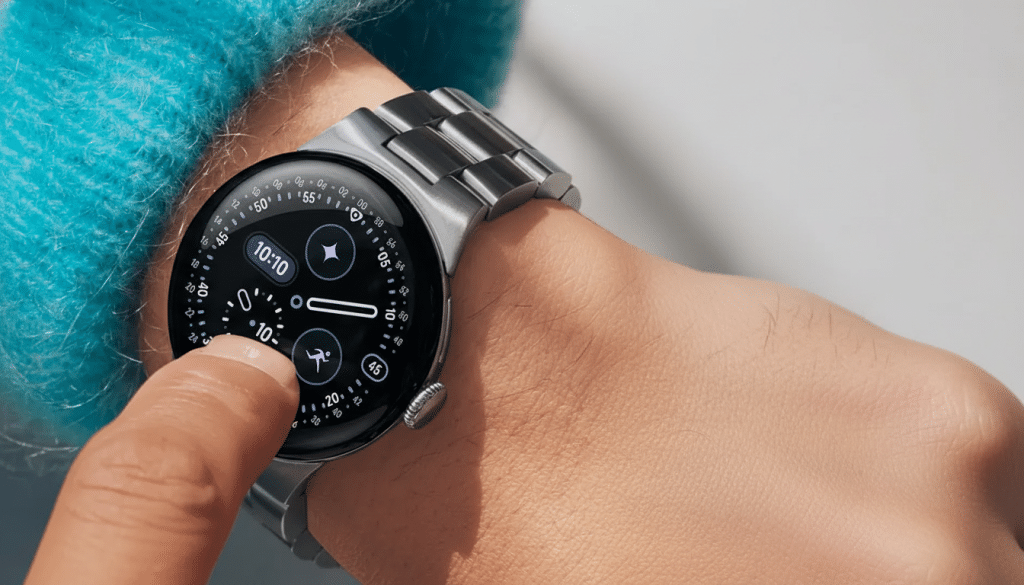
Google’s fresh Wear OS 6.1 deployment should be a no-brainer win for Pixel Watch owners, but the snazziest new features are ring-fenced for the newest hardware. That choice whittles away at something that should be the Pixel Watch’s defining advantage: quick updates and major features that reach everyone, not just those who are first in line for shiny new models.
Headlining with Wear OS 6.1, Android 16 QPR2 is the ‘core’ version of the Google OS release, along with updated Smart Replies and attractive one-handed controls that allow you to pinch fingers or flick your wrist for navigation. With a catch: Gesture controls and an all-new Raise to Talk gesture shortcut for Gemini are only available on Pixel Watch 4. Pixel Watch 3 grabs Smart Reply enhancements, Pixel Watch 2 is mostly in line for security patches, and the first Pixel Watch has sailed out of its guaranteed range.

Updates Without Features Undercut the Pixel Promise
With Pixel, it’s always been simple: Google hardware running Google software (software that tends to be updated very quickly and consistently). That value proposition had made the watches feel special, even when battery life or bulky bezels were criticized. But upgrades that change the version number without unleashing the headline features deflect attention from what you can do with a product to how it looks.
Google’s own release notes tout the new gesture system as a marquee feature that streamlines one-handed use. If that upgrade bypasses options that lines offered in 2019 and are still commonly stocked on dozens of shelves within support windows, I’ll eat a hat. Users don’t buy a smartwatch because of the build number; they buy it for what the watch can actually do on their wrist after every update.
The Hardware Excuse Doesn’t Hold Water Here
For older devices that do not have the right sensors or computing headroom, feature gating sometimes makes sense. That explanation looks thin here. Pixel Watch 4 is built around Qualcomm’s SW5150 with Cortex‑A55 CPU cores at the sort of clocks we know and love, while Pixel Watch 3 is based on the SW5100, which shares the same core architecture but totes up to 2GB RAM. These are theoretically incremental improvements, not anything dramatic that would explain gesture recognition on its own.
Now, it gets weird with Smart Replies. The Pixel Watch 3 does receive updated code that claims to be more accurate and less power hungry, but the Pixel Watch 2 — which is based on the same class of platform as the Watch 3 — does manage a few additional fixes. If there is anything bigger at play, like machine learning models or sensor fusion pipelines, Google needs to be more open around that. Qualcomm’s documentation, for example, and Google’s own support materials do not suggest any kind of must-have new sensor in the Watch 4 that would disqualify previous generations from a basic pinch or flick detection party.
When questioned about timing or technical obstacles, Google’s line that it works on bringing features to older generations “where we can” is noncommittal. With no roadmap and no robust explanation, the split feels a lot more like marketing than engineering.
Rivals Offer Gestures Across Older Models
Rivals have come long before. Samsung added one-hand gestures to One UI 5 Watch as an accessibility feature, and its gesture support has persisted down to the Galaxy Watch 4, a watch released many generations ago. Apple’s AssistiveTouch debuted with watchOS 8, and it’s only gotten better: What began as an accessibility product has morphed into a mainstream feature for people who simply find physical buttons to be inconvenient.
These examples are important because they demonstrate that the category can make useful, low-friction controls across generations without alienating last year’s buyers. If Samsung and Apple can pull it off across disparate hardware stacks, Google has less of an excuse for not doing so on its own tightly integrated ecosystem.
What Buyers Need to Know Before Upgrading
For customers who forked over as much as $499 for a Pixel Watch 3, encountering core usability features walled off months later feels like a tax on loyalty. Industry analysts at IDC and Counterpoint Research have observed that smartwatch replacement cycles are extending as devices mature. In that world, trust—stable attributes and visible support—is a much greater differentiator than year-over-year spec bumps.
Even if Google eventually backports gestures and Raise to Talk, the trust erosion is damage done today. Owners are taught to wait and see what feature actually lands on their wrist, throwing water on the very urgency for fast Pixel updates the approach is meant to inspire.
How Google Can Solve It Without Alienating Owners
Start releasing a feature availability matrix, listing what features exist by model, with explanations of the technical dependencies (be it certain IMU sampling rates, on‑device ML accelerators, or power budgets).
Provide a timetable for porting gestures and such down to Pixel Watch 3 and 2 if possible, and say flatly if a feature cannot make the jump there and why.
Make parity the principle: if a feature is a signature experience and not just a demo for hardware you can only buy second-hand at ludicrous prices on eBay, then it should ship to every supported Pixel Watch alongside its brethren. That position lines up with the trajectory that Apple and Samsung have charted, reframing accessibility features into everyday conveniences, and would bring back the “software‑first” promise that made Pixel watches interesting to begin with.
Wear OS 6.1 should have been where Google demonstrated what a unified watch lineup could be. Rather, it is a warning that the best thing about Pixel—a trust that your device will improve in meaningful ways over time—can be squandered if we allow avoidable fragmentation.