
George Foreman once said boxing is the sport to which all other sports aspire. Putting aside the breathtaking exhibitions of physical and psychological intensity it can produce, boxing has long been a refuge of the underclass, credited with changing the lives of the disenfranchised and impoverished. There are no barriers to entry. In that sense, it has always sold a democratic dream.
But boxing is, and has always been, the red-light district of professional sports, its flimsy guardrails making it a longtime haven for brazen criminals and the kind of grift and corruption that strains credulity. There are no barriers to entry. The idea that a sport which gave the world Don King, Frank “Blinky” Palermo and Park Si-hun v Roy Jones Jr could somehow be further debased is almost laughable.
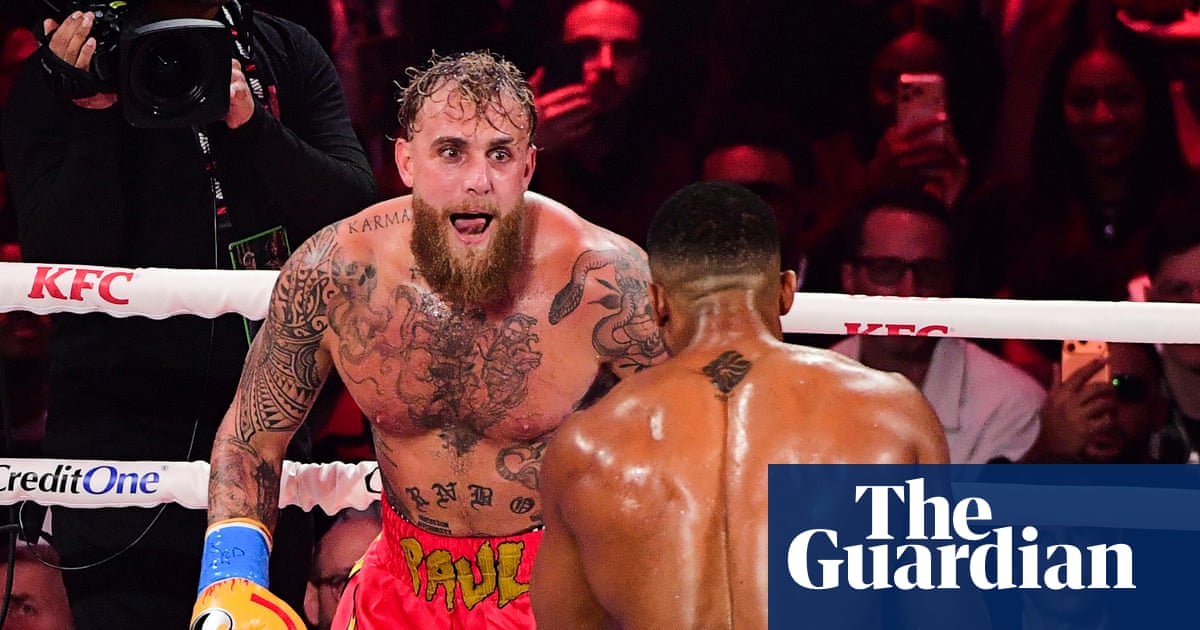
Yet in the hours after Anthony Joshua meted out the reality check of a lifetime to Jake Paul on the neon edge of south-east Florida, the instinctive grappling with What It All Means has left us staring at some uncomfortable questions. Not so much about boxing’s future, but about the world now consuming it – and the environment that enabled Friday night’s artless, cynical spectacle to generate a reported purse of $138m (£103m) to be divided between its participants.
Paul is not an aberration within boxing so much as a stress test of its contradictions. His five-year foray into professional fighting, once derided as vapid boxing cosplay in this space, has been legitimately impressive in a sport where countless celebrity interlopers have failed spectacularly down the decades and vanishingly few who start past their teenage years make any mark at all. Speed-running a credible fistic education is easier with Paul’s limitless time, money and resources, but the Ohioan has plainly given himself over to the discipline. He has built a profile on a procession of faded mixed martial arts fighters, fellow YouTubers, a retired basketball player and a 58-year-old Mike Tyson. But when Paul says boxing has helped him as a person, as he did through a broken jaw during Friday’s aftermath, it’s not hard to believe him.
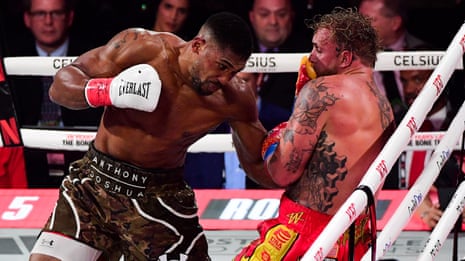 Anthony Joshua calls out Tyson Fury after knockout victory over Jake Paul – video
He is a better boxer than his critics allow, but he is a genuinely brilliant businessman, even if he’s preying on our baser instincts. Paul rattles off his many jobs easily: venture capitalist, chief executive, boxer, entrepreneur. At heart, though, he remains a YouTuber, unafraid of looking stupid on camera in pursuit of views and clout. He has found a lane that uses spectacle to turn notoriety into capital, and boxing, ruthless about exposing frauds, has offered just enough legitimacy to make the enterprise scalable.
What’s funny is that Paul chose a trade that he knew would inevitably find him out. For all his bluster, he knew this night would come. He had simply made peace with it. In the end, Paul gave the worldwide audience afforded by Netflix’s roughly 300 million subscribers exactly the Christmas present it wanted: to see him knocked out brutally. The clip of Joshua fracturing Paul’s jaw in two places during the final assault will almost certainly be the most-viewed piece of boxing content on YouTube before the new year.
The event nearly sold out the 20,000-seat home of the NBA’s Miami Heat, helped by ticket prices that fell as low as $31 by fight night. The atmosphere felt less like that of a boxing crowd than a content farm: phones everywhere, people filming one another in the concourses, strangers wandering into streams and dapping each other up for the camera. Paul’s theatrical ringwalk alongside the widely despised SoundCloud rapper Tekashi 6ix9ine was a calculated provocation, a reminder that outrage still converts. Then came the fight itself. Paul’s gameplan – circling endlessly in a 22-foot ring, avoiding engagement – drew boos within 45 seconds. He was obviously gassed after nine minutes, throwing fewer than 10 punches in each round. Afterwards, Joshua said the right things, but looked almost sad and embarrassed by it all.
So why has it left such a sour taste? Perhaps because sport has always reflected society – boxing most of all – and we probably didn’t like what we saw in the mirror on Friday night. Certainly not at the nadir of the farce, as a pathetic Paul repeatedly threw himself to the canvas without so much as a point deduction, so physically spent from his perpetual retreat that a stiff breeze might have felled him.
Some argue Netflix should be embarrassed for endorsing a fight that may not have been sanctioned in Las Vegas, let alone by the British Boxing Board of Control. But the streaming company didn’t stumble into this moment; it merely identified it early. In an era when the Oscars are decamping from network television to YouTube and live sports have become the last reliably communal media experience, this was a proof of concept in a crucial theatre of the streaming wars. It is no longer unthinkable that the Super Bowl will be off broadcast within a decade. From that perspective, Friday night was less a money-burning sideshow than a strategic investment.
Paul’s entry into boxing may be a net positive. Consider Amanda Serrano, the first fighter he signed to his promotional company. An eight-division champion unknown to all but hardcore boxing fans for most of her career owing to a lack of investment in female fighters, she went from getting paid $1,500 for a world title defence to earning multiple seven-figure purses by riding the slipstream of Paul’s fame. Attention, unevenly distributed, can still redistribute money to the deserving. The four women’s title fights on Friday’s card were the highlight of the show by some distance.
Amanda Serrano, seen here in 2022, signed to Jake Paul’s boxing promotion company in March 2025. Photograph: Ian Hodgson/PA
Things are going well in the world of Jake Paul Inc. He will reportedly earn at least $70m for Friday’s proceedings, possibly more. His fiancee, the Dutch speedskating star Jutta Leerdam, is favoured to pick up a medal in the Olympic 1,000m in two months’ time; together they are in effect that sport’s Travis and Taylor. He is a very good talker, he’s corporate-approved and can do pretty much whatever he wants. I’ll be shocked if he’s not a major-party US presidential candidate in the next 20 years.
Boxing may emerge from the Jake Paul era intact – even improved in places – because it still demands something real: preparation, pain, consequence. What should trouble us more is the world that allowed a 13-fight novice to become a face of the sport built on merit. Paul’s popularity tells us plenty about where we are heading, and it is not to higher ground.