
In Southern Africa, people live alongside elephants, but not always peacefully.The growing reports of human-elephant conflict have triggered calls for elephant culls in some countries, like Zimbabwe.But conservation groups are working hard to promote coexistence, using technology that can warn farmers about approaching elephants or link farmers to more lucrative markets to offset the cost of living with one of Africa’s most charismatic mammals.In all of this, adaptation is the key: Farmers are adapting the way they farm, while elephants are learning to move at night and stick to specific routes through populated areas to avoid conflict.
See All Key Ideas
Elephants are considered a sacred totem by many in northwestern Zimbabwe, but they also frequently raid villagers’ crops near harvest time, says Agripa Ngorima, who has studied attitudes toward conservation in Simangani. During his fieldwork, he presented residents with two scenarios: one in which elephants provided benefits — such as meat, skins for ornaments or safari-industry jobs — and another in which people only incurred costs, including crop losses, fence damage or injury. Their responses diverged sharply: 88% said they would support elephant culls or translocations if they received no benefits, compared with just 20% if elephants supported their livelihoods, and 92% were unwilling to engage in conservation due to lack of financial gain from elephants.
“Any cultural willingness to coexist with elephants is conditional and will be withdrawn if livelihoods are threatened,” Ngorima says.
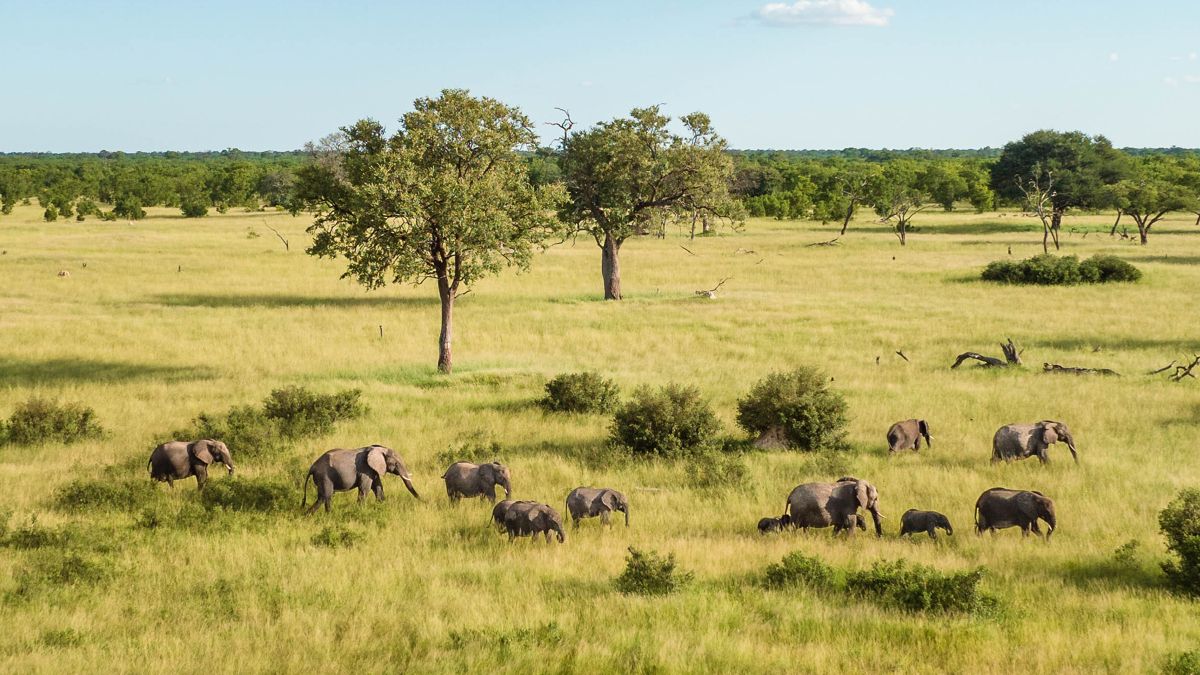 Elephants roam freely from Hwange National Park into bordering communal farming lands. IFAW’s EarthRanger project has tracked the movement of collared elephants, with some ranging more than 200 kms from the protected area and traversing communal land along the way. Image courtesy of Tyson Mayr / IFAW.
Learning to live with elephants
Since his fieldwork in Simangani in 2018, the government and NGOs have introduced outreach programs, teaching villagers about elephant behavior and promoting the cultivation of red-hot chile peppers — plants the animals can’t abide. Yet the most effective deterrent, physical fencing around fields, remains out of reach for most, leaving the majority of households unprotected.
“This implementation gap means the current costs of living with elephants continue to outweigh the benefits for most.”
Tolerance among residents of Simangani and thousands of similar settlements across Southern Africa is strained to a breaking point. When crops are raided, rangers often respond by killing so-called problem elephants. Calls for culling are growing louder, as some ecologists and wildlife managers argue that this part of Zimbabwe has exceeded its carrying capacity, with elephant numbers estimated at just over 61,000 in a 2022 aerial count.
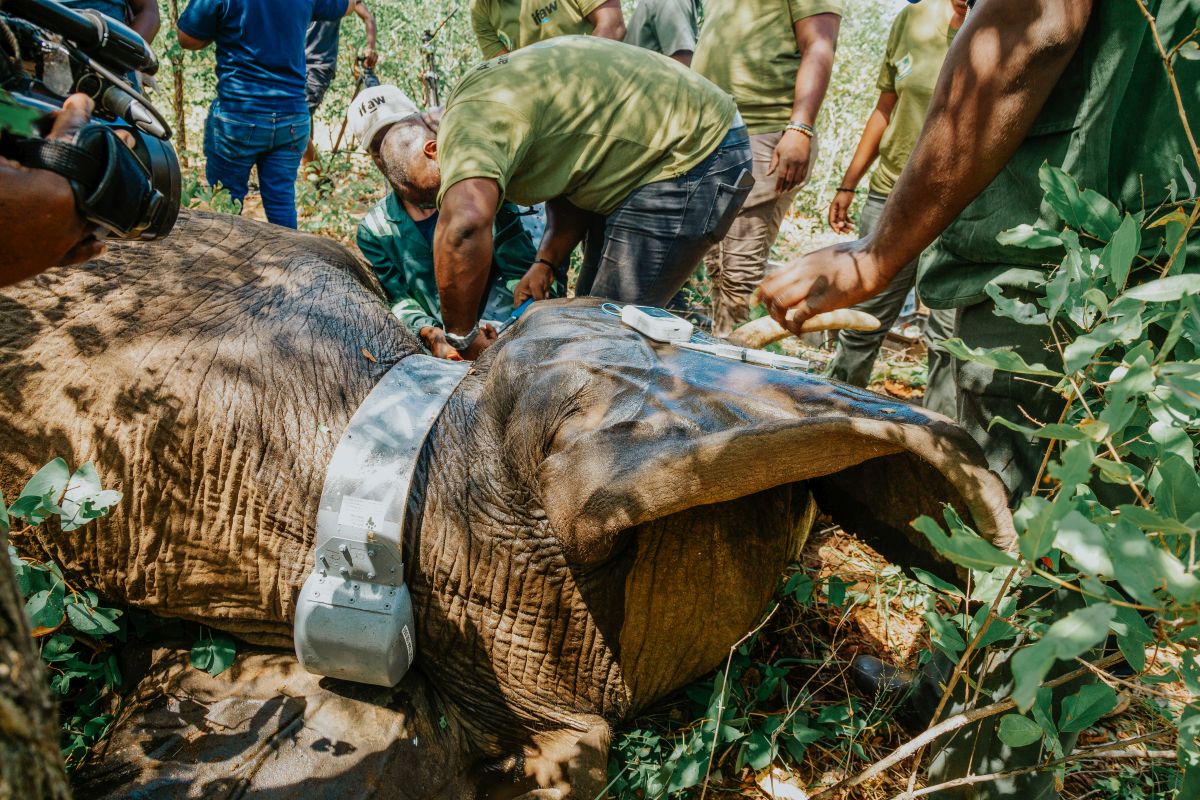 Conservationists fit a GPS collar to an elephant near Hwange National Park, Zimbabwe, to study their movement patterns and promote peaceful coexistence with nearby communities. Image courtesy of Tsvangirayi Mukwazhi / IFAW.
Geofences make good neighbors
Across the region, conservationists are using virtual fencing and tracking collars, phone apps and better land use planning to find ways to help farmers coexist with the animals many still revere.
Around 130 kilometers (80 miles) southwest of Simangani, elephants from Hwange National Park frequently raid fields of maize, sorghum and millet along the park’s borders — but here, technology is providing the area’s more than 14,000 residents with an early warning system.
The International Fund for Animal Welfare (IFAW), a conservation group working with the Zimbabwe Parks and Wildlife Management Authority, has put satellite collars on 16 adult members of the elephant herds found roaming within the farming districts.
With each herd comprising 8-15 animals, it means the movements of around 200 elephants are now being monitored, says Henry Ndaimani, IFAW’s program manager for landscape conservation.
In November, another eight elephants were collared.
The collars transmit signals to a command center at Hwange’s Main Camp; when the elephants breach a geofence — a virtual fence established just outside the park’s border — the computer software system, known as EarthRanger, sends alerts via SMS and WhatsApp to response teams on the ground, who let community members know a herd of hungry elephants is on the way.
Forewarned, farmers can take action to repel elephants. Depending on the time of day, they light fires, shine torches, beat drums or call in the support of national park rangers to fire shots into the air.
The system is still in its early stages, Ndaimani says, and it relies on connections to patchy local cellphone networks. But he’s confident the system will foster coexistence.
“It’s a huge park; we have lots of elephants, so we think the [early-warning] information is going to be very useful, and it’s going to reduce conflict.”
The IFAW manager also says the abundance of elephants in Hwange is a local problem that can be solved by allowing the elephants to move to other areas where elephant densities are lower. To the northeast of Hwange, for instance, lies the Sebungwe region, which includes the southern shores of Lake Kariba. The 2022 survey counted fewer than 3,500 elephants there. If they cut through human settlements to reach those areas, satellite tracking can monitor their movements, and farmers can be warned to respond to minimize conflict.
“We have lots of areas where the elephant density is low,” Ndaimani says. “If they spread, they move to other areas where there is enough forage, there is enough water, we give them a chance to survive.”
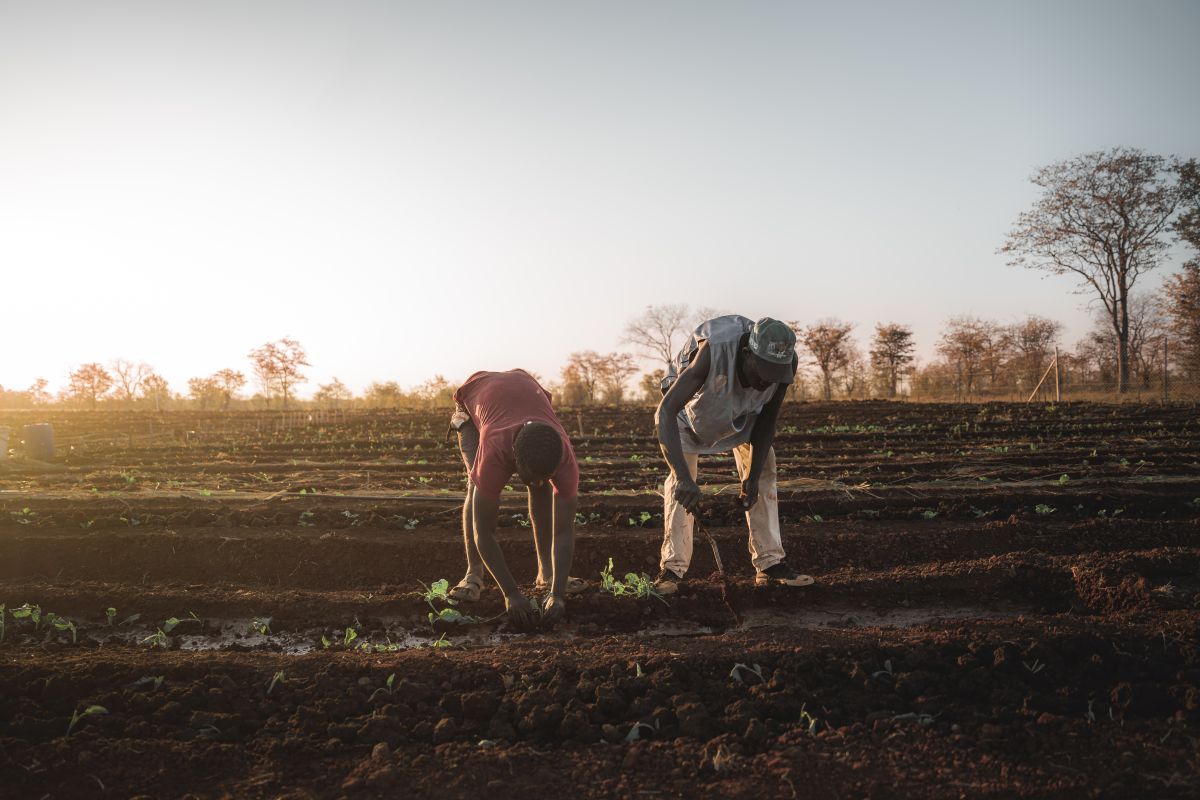 IFAW has established four fenced gardens, each measuring a hectare in size, that benefit a total of 166 households near Hwange National Park. The gardens, supplied with water from boreholes, also make it easier for community members to access water from safe areas, thus minimizing contact between people — mostly women and children — and wild animals like elephants. Image courtesy of Naude Heunis/ IFAW.
Mutual respect
Both Simangani and the districts IFAW is monitoring around Hwange are located within the Kaza-Zambezi Transfrontier Conservation Area, a 50,000-square-kilometer (19,300-square-mile) region spanning northwestern Zimbabwe and parts of four neighboring countries.
KAZA accommodates more than 50% of Africa’s remaining savanna elephants (Loxodonta africana). The conservation area is also home to about 3 million people, most of whom, like the people in northwestern Zimbabwe, depend on agriculture to survive.
To effectively reduce human-elephant conflict in this context, one needs to target farmers, says Anna Songhurst, the chief executive of Ecoexist Trust, a conservation group working on the eastern side of Botswana’s Okavango Panhandle, the long section of the Okavango River that flows down from Botswana’s northern border before it splays out into the famous wildlife-rich delta in the middle of the Kalahari Desert.
An estimated 18,000 elephants slightly outnumber the 16,000 or so human residents here. Every year, at least one person is killed by elephants — and more than 25 elephants are killed by people, Songhurst says.
Her organization has been working for the past 13 years to promote human-elephant coexistence across 8,000 km2 (3,000 mi2). A key strategy is Elephant Aware Farming. Farmers, for instance, respect GPS-mapped elephant corridors — routes that most of the animals take through human-populated areas to reach water, grow crops in cluster farms fenced off and located a safe distance from the elephant thoroughfares, and work to produce higher yields in one place instead of regularly shifting to new areas that could put their crops in the path of elephants.
Adopting varieties of the staple millet, maize and cowpea beans that take a shorter time to mature is another canny way that elephant-aware farmers here avert losses: The crops mature in March, before elephant numbers begin to swell along the Panhandle as ephemeral water pans farther inland dry up in April.
Ecoexist Trust has also developed an app that hundreds of participating farmers use to digitally record their compliance after they sign conservation agreements that give them access to better-paid markets for their produce.
Buyers include the Okavango Brewing Company in the tourist hub of Maun and a milling company supplying gluten-free flour to safari camps to feed their staff and clients.
Some farmers invest those higher earnings in mitigation infrastructure, like small solar-powered electric fences. “You can see that it’s helping to incentivize coexistence behavior,” Songhurst says. “I think it’s got huge potential to have more impact.”
And it isn’t only farmers who are changing their behavior. Most elephants here travel at night to avoid people; they use paths farther away from agricultural land and group together in bigger herds to travel past villages where they perceive a higher level of danger. They even wait for traffic to clear before crossing roads.
“They’re very different from an elephant that you’d find in the middle of the Okavango Delta,” Songhurst says.
She envisages a time when others along the Panhandle can leverage their proximity to elephants to improve incomes, such as local craft makers selling wares to tourists, all part of a bigger “elephant-aware economy.”
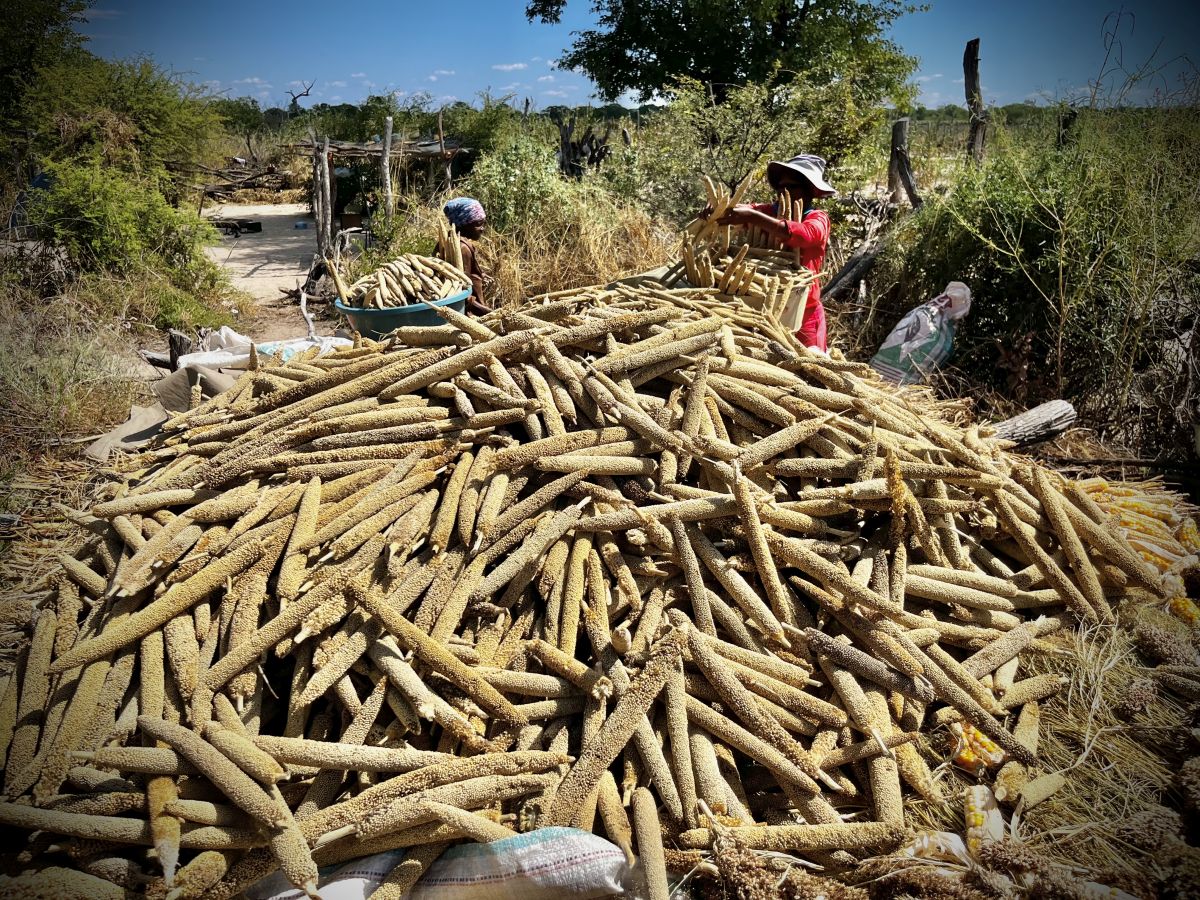 An elephant-aware harvest of millet in Botswana. Certified farmers receive higher prices for their crops in return for expending greater effort in farming to avoid conflict with elephants. Image courtesy of Ecoexist Trust.
Mutual precautions
While elephants outnumber people in that part of Botswana, in places where people outnumber elephants, conflict still occurs.
Beyond KAZA, on the border between the Kunene and Erongo regions in northwestern Namibia, near Namibia’s 2,600-meter-high (8,500-foot-high) Brandberg Mountain, conservation NGO Elephant-Human Relations Aid (EHRA) is working with farmers, both communal and commercial, to promote coexistence in an extremely arid region. The NGO has so far collared five bulls and seven adult females from separate herds among the roughly 150 elephants still living in this area, which once supported as many as 3,500. Though small in number, their desperate search for food and water on farmland can create big problems.
EHRA has set up 180 geofences to protect villages and their lush vegetable gardens from elephant raids. Once crossed, community elephant guards are alerted via WhatsApp and can warn farmers of their approach.
Nonlethal repellents include blasting air horns or shining powerful flashlights as well as amplifying recordings of swarms of bees, which desert elephants instinctively fear despite having little or no direct experience of them.
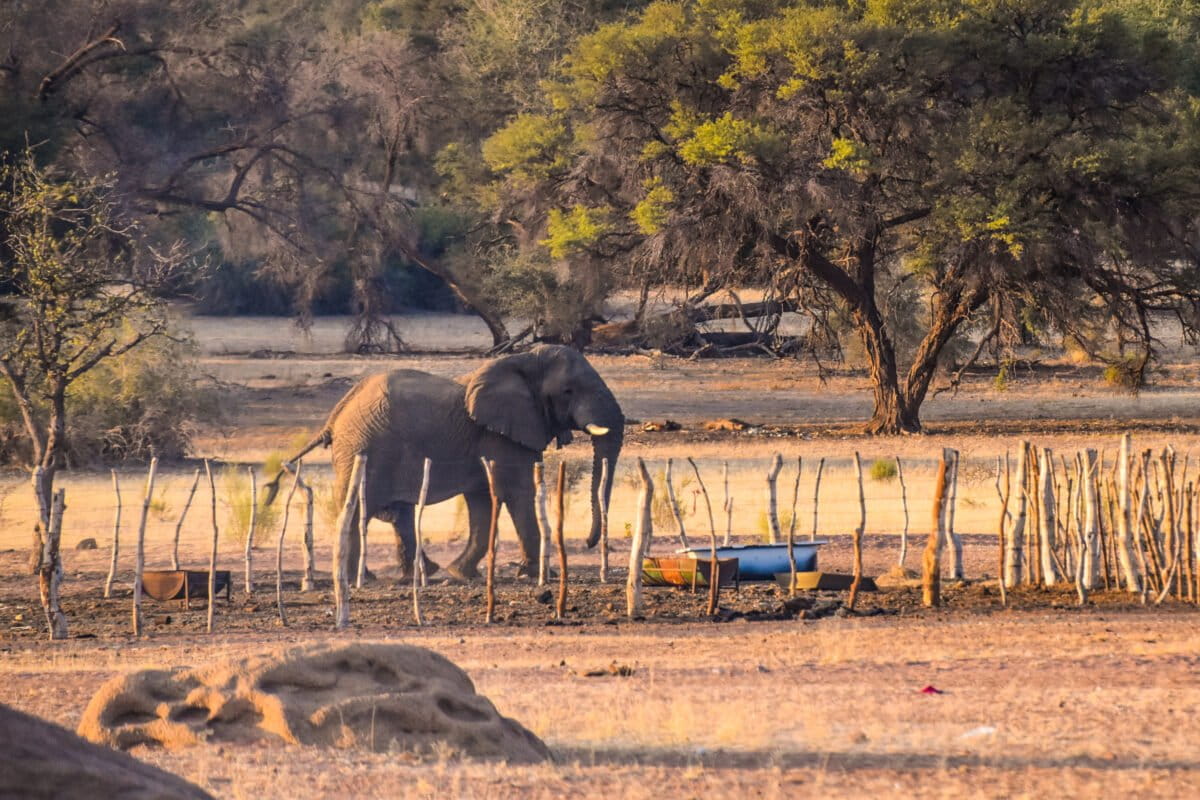
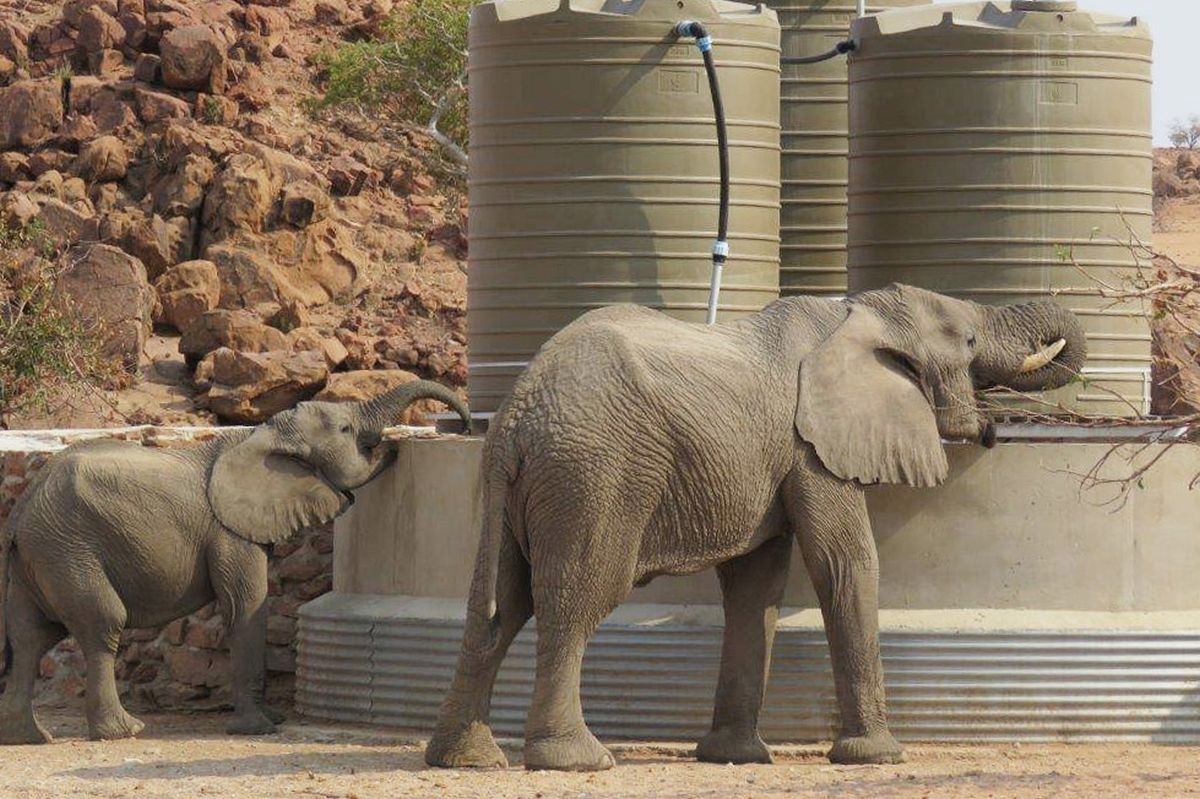 Elephants slake their thirsts at a water tank in a village in Namibia’s Kunene region. Image courtesy of EHRA.
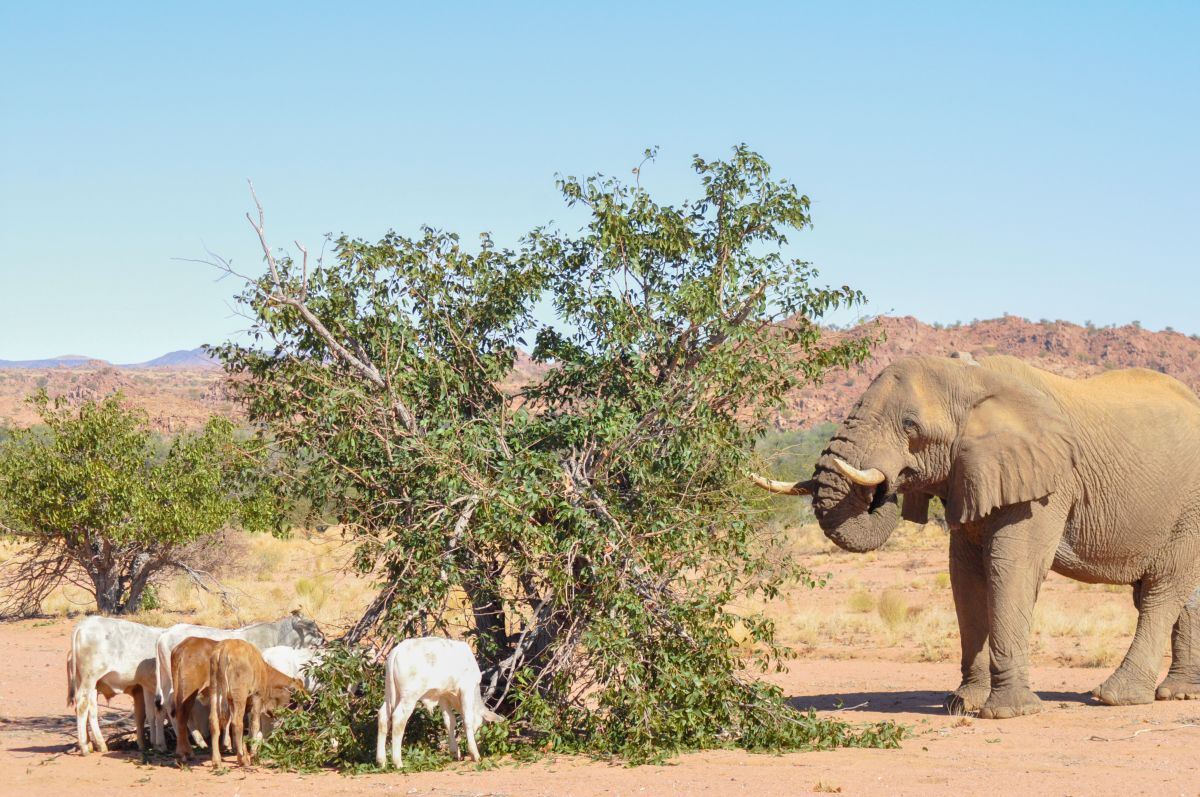 A male elephant collared by EHRA forages on a tree alongside livestock near the Ugab river in Namibia. Image courtesy of EHRA.
The elephants themselves are learning their own survival strategies, says Christin Winter, EHRA’s conservation programs manager. They confine themselves to nearby mountains by day to avoid people and make swift incursions into farms at night to get water.
The mitigation work is vital: Elephants can trash farmers’ gates, fences and water pipes during some of these nighttime forays. But even small actions are proving effective at building trust and promoting coexistence. One farmer fenced off a freshwater spring as an “elephant corner” on his property after EHRA data showed that 80% of elephant movement centered around the natural water source. So far, it’s meant the elephants have stayed away from the rest of his farm.
Replacing diesel-powered pumps in villages with solar-powered ones makes pumping water out of boreholes into communal reservoirs less expensive and therefore less galling for people having to share it with elephants.
The satellite-monitoring work has increased elephant safety: Prevention of crop-raiding and damage to water infrastructure means fewer angry farmers and less retaliation.
“But also, people’s safety has improved by knowing where the elephants roam most of the time,” Winter says.
“Slowly, when the most problematic issues are being solved, you suddenly start to see a shift between complete anti-elephant [sentiment] to more tolerance.”
Banner image: A bull elephant strolls past a fenced rural homestead in Namibia. Image courtesy of Abi Best.
Corridors, not culls, offer solution to Southern Africa’s growing elephant population
Migrating elephants get room to roam via community conservation efforts
Analysis of largest elephant surveys ever shows stable population, but disturbing trends
‘Explorer elephants’ in transfrontier conservation area offer solution to tree damage
FEEDBACK: Use this form to send a message to the author of this post. If you want to post a public comment, you can do that at the bottom of the page.
