
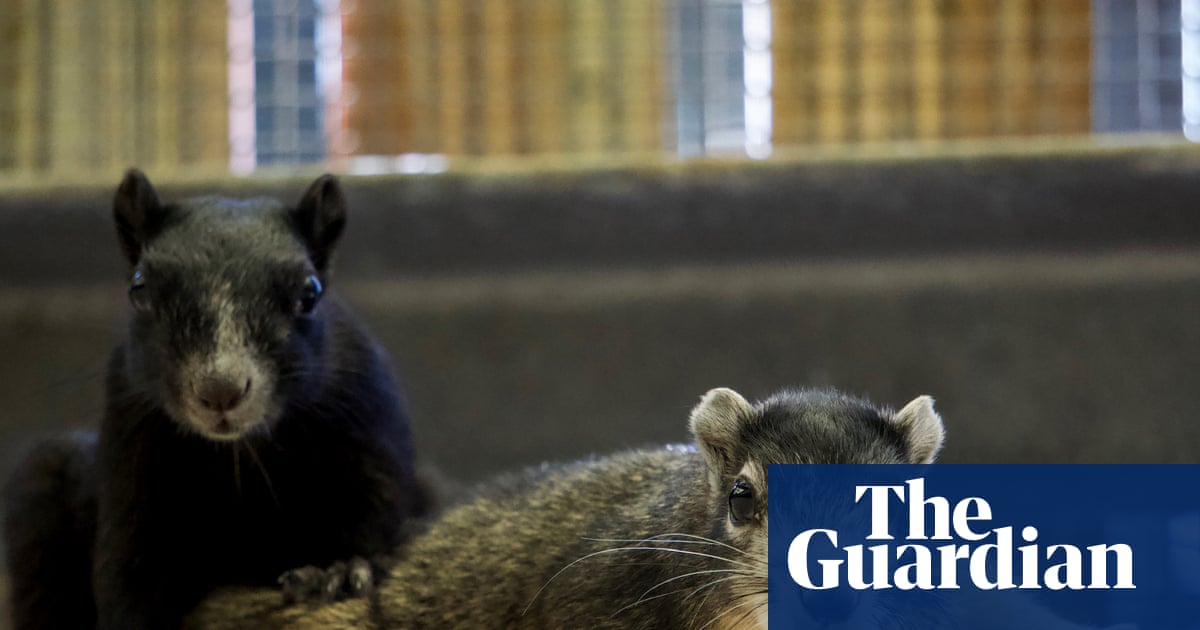
Two “rare and elusive” juvenile squirrels have a new home for the holidays after they were injured falling from their nests and spent several weeks in a Florida wildlife “rehab” facility.
The pair of Big Cypress fox squirrels, a threatened species so uncommon that the Conservancy of Southwest Florida hasn’t treated one in at least a decade, was released back into the wild at a carefully selected site rich in “high-quality pine and cypress habitat” near the nest where one of them was originally found.
The two rodents bonded during their two-month stay at the conservancy’s von Arx wildlife hospital and were set free together to reduce stress and support natural behaviors during their transition back into the wild, increasing their chance of success, said Lauren Barkley, the hospital’s associate director.
“This was a special case for our team. Being able to rehabilitate these rare animals and return them to their natural habitat just before the holidays is exactly why my team and I are inspired to do this work every day,” she said.
Big Cypress fox squirrels can grow up to three times larger than the much more common gray variety of the rodents, and are listed as a threatened species in Florida. Pockets of the animals, which were hunted as game as recently as the 1950s, live in pine and cypress forests and swamps of south-west Florida, according to the National Park Service.
One of the squirrels, believed to have been orphaned, was rescued after it was found approaching people as it searched for food. The other was admitted to von Arx about two weeks later with a nosebleed after it was found following a fall from its nest, although both had injuries consistent with falls from height.
Barkley said they were placed on special diets and housed together, allowing them to develop natural behaviors such as climbing and foraging, and reducing the stress of isolation.
They were moved to an outdoor enclosure to simulate life in the wild, and eventually deemed ready for release after demonstrating their abilities to climb, jump and crack nuts on their own, Barkley added. One had been in the hospital for 74 days, the other for 56.
One of the pair has a striking black and white coat from a genetic mutation known as melanism, which affects fur pigment. The mutation is more common in fox squirrels from colder climates, and rarer in the heat of southern Florida.