
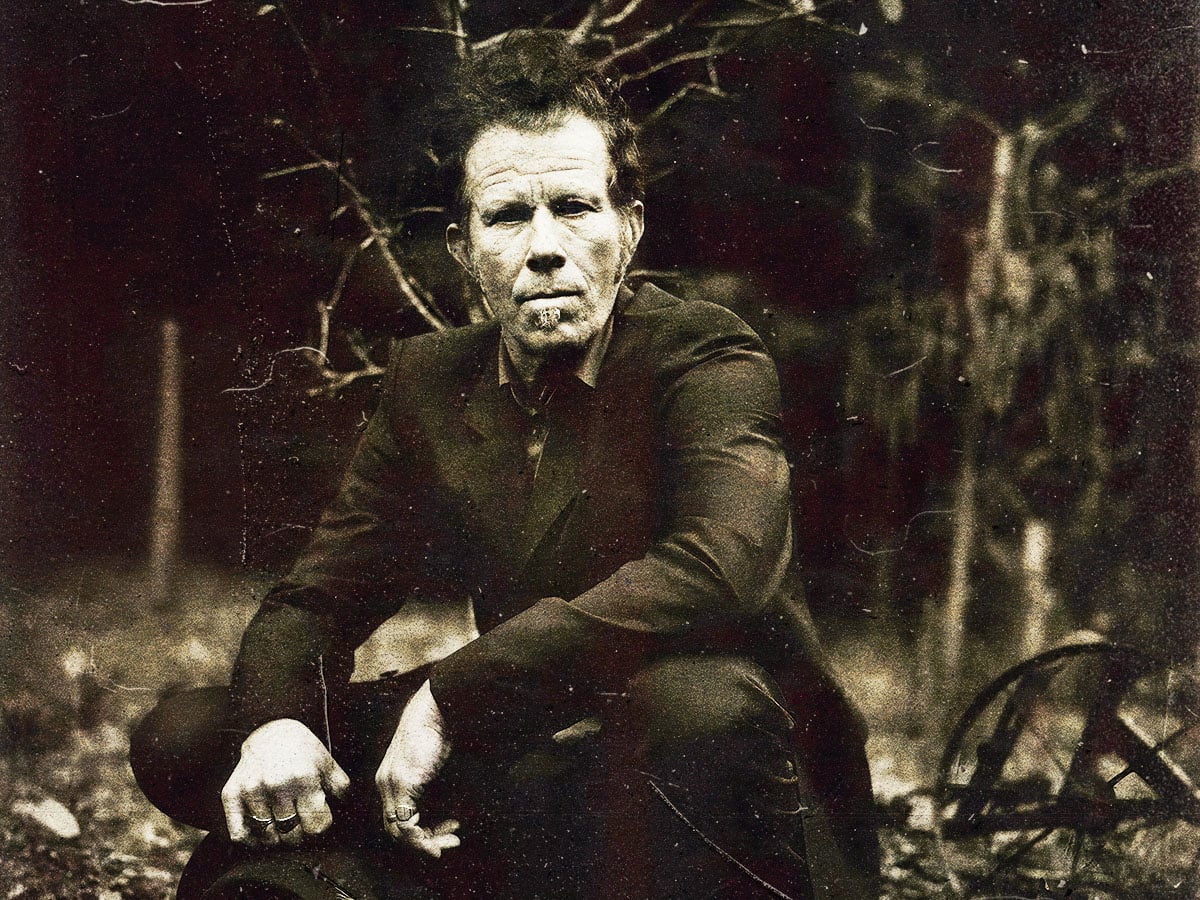
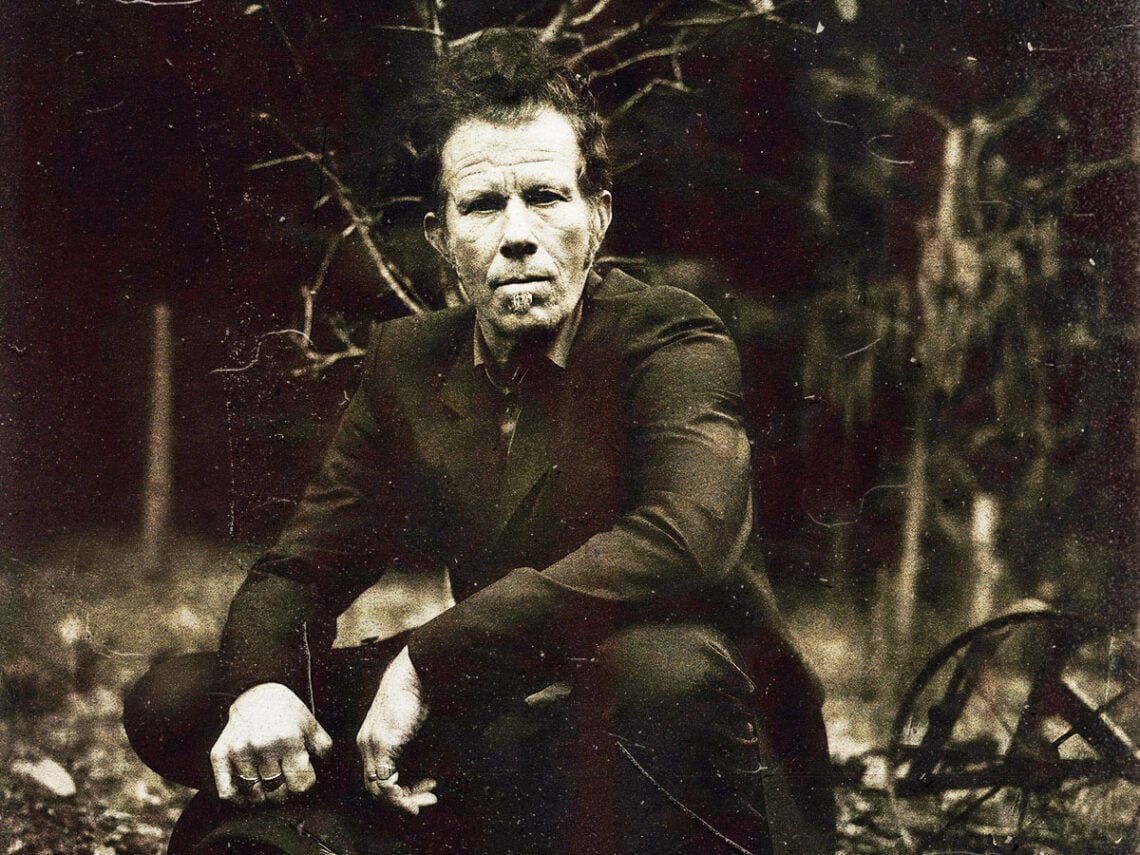
(Credits: Far Out / J.B. Mondino)
Tue 23 December 2025 19:00, UK
If a film is truly great, it will linger for a long time.
Sometimes, when I’m stuck with no signal on the tube or in the deep belly of a forest, I’ll conjure up the fantastical shapes of the shots in Stanley Kubrick’s The Shining, or the visual typography in Tarsem Singh’s The Fall, but a film can be invoked differently; rather than appeasing you, it can, quite frankly, scar you for life, and one knows this better than Tom Waits.
The American singer-songwriter loves film just as much as the next guy, and his experience with the cinema started when he was young, because Waits’s story sounds similar to my own: at seven years old, I spent an evening with a strange babysitter I’d never met before, who put the gaudy, grizzly Hot Fuzz on the television and allowed me to stay up way past my bedtime to see one of the characters impaled through the bottom of his jaw.
Waits’ experience isn’t too far from that, but rather than the comfy confines of a cluttered couch, his took place in a cinema, when at the tender age of nine, Waits admitted that he was already “looking for something, you know, [like when] you see a Fellini movie,” referencing Italian film director and screenwriter Federico Fellini, the man behind dazzling cinematic epics like La Dolce Vita and Amarcord, works that expanded the film industry beyond anyone’s wildest dreams.
But Fellini wasn’t the directorial mastermind behind the film that lingered uncomfortably with Waits, it was Sidney Lumet who directed the 1964 film, The Pawnbroker, which follows a Jewish pawnbroker who loses all faith in his religion and mankind after he was numbed by the experiences in a concentration camp during the Nazi reign.
It’s a film of sharp edges and harsh realities, which ends in profound tragedy that amalgamates the crushing legacy of trauma and guilt, and for a nine-year-old, that’s a hell of a lot to swallow.
Things got weirder for Waits, who was so discombobulated from the experience that he mistook the next screening for a pertinent follow-up to the classic. He admitted, “It was on the bill with – this is really weird – Mary Poppins.” Sure enough, Waits sat through both movies, one after the other, his brain in overdrive, trying to tease out what exactly the link between the two could be: “I thought it was a double bill, and these two films were being presented together. I think it scarred me.” Forget Barbenheimer, this is the real deal.
Mary Poppins, which was also initially released in 1964, at least has a much lighter tone than The Pawnbroker’s rumination on the darkness of the human psyche and the pitfalls of collective responsibility, because the umbrella-riding, happy-go-lucky nanny Mary Poppins who arrives to look after two mischievous children, teaches essential lessons of life through happiness, cheer, and a chimney sweep or two. I know which movie I’d rather watch, nine years old or otherwise.
Related Topics
The Far Out Music Newsletter
All the latest music news from the independent voice of culture.
Straight to your inbox.