
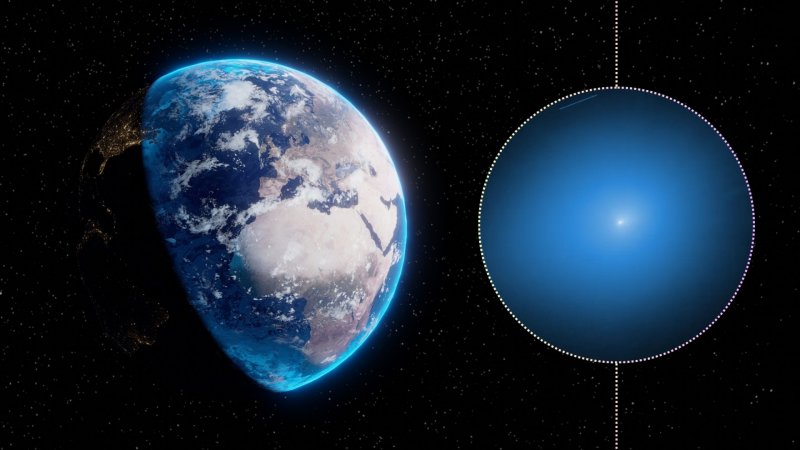
The year 2025 has captivated stargazers worldwide as three remarkable comets surged into the inner solar system, dazzling observers as they endured close encounters with the sun before re-emerging and speeding back into the depths of space, never to return.
Among these celestial visitors — the interstellar object 3I/ATLAS, along with C/2025 A6 (Lemmon) and C/2025 R2 (SWAN) — not all withstood the intense bombardment of solar radiation unscathed, News.Az reports, citing Space.com.
Some fragmented or faded, while others captured global attention, driven by their scientific importance and, in certain cases, by waves of misinformation that circulated alongside legitimate observations.
As 2025 draws to a close, we revisit six of the most unforgettable comet-related moments of the year, highlighted by breathtaking astrophotography, the surprising arrival of an interstellar intruder, and the spectacular destruction of an icy traveler from the distant Oort Cloud.
Interstellar comet 3I/ATLAS
Comet 3I/ATLAS was discovered on July 1, 2025, by the NASA-funded ATLAS telescope in Rio Hurtado, Chile and was quickly confirmed to be just the third interstellar visitor to our solar system, after 1I’Oumuamua and 2I/Borisov.
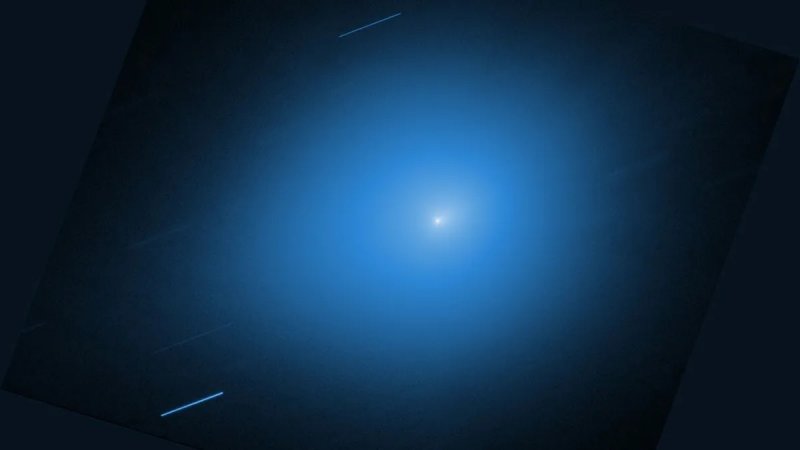 Hubble Space Telescope captured interstellar comet 3I/ATLAS in November (Photo: NASA)
Its exotic nature quickly seized the interest of the scientific community and the imagination of the public while simultaneously sending the conspiracy-peddling community into a frenzy, some of whom claimed that 3I/ATLAS was an alien spacecraft that had voyaged to the heliosphere for reasons unknown.
Follow-up observations confirmed 3I/ATLAS to be the brightest and potentially the largest interstellar object discovered to date, measuring up to 3.5 miles (5.6 kilometers) in diameter, based on observations from the Hubble Space Telescope, according to NASA.
An icy Lemmon
If 3I/ATLAS was the most scientifically riveting of the cometary trio, C/2026 A6 (Lemmon) was arguably the most dynamic and photogenic. Comet Lemmon was discovered on Jan. 3 earlier this year and swiftly became a popular target among the astrophotography community, as it brightened from +21.5 to naked eye visibility around its close approach to the sun —known as perihelion — on Nov. 8.
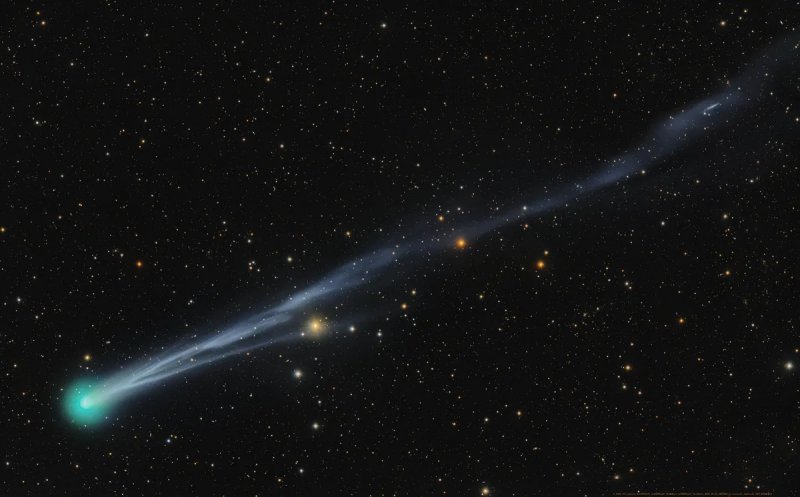 A view of Comet Lemmon on September 20th (Photo: Dan Bartlett)
Astrophotographers kept C/2026 A6 (Lemmon) firmly locked in their field of view throughout its journey, capturing each stage of its dramatic evolution. As it approached the sun, the increase in heat radiation caused icy matter in the comet’s central nucleus to sublimate into gas, dragging dust particles with it.
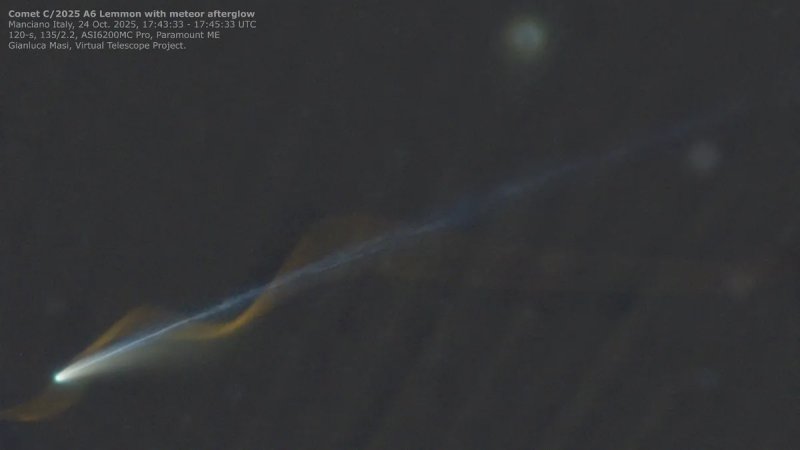 A glowing meteor trail appears to wrap around the tail of Comet Lemmon as seen by astronomer Gianluca Masi of the Virtual Telescope Project on Oct. 24. (Photo: Gianluca Masi, Virtual Telescope Project)
The resulting cloud of cometary debris was then snatched up by the charged particles pouring out from the sun — called the solar wind — giving rise to a spectacular tail.
Astronomer Gianluca Masi captured a rare shot of the cosmic wanderer, when a glowing meteor tail in Earth’s upper atmosphere appeared to wrap itself around Comet Lemmon’s distant tail as it passed through the constellation Serpens on Oct. 24, creating a “a pure perspective miracle”.
A cosmic SWAN
While Comet Lemmon’s complex tail snagged the attention of astrophotographers worldwide, others took aim at the solar system wanderer C/2025 R2 (SWAN), which put on a magnificent show on Oct. 17, as it passed in front of the Eagle Nebula in the constellation Serpens.
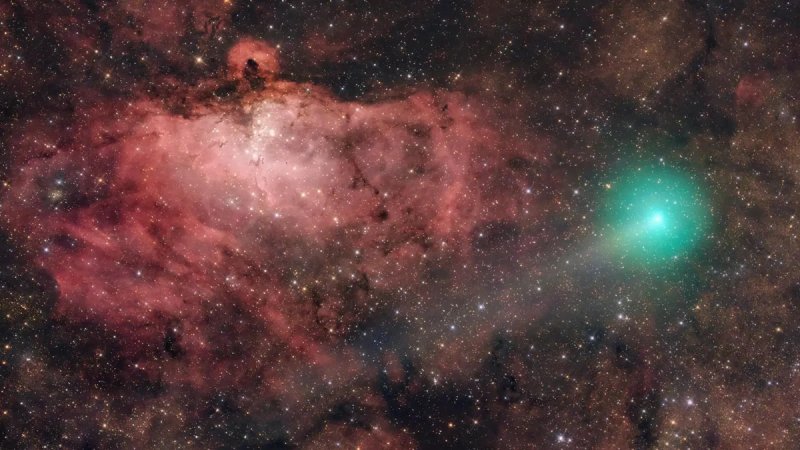 Comet C/2025 R2 (SWAN) glows alongside the Eagle Nebula. (Photo: Daniele Gasparri)
Daniele Gasparri captured a striking view of C/2025 R2 (SWAN)’s vivid green coma as it hung in the pristine skies above the Atacama Desert in Chile, with the vast emission nebula serving as a jaw-dropping backdrop for the cometary body.
The pillars of creation, vast columns of interstellar dust and gas shaped by the radiation of nearby stars and made famous by the Hubble Space Telescope, can be seen nestled in the glowing heart of the vast nebula, to the left of the comet’s glowing central nucleus.
Comet 3I/Atlas reaches perihelion
Oct. 30 marked the climax of interstellar traveller 3I/ATLAS’s headlong charge into the inner solar system, as it made its closest approach to the sun, passing 125 million miles (202 million km) from our parent star at the point of perihelion.
The event occurred just as 3I/ATLAS flew behind the sun from the perspective of Earth, robbing some of humanity’s most powerful observatories of the chance to analyze the comet’s chemical composition as it reached a peak of activity. Thankfully, perihelion was observed from elsewhere in the solar system by a flotilla of spacecraft orbiting Mars and travelling through interplanetary space.
3I/ATLAS finally emerged intact from behind the glare of the sun to become visible to Earthbound astronomers and skywatchers in early November, though it remained too dim to spot with the naked eye.
NASA subsequently held a press conference on Nov. 19 following the re-opening of the federal government, where it revealed several new images of the interstellar invader that documented its glowing central nucleus, sun-facing jet and growing tail. Conspiracy theorists were left somewhat broken-hearted by NASA Associate Administrator Amit Kshatriya, who noted, “It looks and behaves like a comet, and all evidence points to it being a comet”, as opposed to the technologically advanced spaceship suggested by others.
K1 Atlas breakup
One of the most dramatic cometary moments of 2025 occurred on the night of Nov. 11, when astronomers tracked the solar system comet C/2025 K1 (ATLAS) as its central nucleus broke into three massive pieces, following its close pass of the sun on Oct. 8.
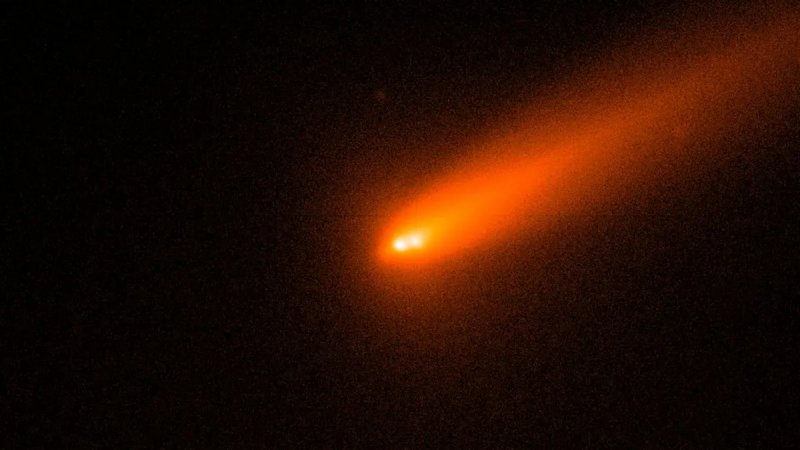 Comet C/2025 K1 (ATLAS) caught fragmenting by the 1.82 m Copernicus telescope at the Asiago Observatory in Italy (Photo: F. Ferrigno/INAF/Univ. Parthenope)
The comet may have crumbled during its first visit to the inner solar system from the shell of icy material which surrounds its outer edge, known as the Oort Cloud.
The increase in heat radiation experienced during perihelion may have created a violent and sudden outflow of material from the nucleus, which could have undermined its structure, leading to the fracturing seen on Nov. 11, according to Elena Mazzotta Epifani of the Italian National Institute for Astrophysics.