
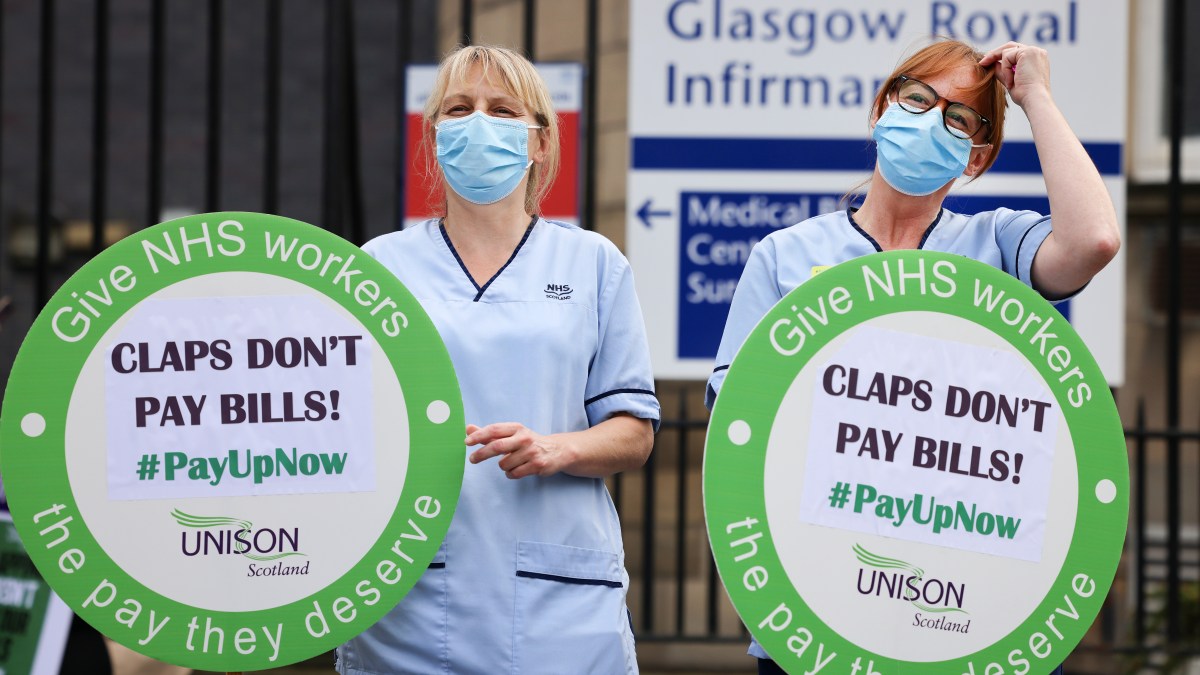
Almost 170,000 NHS staff in Scotland are to receive another pay rise due to the activation of an “inflation clause” agreed by SNP ministers to avoid strike action.
Scottish NHS workers secured a 4.25 per cent pay rise in 2025-26, and union negotiators demanded a stipulation that the final settlement must end up higher than a running average of monthly consumer prices index (CPI) inflation rates, plus 1 per cent, between January and December of this year.
With only figures for December to come, it is highly likely the clause will be activated, meaning thousands of healthcare workers will receive a backdated, lump sum in their March pay packets.
Although the size of the individual payments is expected to be low — amounting to an additional 0.15 per cent of overall pay — it would still cost the government about £12 million.
The award will also be baked into future salaries, as it is treated as a permanent increase rather than a one-off compensation payment. It comes in addition to NHS workers having their weekly working hours cut by 90 minutes due to concessions won in previous deals.
The inflation clause is also set to benefit Scottish Prison Service (SPS) staff, whose representatives negotiated a similar deal.
It will also remain in force for next year, as NHS and SPS staff have already secured a 3.75 per cent pay rise for 2026-27. Every 0.25 per cent uplift required as a result of the inflation guarantee would cost the taxpayer £23.25 million a year.
SNP ministers are continuing to negotiate with resident doctors, formerly known as junior doctors, over pay. Unlike NHS staff such as nurses, midwives and porters, doctors and consultants negotiate their pay awards separately.

John Swinney’s government has a pay deal with nurses and other NHS staff but is facing a strike by resident doctors in January
JANE BARLOW/PA
The dispute, which as it stands would result in resident doctors walking out between January 13 and January 17, arose after the BMA rejected the deal accepted by other NHS workers. The union accused the SNP of reneging on a promise to make “credible progress” towards restoring real terms pay to 2008 levels.
Matt McLaughlin, head of health at Unison Scotland, said: “It is always hard to predict inflation over the winter months, but at present it looks like the pay agreement Unison struck with government could result in a very modest additional uplift for tens of thousands of NHS workers in Scotland,” .
“An additional uplift of less than 1 per cent is unlikely to excite NHS workers who are being worked into the ground by this government. But it is an important principle that pay deals should be able to keep ahead of inflation, particularly when inflation and the world economy is so volatile.”
While the £12 million ministers are likely to have to find is expected to be manageable, the inflation clause puts the public finances at risk in the case of unforeseen or unpredictable global events. For example, Russia’s invasion of Ukraine caused CPI inflation to spike to 9.1 per cent in 2022.
Had the inflation clause been in place then, 170,000 NHS workers would have been entitled to an immediate and permanent 10.1 per cent pay rise.
If NHS workers had received a 4.25 per cent pay rise in 2022-23, as they did this year, the clause would have cost the government about £400 million.
Large public sector pay deals have been cited by experts as a reason for a projected £5 billion hole in the Scottish government’s finances by the end of the decade.
A Scottish government spokesman said: “We are ensuring that our hard-working nurses, midwives and other healthcare staff are protected from inflation, thanks to the NHS Scotland Agenda for Change (AfC) 2025-27 pay agreement.
“The final CPI figure for 2025 has not yet been published by the Office for National Statistics, but if an uplift is required, pay rates will be adjusted to include back pay.”