
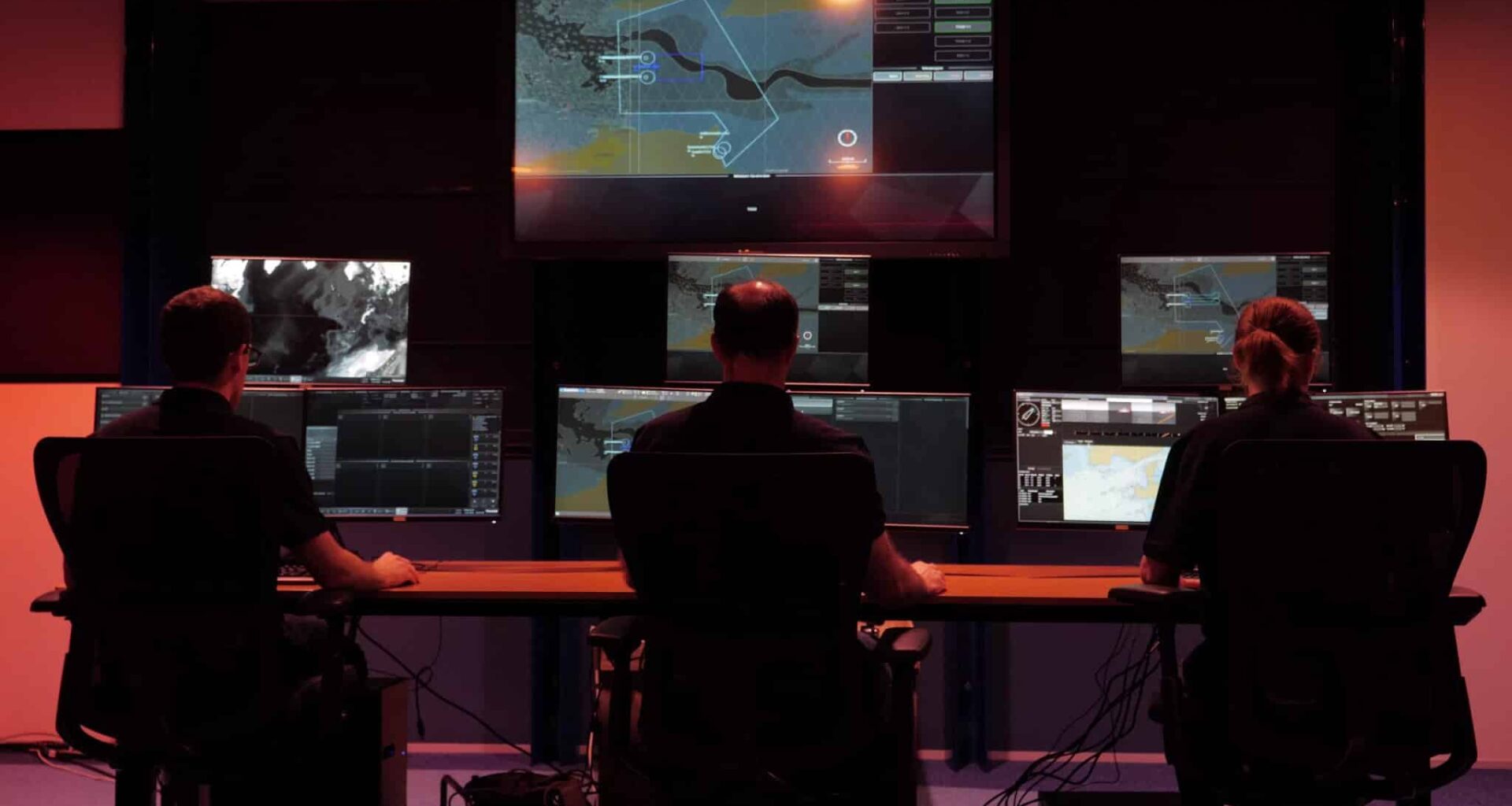
The UK Ministry of Defence (MoD) has contracted Thales to design, develop, and deliver portable, remote command centres (RCCs) to help transform the Royal Navy’s (RN’s) mine-hunting capability (MHC) and broader seabed warfare capacities through enhanced use of autonomous systems.
The contract – issued by the MoD’s Defence Equipment & Support (DE&S) acquisition organisation – is valued at up to GBP100 million, will run for three-and-a-half years (with options for extension), and will deliver up to eight containerised RCC units. It covers supply of hardware, software, training, and technical advice to support delivery and integration of the RCCs and wider MHC equipment, Thales said in a 29 December statement. Within the overall contract, an initial phase – covering RCC design completion by late 2026, plus establishing the programme’s core management – is valued at GBP10m.
“The requirement [is] to integrate the currently disparate and separately controlled range of key MHC platforms and autonomous capabilities into the Thales maritime mine-countermeasures (MMCM) RCC to deliver a single, unified RCC, thereby allowing integrated command, control (C2), and operation of the full range of MHC platforms, systems, and sub-systems,” David Hunkin, Thales UK’s Mine Warfare Capture Director, told Naval News.
In its June 2025 Strategic Defence Review (SDR), the MoD noted that rapid evolution of the RN’s MMCM capability through harnessing autonomous platforms would be central to the service’s transformation into a ‘hybrid navy’.
In its statement, Thales explained the integrated impact of its M-Cube mission management software, Mi-Map database, and cortAIx artificial intelligence (AI) applications as the core of the RCC concept. M-Cube – already in service with multiple navies, providing planning, execution, and evaluation options for conventional and autonomous MMCM missions – brings maritime situational awareness (MSA) from task force to unit level. Mi-Map and cortAIx combine as the other components, Mi-Map building a database of raw data, which when filtered through cortAIx provides more accurate and streamlined information more quickly to support MHC including through (for example) automatic target recognition.
The package of integrated software and enabling hardware will be deployed onboard ships – or ashore – as a containerised, modular solution connecting platforms, systems, and sub-systems. It will enable RN operators to co-ordinate a multi-domain fleet of autonomous and remotely operated uncrewed systems.
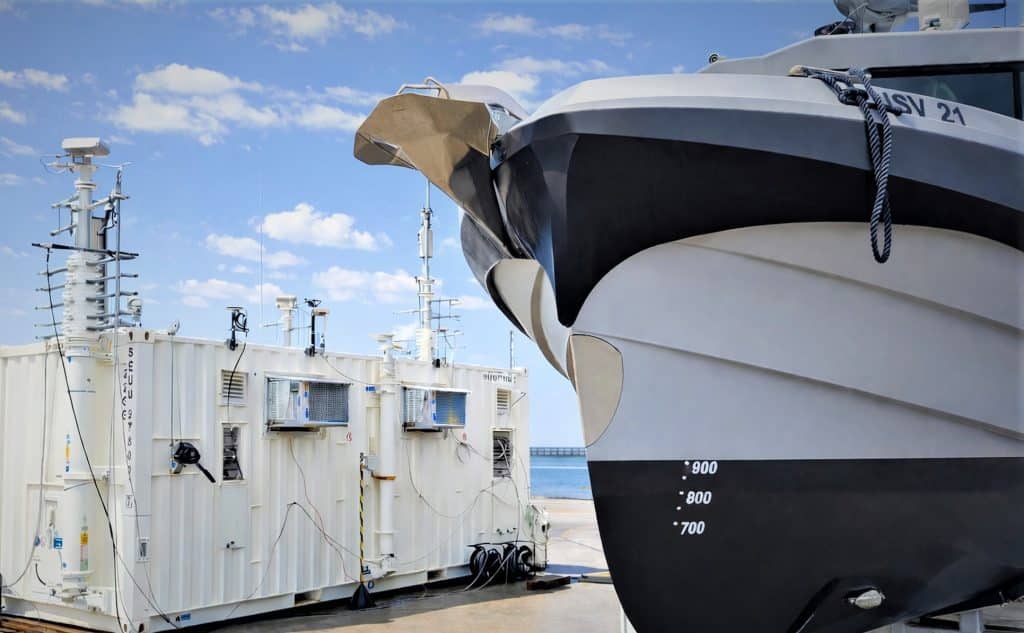
The RCC concept is based around using containerised packages, deployed at sea or ashore, to conduct integrated C2 of the full range of MHC crewed/uncrewed platforms, sensors, and effectors. Thales UK picture.
Capability concept
Autonomous capabilities that deliver MMCM and other seabed warfare effects are integral to enabling the RN and its NATO naval allies to deter threats to freedom of navigation at sea in what are now highly contested waters across NATO’s area of operations. Freedom of navigation includes being able to secure access to maritime choke points, littorals, and ports and harbours, plus being able to transit unimpeded across open waters: strategic-level sea lines of communication, including seabed critical infrastructure like data cables, thread their way throughout these seas.
Capability to deter threats to freedom of navigation can be enhanced by building more efficient and effective sensing presence and mass using uncrewed systems. Integrating maritime uncrewed systems more routinely into crewed system operations – the intent of the MMCM RCC concept – enhances mass while also offering faster and more adaptable operational response.
Delivering operational outputs through combining platforms (crewed/uncrewed), sensors, and effectors represents a ‘system of systems’ approach. In this context, the MMCM RCCs will operate as ‘hub’-style command centres for integrated C2 of various uncrewed systems.
The RCCs’ modular hardware construct and software architecture also support the MoD’s rapid capability adoption and spiral acquisition requirements, enabling upgrades based on operator feedback and technology advances and providing adaptability for future mission requirements.
Hunkin said the RCC concept is based around the containers being portable and adaptable, with their internal configuration designed for maximum flexibility. “This allows the RN to tailor according to the specific requirements of each deployment. The modular design approach ensures the solution can readily accommodate a range of payloads, supporting current and evolving operational needs,” he added.
M-Cube’s use at the RCC concept’s core – especially to integrate different uncrewed vehicles – reflects its inherent modularity and versatility as a mission management system required to deliver C2 of different platforms (crewed/uncrewed), systems, capabilities, and effects.
“The development focus has been on ensuring the system can easily interface and work seamlessly with external partners’ systems. This is essential for collaborative operations and future proofing,” said Hunkin. “This flexibility ensures the RN can readily integrate both new and legacy systems as requirements or technologies evolve. Whether the RN selects traditional manned platforms or newer uncrewed/autonomous vehicles, the integration approach allows for rapid adaptation, interoperability, and scaling of capabilities.”
“M-Cube’s open, modular architecture ensures it can integrate seamlessly with various uncrewed systems, both currently in service and anticipated in the future, providing the RN with the flexibility to adapt to evolving operational requirements,” Hunkin added.
The various uncrewed systems can be provided by different suppliers. Hunkin told Naval News Thales is collaborating with experienced industry partners to bring together the best capabilities to ensure the RN’s solution is flexible and future-ready.
The RCC concept and capability is a first step for the RN in its transformation towards enhancing the contribution of uncrewed systems to MMCM operations and (as set out in SDR) developing more broadly a ‘hybrid’, crewed/uncrewed naval force structure. “We are generating vital lessons that will inform wider transformation across the fleet,” Hunkin explained. “In the initial phases, current mine countermeasures vessels (MCMVs) will continue to operate alongside autonomous systems, ensuring continued operational effectiveness while enabling a smooth and informed transition.”
Naval News comment
The RCC concept – integrating C2 of crewed/uncrewed systems, sensors, and effectors but in a portable, deployable construct – underlines the RN and wider NATO naval focus on building both multi-domain and distributed operational capability at sea. Such containerised, distributed capacity enhances rapid response – something NATO has found to be particularly needed over the last year, given for example the emergent need to deploy packages of sensing capability and C2 to respond to threats to critical underwater infrastructure (CUI). Uncrewed systems (remotely operated and autonomous) used for MMCM bring significant sensing-and-effect capacity for countering CUI risks.