
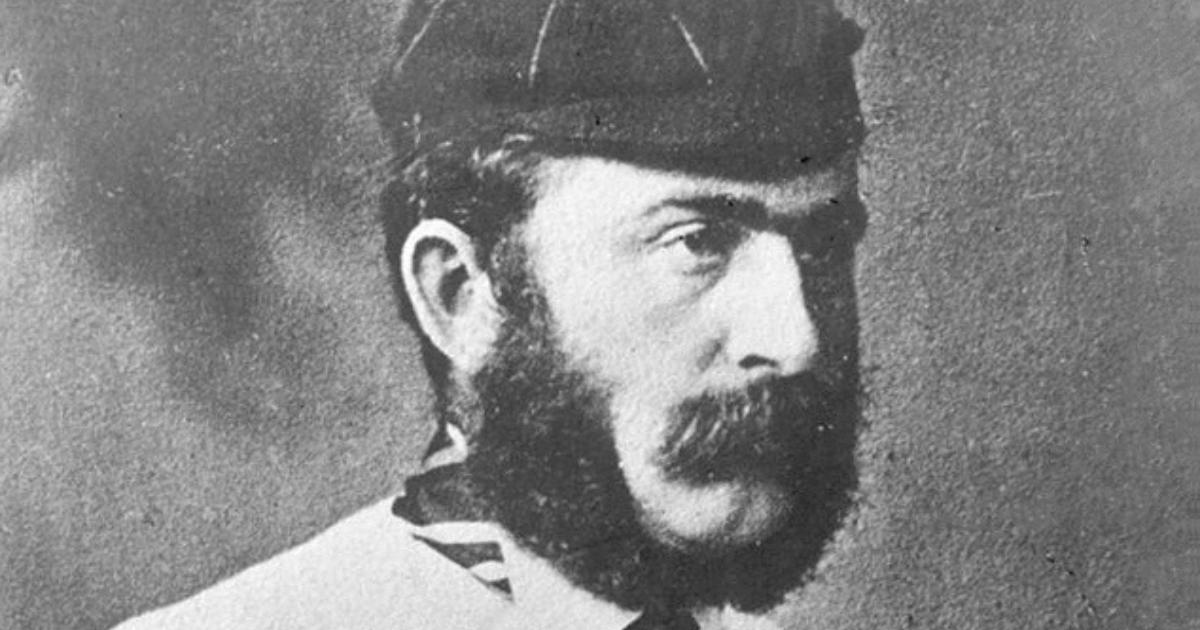
James Lillywhite jnr was born in West Hampnett on February 23, 1842, and died in Chichester, on October 25, 1929, at the age of 87.
A pioneering figure in the early years of international cricket, he led the England team in the very first Test match ever played.
According to the Wisden Cricketers’ Almanack, Mr Lillywhite was a slow left-arm bowler known for his high, accurate delivery. He was also a hard-hitting lower-order batsman and a reliable fielder. He came from a notable cricketing family with five close relatives who also played for Sussex.
The English cricket team in 1876 before its tour of Australia, with Captain Lillywhite in the centre (Image: Wikimedia)
Between 1862 and 1881, he played in every game Sussex contested. He toured Australia six times, captaining England in the historic 1876-77 tour.
There had been previous teams to tour the Antipodes, but not until March 1877 did the Australians regard themselves as strong enough to engage an English eleven on level terms.
Australia won the first Test by 45 runs, but in the return match played soon afterwards, England won by four wickets.
Of the 22 men who played in that historic game, only three were alive at the time of Mr Lillywhite’s death and all were in Australia: Charles Bannerman, J. McCarthy Blackham, and Tom Garrett.
James’ uncle William Lillywhite, who was also a famous cricketer (Image: Wikimedia)
Mr Lillywhite’s uncle, William Lillywhite, known as “The Nonpareil,” a renowned cricketer himself, was also born in West Hampnett and had a long career playing for Sussex.
James Lillywhite jnr. made his debut at Lord’s in June 1862 in a match between Sussex and the Marylebone Cricket Club, where he took 14 wickets for 57 runs – including nine wickets for 29 runs in the second innings.
He bowled unchanged through an entire match 12 times for Sussex.
A painting of a match held at The Level in Brighton in 1849, when it was a cricket ground (Image: Wikimedia)
Three of those occasions came in consecutive games in 1873 – against Surrey at The Oval, Kent at Lord’s, and Gloucestershire at Brighton.
In other notable matches, he bowled without a change for the Players of the South against the Gentlemen of the South at Southampton in 1865, and for South against North at Liverpool in 1872.
James Lillywhite jnr., the first man to captain England in a test match (Image: Wikimedia)
During his early tours of Australia, he produced outstanding bowling figures.
In 1873-74, he took 18 wickets for 72 runs against New South Wales and Victoria at Sydney, and 12 for 61 against Victoria at Melbourne.
Three seasons later, he claimed nine wickets for 23 runs against South Australia at Adelaide.
His best seasons came in 1872 and 1873, when he took 94 and 101 wickets respectively, at an average of 13 runs each.
In 1876, he claimed 91 wickets at 14 runs each.
Lords, known as the Home of Cricket, where Lillywhite jnr. made his debut (Image: Wikimedia)
A versatile player, Mr Lillywhite also made his mark as a batsman.
He scored two centuries for Sussex – 105 against Hampshire at Brighton in 1864, and an unbeaten 126 against Middlesex at the Old Cattle Market Ground in Islington.
He played his first match for Sussex in 1862 and his last against Yorkshire in 1883, taking 917 wickets for the county at an average of 14.75.
Mr Lillywhite also visited the United States and Canada in 1868.
The legendary WG Grace, who James Lillywhite played under (Image: Wikimedia)
His visits to Australia began in 1873-74 as a member of the side led by the legendary W.G. Grace.
He returned as captain in 1876-77 and made four subsequent tours.
Later in his career, he focused on the business side of these tours, partnering with Alfred Shaw and Arthur Shrewsbury.
He served as secretary of the United South of England XI for some years and later established a reputation as a more than capable umpire.
The Australian team of 1899, who Lillywhite jnr. played against (Image: Wikimedia)
Mr Lillywhite benefited from two testimonial matches during his career.
The first, held in Brighton in 1881, featured a dramatic match in which both the Players and the Gentlemen scored 204 runs in their first innings.
He took 35 wickets in Gentlemen v Players matches at an average of 20.
His second benefit match was North v South at Chichester in 1889.
He also arranged the fixture lists for the first two Australian teams to tour England in 1878 and 1880.
He died in Chichester, the last English survivor of the first Test match.