
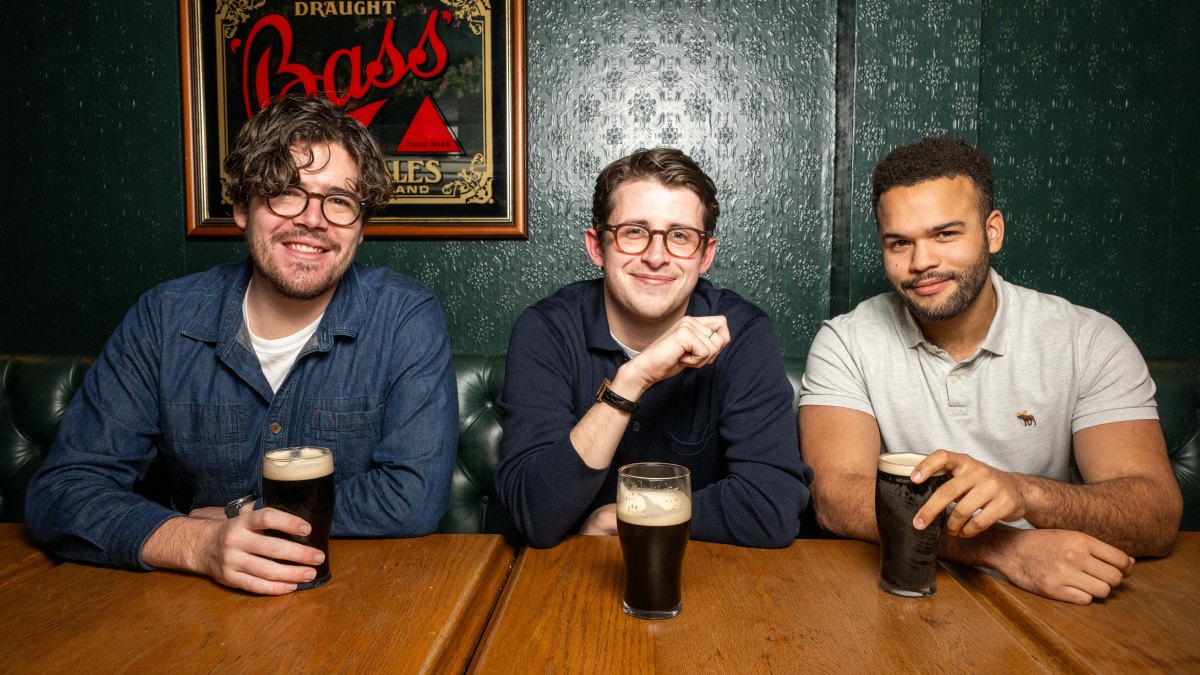
It was August last year and Charlie Cooke and his friends were pondering a seemingly unanswerable question. How long would it take to drink one million beers?
Cooke, 31, from London, formed a WhatsApp group to count. He added his friends, went to the cinema and by the time he turned on his phone aftera the film, it had crashed. Hundreds had joined his “One Million Beers Please” group.
As of Monday evening, the group — which now goes by OMBP — had collectively drunk over 105,000 beers. It is still counting.
In the 14 months since they began, rival group chats have sprung up, all with slight variations on the same theme: racing to one million beers.
A group of Scots at 20,000 beers have booked an anniversary trip to Octoberfest; a group with a strong Spanish contingent have surpassed 48,000; and a group of Bahamas-based Americans are hoping to pass 40,000 on New Year’s Eve.
The format of each chat is simple: post a photo of your beer and number it. Other rules have evolved: no “chat” or messages are allowed, only interact through a system of emojis, photos with the wrong numbers will be deleted by a team of admins.
WhatsApp limits the number of people in one group chat to 1,024 but, as anyone can add their friends, the people in each of the group chats constantly fluctuate.
Several of the groups have started introducing “culls” in which inactive participants are removed, making way for better contributors.
Cooke, who believes his group is the original, has members all over the world. They have in-person socials, a logo, and merchandise that he sends as prizes — an incentive to keep people posting.

He said he has seen photos ranging from a fisherman from Papua New Guinea holding his catch in one hand and a beer in the other, to a new father holding a pint next to his newborn baby in a hospital delivery room. This month he woke up to a video of a Texan pouring the 100,000th beer over his head.
Cooke, who only drinks once or twice a week, said, “I don’t really think it’s about drinking to excess. I think people like the community more than they like drinking a lot.”
The monthly prizes reward engagement, such as high interaction through emojis or the funniest photos, rather than the biggest drinker.
He said scrolling through the photos on the chat was more “authentic” than social media and had none of the vitriol, “You don’t even get a chance to talk about what divides you. You can only bond over what you share, which is that you enjoy going to the pub, basically.”
On the copycat groups, Cooke said, “I’m not threatened. I’m quietly confident.” At its current pace, he is due to be 44 before the group chat reaches one million beers. “I would defy any other group to do it in under 12 years,” he said.
A rival group, also based in London, who go by 1MB (1 Million Beers), only started in August but had surpassed 45,400 beers at the time of writing.
They claim to have a quicker drinking rate than Cooke’s group, at an average of 303 beers per day compared to Cooke’s 213, despite only allowing one beer per photo.
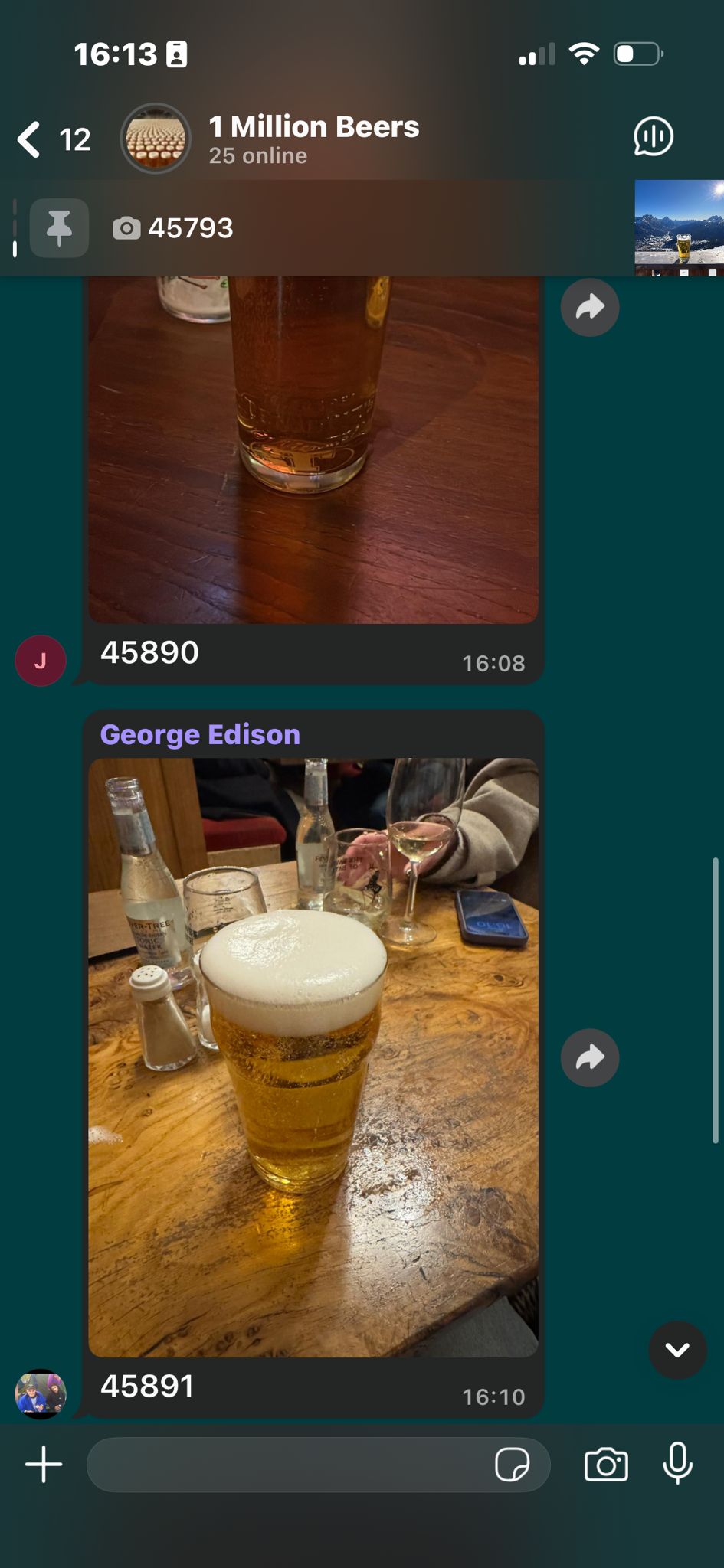
Although their photos have announced proposals and featured celebrities such as Gabby Logan and Steven Gerrard, the newer group is focused on efficiency, rather than creativity.
Their data analysis informs their culling of inactive members and their recruitment of admins to monitor the beer numbers in every time zone.
While OMBP keeps a dashboard with a running tally, the newer 1MB has an extensive spreadsheet recording thousands of data points. Such points include daily, weekly and monthly performance of the total group and top drinkers, the projected finish date (May 11, 2033), and membership information of how much each person contributes.
Their record week saw 4,480 beers drunk and their top drinker, Henry, who preferred not to give his surname, has posted 587 beers since August, an average of 4.1 a day.
Toby Trumper, 26, from Hampshire, an auditor, said their priority was getting all 1,024 members to post.
“Even on our highest ever day, we had 300 out of 1,000 people posting, so each person’s posting about two and a half pints, but there’s still 700 people who are not posting,” he said. “I think if we can get that unique post number up, that’s where it will just completely change the whole growth rate.”
After a few bumper weeks of beers, all group chat admins said they were expecting a decline during Dry January.
The pub industry was grateful for the trend, which kept people coming through their doors amid significant closures and Gen Z drinking less than previous generations.
Emma McClarkin, chief executive of the British Beer and Pub Association, said, “It’s clear that the love of a pint and the pub is as strong as ever, with people finding new ways to connect and appreciate a good beer at their local.”