
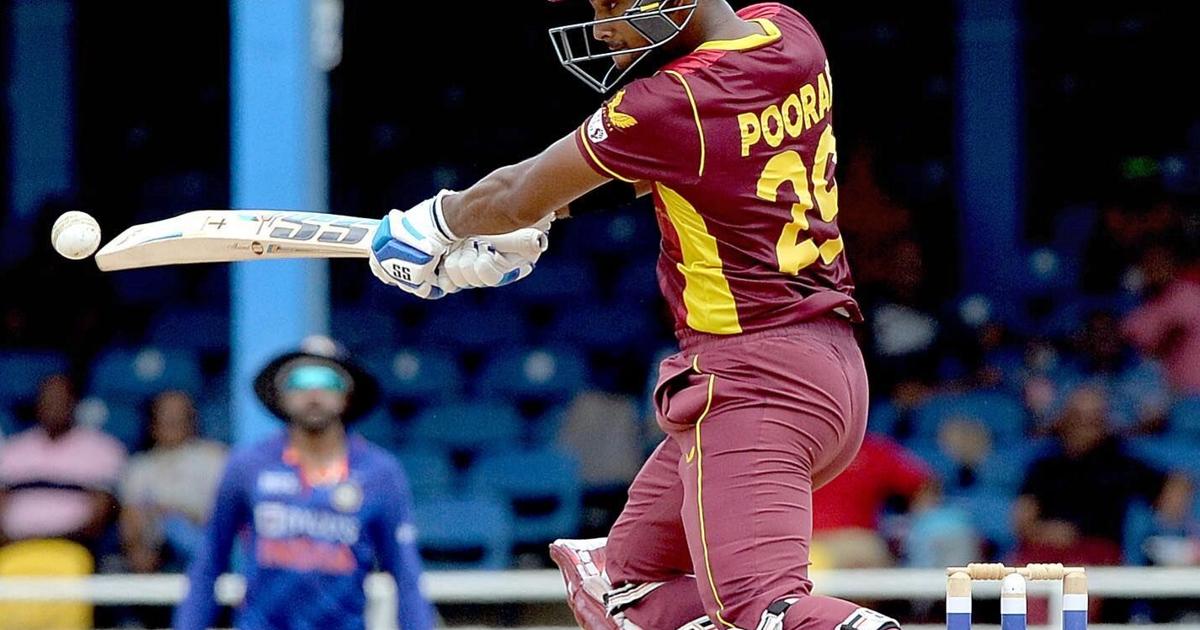
For Nicholas Pooran, stepping away from international cricket at 29 was not about turning his back on West Indies cricket but about continuing a personal journey towards becoming “the best version of myself”.
Speaking on the Beard Before Wicket podcast—a popular cricket podcast hosted by England cricketers Moeen Ali and Adil Rashid, alongside host Nubaid Haroon— the T&T left-hander, who retired from international duty in June, explained that his decision was never about rebellion but rather the realisation and understanding that time, health, and opportunity are never guaranteed in professional sport.
“At the end of the day, I’m still doing what I love the most, which is playing cricket,” Pooran said. “I’m still getting the opportunity to play cricket all over the world and I’m still getting that chance to be the best version of myself. I still feel I haven’t reached that stage where I’m the best version of myself yet,” he added.
Pooran acknowledged his career never followed a straight line. From a debut based on “potential”, to being dropped, banned, injured and doubted, he said his early years forced him to grow up fast and taught him quickly that readiness and reality are often very different things.
“I felt like I was ready but really and truly, I wasn’t,” he said of his first taste of international cricket. Dropped soon after, Ali, Rashid and Haroon felt it was a harsh introduction for a youngster to which Pooran quipped, “but that is West Indies cricket”.
He went back to domestic cricket to prove himself again and Pooran said those experiences hardened him and reshaped his outlook.
Central to that transformation was a controversial decision in 2016 to play in the Bangladesh Premier League domestic T20 competition—a move that led to sanctions but ultimately became, in his words, “the best decision I have made in my entire career”.
“That was the first step in me understanding as an adult, when you make decisions, there’s consequences,” he said. “I feel like something had to happen. And that just opened my eyes at the right age.”
Pooran also rejected the notion that franchise cricket was simply about money, arguing it offers West Indian players exposure to professionalism rarely available at home. “People think you’re going to make money. That’s not only the reason,” he maintained.
“It’s the opportunity to understand what professionalism looks like. We don’t get that opportunity in the Caribbean. We get that when we go to the IPL and other leagues in the world.”
That “professional education”, he said, helped him shed the common label associated with West Indian batters of being powerful, unpredictable and unreliable.
“I just never wanted to be that person,” Pooran said. “I was so inconsistent when I was younger… playing the wrong shots at the wrong time, costing the team the game. And that use to kill me.”
He credits much of his growth to guidance from Kieron Pollard and Dwayne Bravo, whom he described as the “dictionaries of T20 cricket”.
“There’s no Nicholas Pooran without these guys when it comes to batsmanship,” he said. “They don’t give you days off. You underperform, they’re letting you know.”
That same blunt honesty, Pooran said, helped him navigate the brutal realities of the IPL—releases, auctions, price tags and pressure—before finally finding consistency with Lucknow Super Giants (LSG). “I went through that struggle, that inconsistency of understanding franchise cricket,” he said. “That’s why I don’t take it for granted.”
When news of his international retirement broke, reaction was swift and emotional and condemning from some quarters. But Pooran said he understood the disappointment and maintained that the decision had nothing to do with the state of West Indies cricket which at the time was going through some changes with the captaincy of the limited overs team.
“This has nothing to do with West Indies cricket, how it is, what it is, what’s happening,” he said. “This is all about what Nicholas Pooran wants…I’m doing what’s best for myself and for my family.”
He also challenged the suggestion that retirement should only come in the mid-30s after players have given their all to their respective national teams. “If I wake up tomorrow and get injured and my career finishes, is that young?” he asked. “Time is not guaranteed.”
“Of course you’re going to miss representing your country, but we know as players, you can’t do it forever. I don’t know what the future holds for me but I know what I need to do now. I’m living in the present because I’m a person who knows, who has been through the struggle of not knowing what’s going to happen tomorrow or what life holds for you tomorrow,” he related.
Pooran, who turned 30 in October, also dismissed the notion of not being committed to West Indies cricket. He played 61 ODIs for West Indies and 106 T20Is scoring 1,983 and 2,275 runs, respectively.
“I actually committed myself to West Indies cricket. I’ve tried to give my all for West Indies. I was West Indies captain as well. I felt like that didn’t work out for me and for my game and for the teammates. I gave it all up after six months,” he said.
For Pooran, the defining motivation remains growth rather than power or status. “I’m not searching power,” he said. “All I’m searching for is how do I become a better version of myself.”
“I’ve worked extremely hard to be in this position I am in today…I came from nothing and if you know where Trinidad and Tobago is, it’s a dot on the world, so I feel like it’s so difficult for us to be successful from there,” Pooran stressed.
“So when I look back at not only my career but all the other guys for what they have accomplished in this game, for me personally, I would never take it for granted knowing where we come from and the opportunities we had,” he added.
And while his international chapter is closed for now, Pooran believes his cricketing journey is far from complete.