
Your support helps us to tell the story
From reproductive rights to climate change to Big Tech, The Independent is on the ground when the story is developing. Whether it’s investigating the financials of Elon Musk’s pro-Trump PAC or producing our latest documentary, ‘The A Word’, which shines a light on the American women fighting for reproductive rights, we know how important it is to parse out the facts from the messaging.
At such a critical moment in US history, we need reporters on the ground. Your donation allows us to keep sending journalists to speak to both sides of the story.
The Independent is trusted by Americans across the entire political spectrum. And unlike many other quality news outlets, we choose not to lock Americans out of our reporting and analysis with paywalls. We believe quality journalism should be available to everyone, paid for by those who can afford it.
Your support makes all the difference.Read more
Beijing has warned the United Nations that the rapid expansion of Elon Musk’s Starlink satellite constellations in low-Earth orbit pose “pronounced safety and security” concerns globally.
“With the rapid expansion of commercial space activities, the unchecked proliferation of commercial satellite constellations by a certain country, in the absence of effective regulation, has given rise to pronounced safety and security challenges,” a Chinese representative said at an informal UN Security Council event.
The Beijing representative cited several incidents, including near collisions between Starlink satellites and the Chinese space station in 2021.
Referring to SpaceX’s Starlink satellites, the representative said that “such constellations crowd frequency-orbit resources [data shared by all satellites in orbit for communication] and significantly increase the risk of collisions”, SCMP first reported.
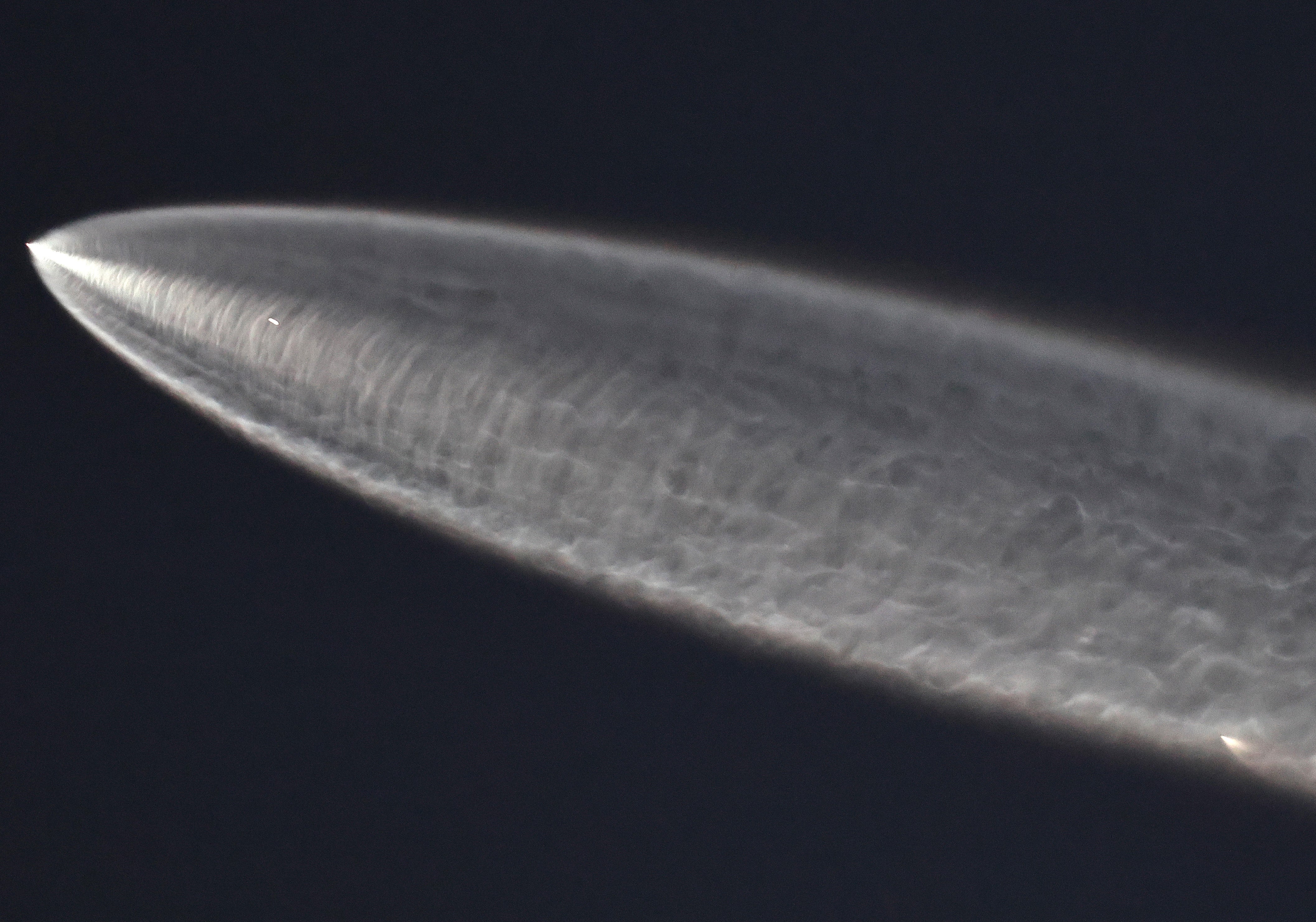 A SpaceX Falcon 9 rocket rises after launching from Vandenberg Space Force Base carrying 28 Starlink internet satellites (Getty Images)
Several recent studies have warned that as the number of satellites in orbit increase rapidly in the era of mega-constellations like SpaceX Starlink probes, there is rapidly increasing chances of satellite collisions.
Currently, as many as 8,500 of the 12,955 active satellites in low-Earth orbit, with just over 66 per cent part of these probes part of SpaceX’s Starlink constellation.
SpaceX chief Elon Musk has said the Starlink constellation could eventually have over 42,000 satellites, with the company currently having permission to launch 12,000.
Each of these satellites is designed for a five-year lifespan before it is deliberately burned up in the Earth’s atmosphere.
Meanwhile, Chinese projects, including the Quianfan broadband network, plans to launch their own internet satellite megaconstellations rivalling SpaceX.
The Shanghai state-backed project aims to mass produce and launch over 15,000 satellites by 2030 to provide global broadband coverage.
With the low-Earth orbit increasingly getting crowded since 2018, the Chinese representative called for countries to better enforce regulations on their commercial space activities.
The diplomat said a Starlink satellite in 2021 “conducted dangerous close approaches to China’s space station … posing grave threats to the safety of Chinese astronauts”.
“For spacecraft operated by developing countries that lack orbit-control capability, space situational awareness, or sufficient reaction time, this undoubtedly constitutes a major risk,” the unnamed representative said in a statement.
SpaceX has not immediately responded to The Independent’s request for comment.
Beijing also warned that commercial satellites are increasingly being used for reconnaissance and battlefield communications, which “aggravated the risk of an arms race in outer space”.
The diplomat called on the US in a veiled reference to “strengthen regulation and oversight of its commercial space activities, and respond to the concerns of the international community”.