
Your support helps us to tell the story
From reproductive rights to climate change to Big Tech, The Independent is on the ground when the story is developing. Whether it’s investigating the financials of Elon Musk’s pro-Trump PAC or producing our latest documentary, ‘The A Word’, which shines a light on the American women fighting for reproductive rights, we know how important it is to parse out the facts from the messaging.
At such a critical moment in US history, we need reporters on the ground. Your donation allows us to keep sending journalists to speak to both sides of the story.
The Independent is trusted by Americans across the entire political spectrum. And unlike many other quality news outlets, we choose not to lock Americans out of our reporting and analysis with paywalls. We believe quality journalism should be available to everyone, paid for by those who can afford it.
Your support makes all the difference.Read more
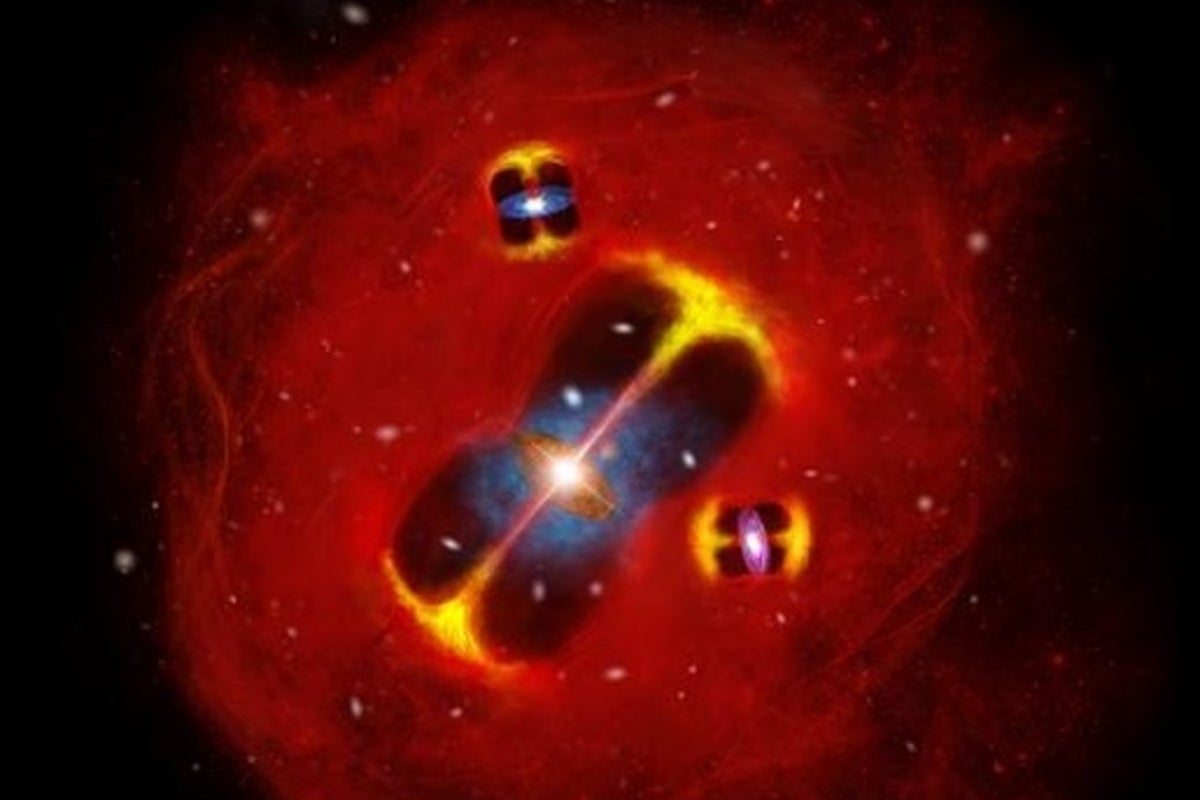
Scientists have spotted an incredibly hot cluster of gas in the universe that shouldn’t be there.
The object is from just 1.4 billion years after the Big Bang, and blazing with hot gas. It was found far earlier in the universe, and is far hotter, than researchers would ever have expected.
The surprising was so surprising that researchers initially thought it might be a mistake.
“We didn’t expect to see such a hot cluster atmosphere so early in cosmic history,” said Dazhi Zhou, from the University of British Columbia.
“In fact, at first I was skeptical about the signal as it was too strong to be real. But after months of verification, we’ve confirmed this gas is at least five times hotter than predicted, and even hotter and more energetic than what we find in many present-day clusters.”
Scientists believe that something in the early universe – probably three supermassive black holes that were found in that cluster – was pumping hot air around the cluster. They didn’t think that something so powerful would be happening so early in the life of the universe.
That could change our understanding of how the clusters of galaxies that clump together and form the shape of the universe first formed.
The work focused on a “baby” galaxy cluster called SPT2349-56, which scientists looked back about 12 billion years to see. Though it is young, it is massive, with 30 active galaxies and a core that measures 500,000 light years across.
They looked at it using a set of telescopes called the Atacama Large Millimeter/submillimeter Array, or ALMA. To measure it, they used a tool called the Sunyaev-Zeldovich effect, which allows them to work out the thermal energy of a cluster.
The fact that it is so hot suggests that the birth of galaxy clusters is far more explosive than researchers had thought. That might suggest a need for a rethink of our understanding of how they begin and evolve.
“Understanding galaxy clusters is the key to understanding the biggest galaxies in the universe,” said Scott Chapman, a professor at Dalhousie University. “These massive galaxies mostly reside in clusters, and their evolution is heavily shaped by the very strong environment of the clusters as they form, including the intracluster medium.”
The work is described in a new study, ‘Sunyaev-Zeldovich detection of hot intracluster gas at redshift 4.3’, published in the journal Nature.