
Key findings
In November 2024, average prices for beef dishes out-of-home rose 12.8% year-on-year, the highest price increase in 2024 (Worldpanel by Numerator UK OOH, 52 w/e 3 November 2024)
Consumers responded to these price increases by reducing the amount and frequency at which they purchased beef dishes or by turning away from beef dishes altogether
Applying an equivalent 12.8% price increase to 52 w/e 20 April 2025 data, predictions show that average beef dish prices will rise +£0.84p, resulting in a -5% decline in the number of beef dishes sold out-of-home (Worldpanel by Numerator UK OOH), equating to an estimated loss of approx. 5,100 tonnes of beef, assuming an equal 5% decline on all beef offerings (forecast based on AHDB estimates from Worldpanel by Numerator UK OOH data)
In April 2025, consumer confidence fell to its lowest point since November 2023, driven by concerns around inflation, rising prices and global economics (GFK Consumer Confidence, April 2025)
Within the out-of-home market, this uncertainty has led to a -1.9% reduction year-on-year in the number of out-of-home occasions, including dining out, takeaways and buying to eat on the go (Worldpanel by Numerator UK OOH, 52 w/e 20 April 2025).
With 176.9m out-of-home occasions containing beef (Worldpanel by Numerator UK OOH, 12 w/e 20 April 2025), this protein is a key part of the market, representing 12% of spend and 7% of dishes across total out-of-home food (Worldpanel by Numerator UK OOH, 52 w/e 20 April 2025).
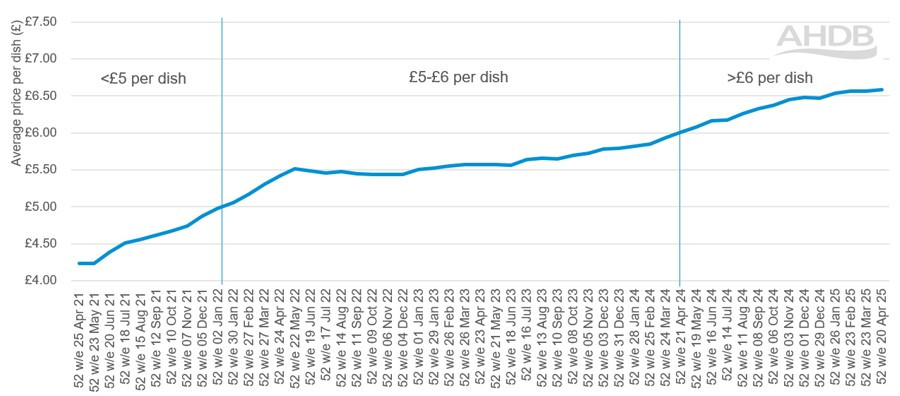
Over the past five years, average prices per dish for beef out-of-home have been steadily increasing, with prices now averaging over £6 per dish.
Average price per dish (£) for beef out-of-home dishes
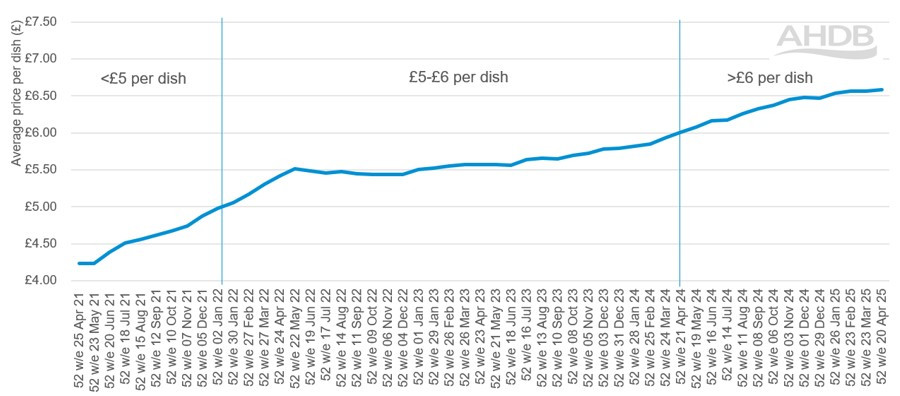
Source: Worldpanel by Numerator UK OOH 52 w/e 25 April 2021 to 20 April 2025
How have consumers previously reacted to out-of-home beef price rises?
In November 2024, average prices for beef rose 12.8% year-on-year, the highest price increase in 2024, pushing average prices to £6.45 (Worldpanel by Numerator UK OOH 52 w/e 3 November 2024). This February, average prices increased again by 12.1% (Worldpanel by Numerator UK OOH 52 w/e 23 February 2025). With these price rises in play, we saw consumers reacting in three different ways:
Consumers reduced the number of beef dishes they purchased within an occasion (e.g. a couple who typically visit a restaurant and order two beef steaks changed to ordering only one beef steak, with one person switching to a cheaper option on the menu, e.g. a cheaper protein like pork or a meat/fish/poultry-free option).
Consumers reduced the frequency at which they purchased beef dishes (e.g. a family who typically purchase beef burgers from a quick service restaurant once every four weeks changed to purchasing once every six weeks).
Consumers turned away from beef dishes altogether.
How do we predict consumers will react in the future for similar out-of-home beef price rises?
Understanding the patterns of consumer behaviour in the past allows us to predict potential behaviour changes as beef prices continue to rise. Note that there are many different factors that can impact purchase behaviour, including promotions and availability through menu changes. The predictions shown in this article are based on the assumption that all other factors remain equal.
Total beef
Based on a 12.8% price rise applied to 52 w/e 20 April 2025 data, predictions show that average beef dish prices will rise +£0.84p, taking the average price per dish to over £7 (Worldpanel by Numerator UK OOH).
As a result of this price increase, 230K consumers are predicted to turn away from beef dishes out-of-home altogether. Consumers who continue to purchase beef dishes are predicted to reduce the number of beef dishes by occasion by -0.1 dish per occasion on average and reduce the frequency of beef dish occasions by -1.2 occasions per year on average.
The consequence of these consumer behaviour changes would result in a -5% decline in the number of beef dishes sold out-of-home (Worldpanel by Numerator UK OOH). This would equate to an estimated loss of approximately 5,100 tonnes of beef, assuming an equal 5% decline on all beef offerings (forecast based on AHDB estimates from Worldpanel by Numerator UK OOH data).
Predictions for total beef
Prediction based on 12.8% price rise
Price per dish
Percentage of population shopping
Average number of dishes per occasion
Average number of occasions per year
52 w/e 20 April 2025
£6.58
73.1
1.3
17.9
Prediction with price rise
£7.42
72.4
1.2
16.7
Impact with price rise
+£0.84p
-230k consumers
-0.1 dishes per occasion
-1.2 occasions per year
Source: Worldpanel by Numerator UK OOH
Channels and dishes
Four key channels are responsible for 88% of beef sold out-of-home: (i) quick-service restaurants, (ii) bakery, sandwich and salad outlets, (iii) pubs and bars, and (iv) full-service restaurants.
Quick-service restaurants
Bakery, sandwich and salad
Pubs and bars
Full-service restaurants
% of beef dishes
51%
17%
13%
7%
Source: Worldpanel by Numerator UK OOH 12 w/e 20 April 2025
Burgers, pasties, steaks and beef meals account for 77% of beef dishes and are tightly linked to the different channels. Trends in the market indicate that these different beef dishes may be impacted in different ways as prices rise.
Quick-service restaurants
Bakery, sandwich and salad
Pubs and bars
Full-service restaurants
Share of dishes
89% Burgers
90% Pasty
34% Burgers
14% Beef meals
25% Burgers
25% Steak
Source: Worldpanel by Numerator UK OOH 12 w/e 20 April 2025
Click on the drop-downs below to explore the detail for key beef out-of-home dishes.