
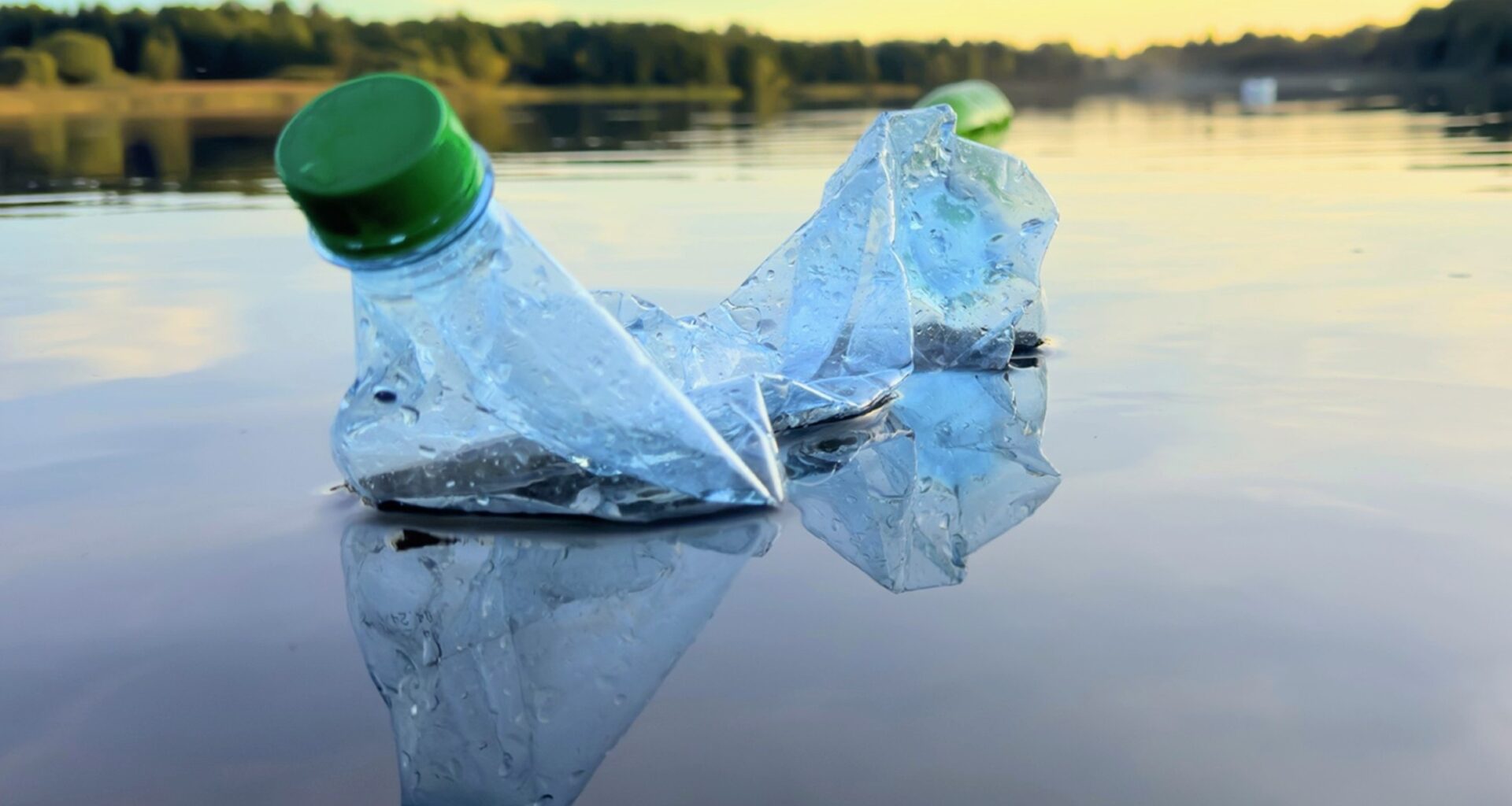
On a hike in Bear Mountain State Park, chemist Yuwei Gu stopped short at an all-too-familiar sight: plastic bottles scattered across a trail and skimming a nearby lake. The scene set off a chain reaction in his mind.
Plastics are polymers – long chains of repeating molecular units – and so are life’s most essential materials: DNA, RNA, proteins, cellulose. Yet natural polymers come and go without piling up for decades. Synthetic plastics, famously, do not.

“Biology uses polymers everywhere, but nature never faces the long-term accumulation mess we’ve created,” Gu said.
The difference, he realized, had to be chemistry – specifically, how nature builds an exit ramp right into the molecule itself.
Borrowing from nature
Natural polymers are not indestructible. They carry small chemical features that make select bonds easier to undo under the right conditions.
Cells use this mechanism to recycle proteins, and DNA strands unzip during replication through similar chemistry.
Gu asked a deceptively simple question: What if we borrow that structural trick? Could we build plastics that stay strong during use, then come apart gracefully afterward?
In a new study, Gu and colleagues from Rutgers University showed that the answer can be yes.
By engineering tiny “weak points” into the polymer backbone – without changing the basic building blocks – they created materials that hold up in service and then break down under everyday triggers.
Plastic strength and breakdown
A polymer is a chain of monomers linked like beads on a string. The “glue” is a set of chemical bonds that can be tuned to act like a steel cable or a tear-away seam.
The stronger and more uniform those bonds, the tougher the plastic. That strength also makes it harder for water, light, or microbes to find a way in once the product is discarded.
Gu’s team focused on the geometry around those bonds. Place the right neighboring chemical groups in just the right orientation and you create a “pre-creased” spot – a tiny stress concentrator at the molecular level.
The chain stays intact in normal conditions, but when you nudge it with a gentle cue, the crease guides the break.
It’s like folding paper along a line so it tears cleanly later. The result is breakdown that can run thousands of times faster than usual, without sacrificing performance upfront.
Timing plastic breakdown
The power of the approach is control. Because the strategy relies on spatial arrangement – the 3D positioning of atoms around a bond – the team can dial the timing up or down.
Shift the orientation slightly and a wrapper might last a day. Shift it another way and an automotive part could last years.
The composition of the plastic stays the same. The “schedule,” though, is encoded in the structure.
The researchers also showed they can flip the switch in different ways. In some formulations, the polymer starts to unspool on its own when exposed to moisture and air.
In others, a short burst of ultraviolet light or a sprinkle of benign metal ions acts as the key. Either way, the trigger is mild and practical, with no special facilities required.
Beyond waste reduction
Imagine packaging that keeps food fresh today and quietly unthreads itself next week. Picture agricultural films that protect seedlings through the season and then fade, saving labor and landfill space.
The team’s early tests suggest the breakdown liquids are not toxic. Even so, the researchers are moving cautiously and running longer-term safety studies to be sure.
The implications stretch beyond trash. The same “timed seam” concept could drive drug-delivery capsules that dissolve on cue, coatings that erase themselves after a fixed service life, or sensors that self-disarm to prevent tampering.
In these cases, programmable degradation is a feature, not just a fix.
Testing breakdown impacts
Degradable doesn’t automatically mean harmless. Gu’s group is mapping the entire journey – what fragments form, how quickly they appear, whether microbes chew them into CO2 and water, and how soils or waterways respond along the way.
The researchers want proof that a graceful exit truly leaves no problematic footprints.
The early signals are encouraging. In lab studies, the liquids produced as the chains unzip didn’t show acute toxicity.
Still, the team is testing across organisms and environments, because “benign by design” has to stand up to real-world complexity.
Practical path to manufacturing
Breakthroughs often stall at the factory gate. Gu and his collaborators are already working on the manufacturing questions: Can this chemistry retrofit conventional plastics or slot into existing processing lines?
Can it be blended to give familiar materials a built-in off switch without changing how they mold, print, or extrude?
That’s the practical path to impact – co-design with producers who are under pressure to cut waste but can’t afford to rebuild their plants.
If the structural tweak rides along with business-as-usual workflows, adoption gets a lot easier.
Simple idea, big potential
Gu still laughs at how ordinary the spark was: a quiet walk, an ugly patch of litter, and a simple thought – copy nature’s structure to get nature’s outcome.
The surprise wasn’t the elegance of the idea; it was that it worked so well.
His long-term vision is that plastics should do their job and then disappear. The tools to make that possible live in the nuances of chemical geometry – how atoms sit, tilt, and lean across a bond.
Get that choreography right, and you can write an end date into a material’s birth certificate.
Future research directions
The team is expanding tests to tougher applications and harsher conditions, from outdoor exposure to repeated mechanical stress.
They’re probing even lower trigger thresholds to make everyday breakdown more reliable.
Researchers are also working with industry partners to pilot products where programmed lifetimes make immediate sense, such as single-use packaging, agricultural films, temporary coatings, or time-release capsules.
It’s early, and there are hurdles ahead. But the path is clear: borrow nature’s exit strategy, bake it into our polymers, and turn “forever” into “long enough.”
The study is published in the journal Nature Chemistry.
—–
Like what you read? Subscribe to our newsletter for engaging articles, exclusive content, and the latest updates.
Check us out on EarthSnap, a free app brought to you by Eric Ralls and Earth.com.
—–