
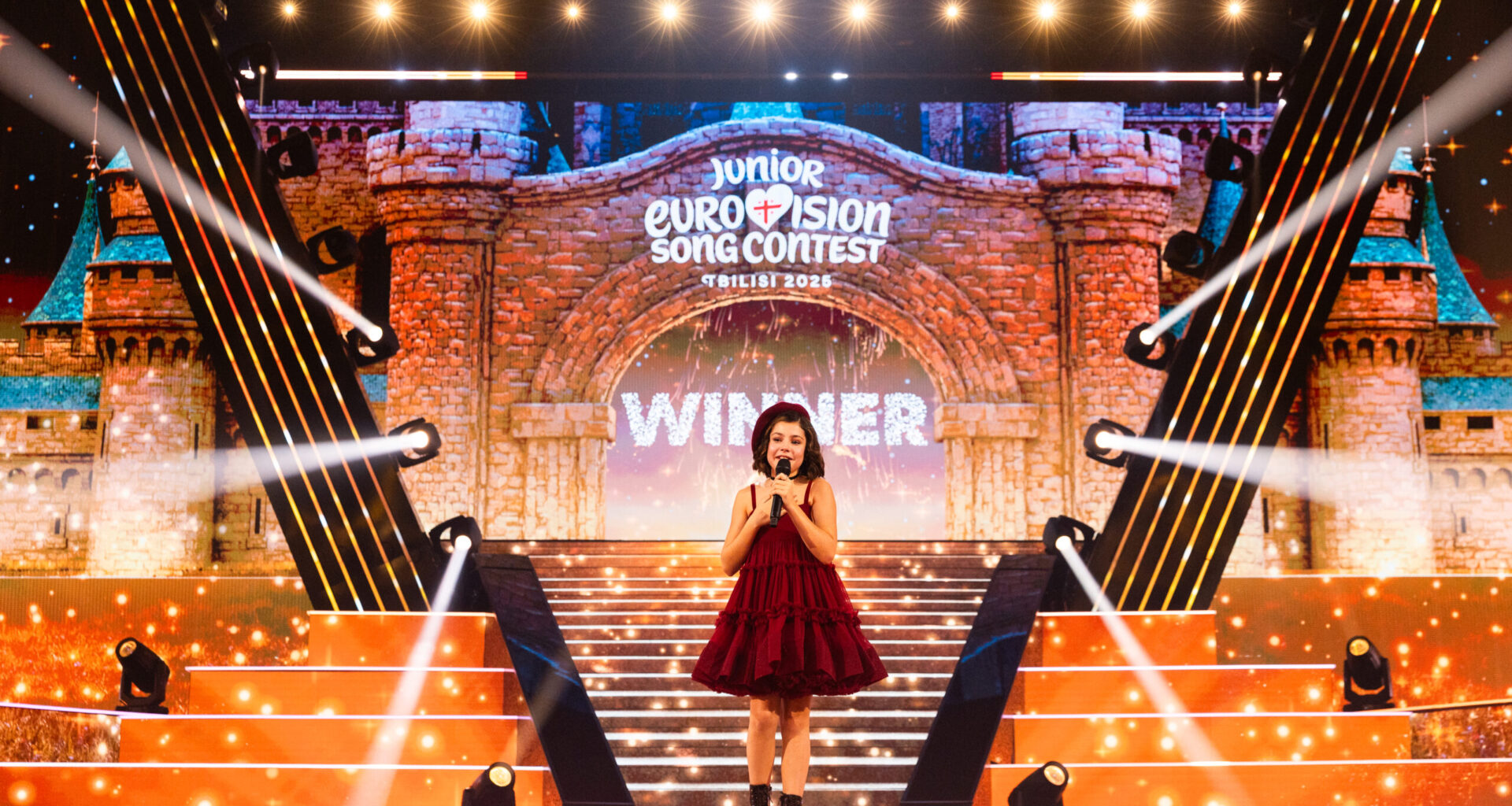
A total of 16 million viewers watched the Junior Eurovision Song Contest 2025 live from Tbilisi.
The EBU has released viewing and digital channel figures for the Junior Eurovision Song Contest 2025. A total of 16 million viewers watched the contest live on television across 14 different markets. This is a decrease of 7 million from the 2024 contest.
The live broadcast achieved a 12.9% viewing share among children aged 4 to 14, more than double the channel average for the measured markets (5.2%). It also achieved a 6.1% viewing share among 15–24-year-olds, outperforming the average 4.2% normally achieved by the same group of broadcast channels.
31.6% of those watching the show on the official Junior Eurovision YouTube channel were under 24. The biggest audience for the YouTube livestream came from Poland, followed by Armenia, Ukraine, Spain and Georgia.
Overall live viewing figures on YouTube Kids increased by 19.2% compared to 2024, with a new record of 101,025 viewers joining the stream for the moment Lou Deleuze won the contest for France.
The Junior Eurovision YouTube channel also passed the 1 million subscriber mark. This achievement was recognised with the presentation of YouTube’s prestigious Gold Creator Award.
For the first time, the Junior Eurovision Song Contest was also streamed on Twitch, reaching 333,270 unique viewers. The biggest audiences on Twitch came from Germany, Brazil and Spain.
The official Junior Eurovision TikTok account received 101.2 million views for the 2025 contest, an increase of 46 million in the same period in 2024. This was the first time that the contest’s TikTok account received over 100 million views.
Content on Instagram reached 7.8 million accounts, a new record, up 37% year on year. Over 7.9 million accounts were reached on Facebook, up 1.6 million on the 2024 event and another record.
Martin Green, Director of the Junior Eurovision Song Contest, stated:
“We’re delighted by the outstanding success of the Junior Eurovision Song Contest 2025, which once again captured the hearts and imaginations of millions of viewers around the world, with exceptional reach across both television and digital platforms.
This year’s Contest was the best yet and the outstanding engagement has reaffirmed its position as a truly global celebration of young talent, creativity and togetherness. Its success shows both the Junior and Eurovision Song Contests as live events and brands are as strong as ever as we approach the latter’s 70th anniversary.
Our sincere thanks go to GPB for delivering such a joyful and memorable edition for audiences everywhere.”
Poland and Spain attracted the largest average television audiences, with approximately 1.2 million and 703,000 viewers each. The show was followed by 372,000 viewers in Portugal, their second-best audience since 2017.
Georgia, the host nation of Junior Eurovision 2025, received its largest audience since 2022 with 71,000 viewers, which was year-on-year increase of more than 50,000 viewers.
In Croatia, a country that returned to the contest for the first time since 2014, the Junior Eurovision Song Contest averaged a 12.8% viewing share, 46% above HRT’s average for its time slot.
The host country of the Junior Eurovision Song Contest 2026 will be announced in the upcoming weeks. France, the winning country of Junior Eurovision 2025, declined to host the event, citing budget cuts in France Télévisions. To date, only San Marino has publicly stated that they will bid to host the 2026 contest.
Lou Deleuze won the Junior Eurovision Song Contest 2025 in Tbilisi for France with “Ce monde”. She scored 248 points, giving France their fourth victory in history and tying them with Georgia for the most wins overall.
Source: EBU