
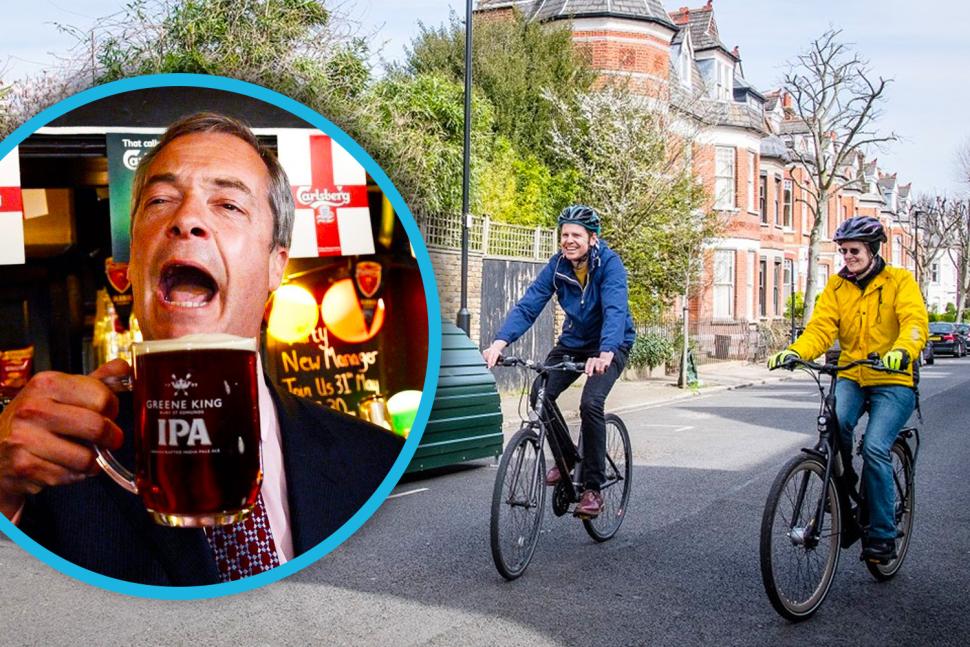
The Labour government’s plans to lower the drink drive limit in England and Wales have been branded “absolutely ridiculous and wholly unnecessary” by Nigel Farage, who claimed the proposals were the work of the “Islington, north London bicycling classes” who “hate” rural Britain.
On Wednesday, the Department for Transport unveiled its new Road Safety Strategy, which it says will save thousands of lives on the UK’s roads by tackling drink driving, improving training for young motorists, introducing mandatory eye tests for drivers over 70, and targeting mobile phone use at the wheel.
The strategy, the government’s first published road safety plan in over a decade, forms part of Labour’s stated ambition to reduce deaths and serious injuries on Britain’s roads by 65 per cent in the next ten years.
> Wheelchairs and mobility scooters could be allowed in cycle lanes under new government proposals
As part of this aim, the government says it will consult on lowering the drink drive limit in England and Wales, which is currently the highest in Europe, having remained unchanged since 1967.
In 2014, Scotland changed its legal alcohol limit from 80 to 50 milligrammes per 100 millilitres of blood, and from 35 to 22 micrograms per 100 millilitres of breath. However, England, Wales, and Northern Ireland’s limits stayed intact, and any consultation on lowering the limit in England and Wales will likely focus on whether the two countries should belatedly fall in line with Scotland.
According to the government’s casualty figures for 2023, one in six road fatalities that year involved drink driving. As well as lowering the drink drive limit, the consultation will also explore the potential use of preventative technology, such as alcohol interlock devices in vehicles, and powers to suspend driving licences for those suspected of drink or drug driving offences.
However, according to Reform UK leader Farage, Labour’s aim to clamp down on drink driving would, instead of making the roads safer, simply sound the “death knell for country pubs across Britain”, the Clacton MP arguing that the proposal was dreamt up by north London’s cycling “elite”.
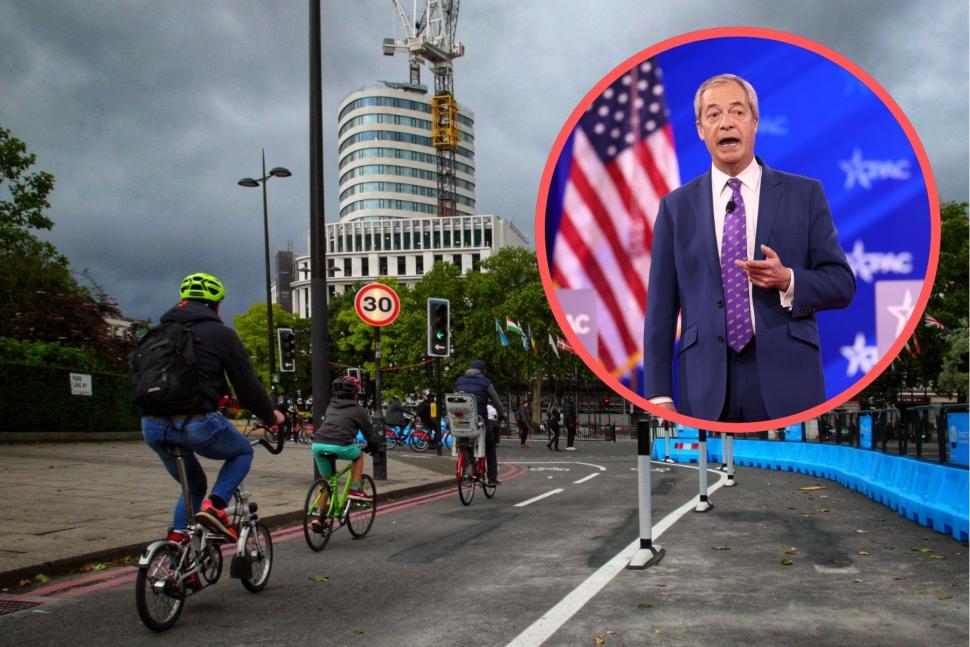 Marble Arch cycle lane (inset: Nigel Farage) (credit: Simon MacMichael/Gage Skidmore via CC BY-SA 2.0)
“It’s a tragedy what’s happening to pubs, it’s been going on for a very long time,” Farage said during a Reform UK press conference on Wednesday.
“I listened to a Labour minister on the TV this morning about the new drink drive laws, basically saying if you want to have a drink, don’t drive.
“This is because we’ve got laws being designed by the Islington, north London bicycling classes. What about rural Britain? No-one cares, of course. In fact, many in Labour seem to hate rural Britain.
“But the drink drive thing is absolutely ridiculous, wholly unnecessary. We’ve been where we’ve been since 1967, it’s worked pretty effectively. If you actually look at road casualty figures, through whatever cause, we are now incredibly safe on our roads. Incredibly safe. Much safer than France, way safer than Germany.
“We’ve actually reached a level on accidents, beneath which it is impossible to go, because there will always be human error of some kind.”
> Cyclist gets new 3D printed face after drunk driver left him with severe facial burns
Farage’s criticism of the proposed policy was echoed by Jonathan Neame, chief executive of Britain’s oldest brewery, Shepherd Neame, who labelled it “socially, morally, and economically wrong”.
“I think there is a real risk that Rachel Reeves is doing to our sector what Margaret Thatcher did to the miners,” Neame told the Times.
However, speaking to LBC, transport secretary Heidi Alexander pointed out that studies have shown that there has been no significant long-term impact on rural pubs in Scotland since its new drink drive limit was introduced in 2014.
“I’m sorry, but rural pubs still do exist in Scotland. The law changed there in 2014, we’re not proposing to do anything different than what the Scottish government did a decade ago,” Alexander said.
“I think that even though it’s quite a marginal difference that we are proposing, I think the vast majority of people are responsible and that they don’t drink and drive when they go to the pub.”
Of course, this isn’t the first time that Farage or Reform have publicly taken aim at cycling and cyclists. Back in 2020, when the former Brexit Party had just rebranded as Reform, Farage announced that the party would target councils that promote cycling and walking in the following year’s local elections.
 Commuters and Nigel Farage (credit: Various)
And more recently the Clacton MP derided local authorities “on the verge of bankruptcy” for wasting “tens of millions” of pounds on “cycle lanes that no one uses”.
Elsewhere in Labour’s new Road Safety Strategy, the government says it will consult on introducing a mandatory three or six month minimum learning period for new drivers, in a bid to tackle the inexperience Labour says is costing lives, with drivers aged between 17 and 24 accounting for 24 per cent of all fatalities and serious collisions on the roads, despite making up just six per cent of all licence holders.
Meanwhile, a consultation on mandatory eyesight testing for drivers over the age 70 will be launched, along with new measures targeting illegal number plates, uninsured drivers, and vehicles without a valid MOT.
> What to expect for cycling if Reform UK get into power
However, the strategy largely avoids the role of cycling and cyclists on the roads, though cyclists will be included as part of a National Work-Related Road Safety Charter pilot. The scheme encourages employers to “promote good practice, accountability, and compliance with existing legislation” when it comes to dealing with employees driving or riding to work.
The strategy was welcomed on Wednesday by Cycling UK – though the charity pointed out that more still needs to be done to educate motorists and increase awareness of the Highway Code.
“The new Road Safety Strategy is a welcome and hugely important step from the government towards making our roads safer for everyone,” Cycling UK’s director of external affairs Sarah McMonagle said in a statement.
“We particularly welcome the inclusion of clear casualty reduction targets, which were scrapped in 2011. This was despite them being instrumental in halving road deaths under the previous Labour government. We’re also really pleased to see a Road Safety Investigation Branch with the aim of preventing future collisions.
“It’s also great to see the government encouraging more walking, wheeling and cycling – including by placing the internationally recognised Safe Systems Approach at the heart of the strategy. This suggests the government is serious about preventing collisions and saving lives by better managing and enforcing safer speeds.
“However, if we want safer streets, we also need to educate people on the rules and increase awareness of how the Highway Code changed four years ago. People first need to know the rules of the road before they can follow them.
“We urge the government to kick-off its ‘lifelong learning approach’ by investing in a major new road safety awareness campaign; the first step towards safer behaviour on our roads.”