
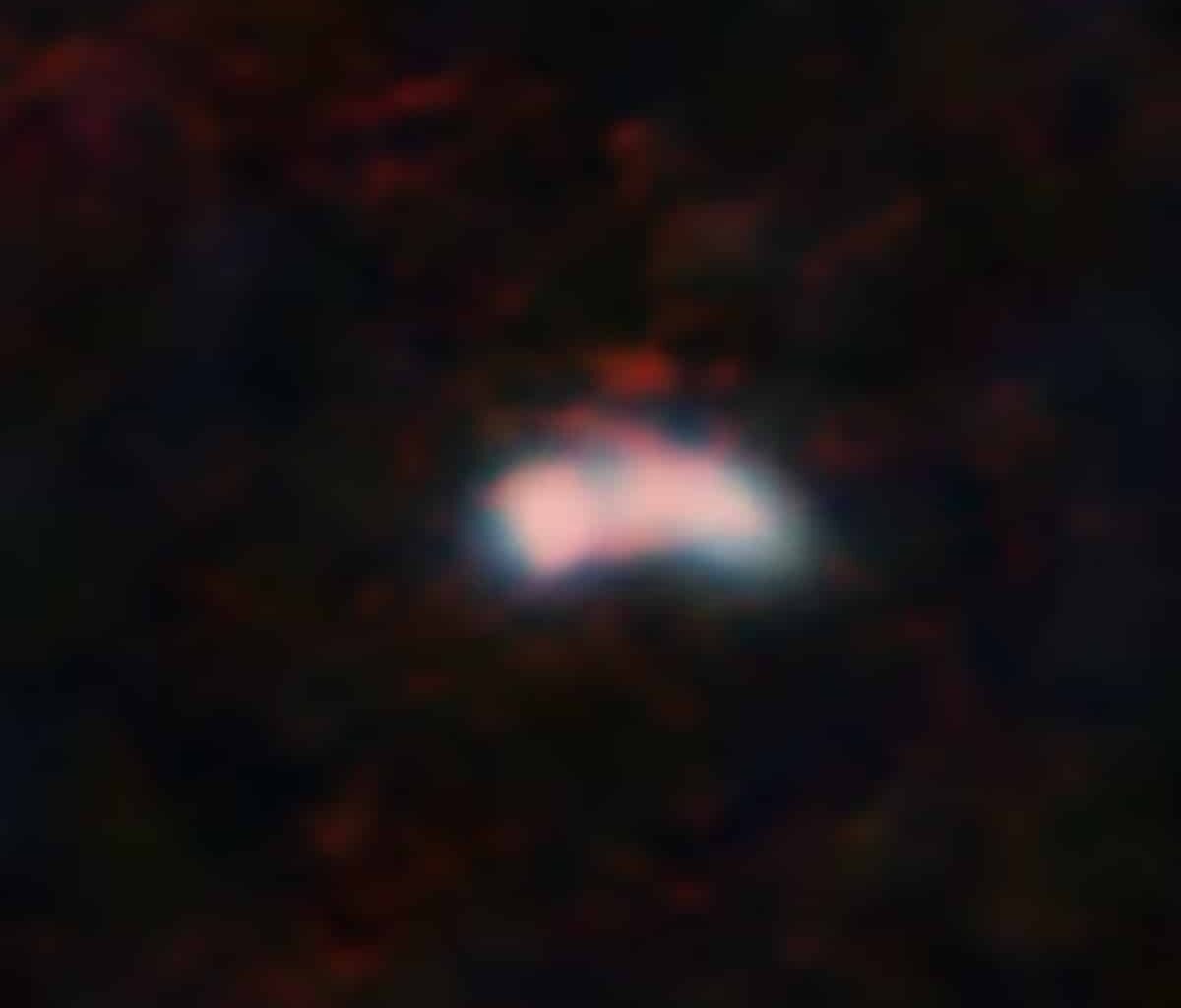
Deep in the early Universe, scientists have identified an extraordinary stellar nursery—a place where stars are forming at a breathtaking rate. In this region, activity is up to 180 times greater than in our own galaxy, offering a rare glimpse into how matter behaves in an environment far denser than anything we experience today.
The Milky Way may feel relatively calm now, but the young Universe was anything but. According to a study published in Monthly Notices of the Royal Astronomical Society, researchers have pinpointed an extremely hot and active zone dating back to the Universe’s earliest epochs, where conditions were far more intense than those around us today.
This area functions as a massive stellar nursery. Packed with dust and gas and flooded with radiation that generates heat, it creates the perfect conditions for particles to collide, stick together, and eventually form new stars.
About 180 solar masses every year
In this region, stars form at a rate roughly 180 times higher than in the Milky Way, where astronomers estimate that only about one solar mass is created each year. Here, that figure rises to nearly 180 solar masses annually.
Such observations were made possible thanks to the ALMA telescope, designed to study extremely distant galaxies. To observe this object, scientists had to look back some 13 billion light-years, meaning they are witnessing events that occurred just a few hundred million years after the Big Bang.
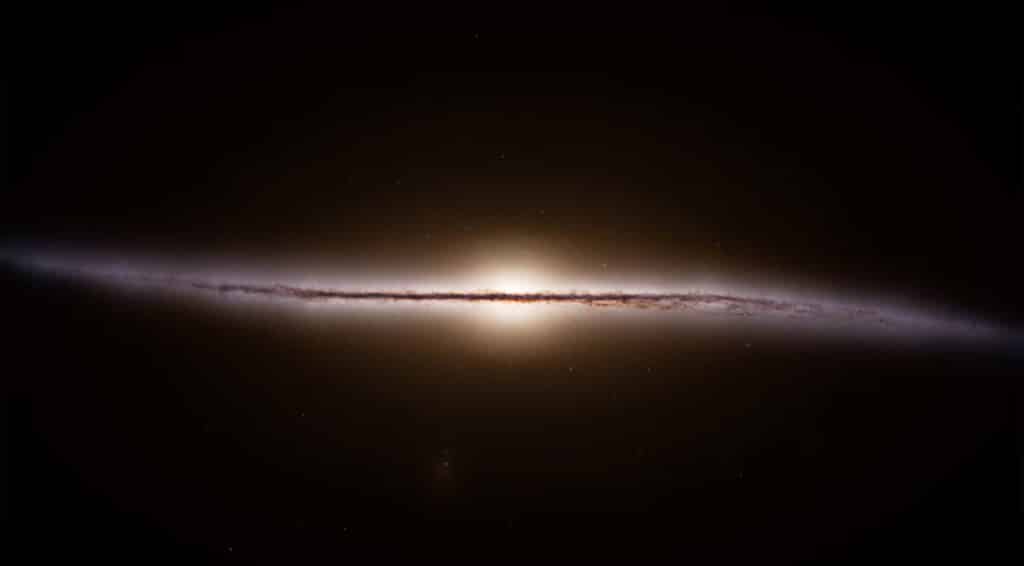
The Milky Way produces only about one solar mass per year. © ESA Gaia
That’s what makes studies like this so valuable. They reveal a version of the Universe that was far denser and more energetic than the one we know today. Understanding how these early environments worked is essential to explaining how the first galaxies grew so rapidly after the Big Bang.
An Orion Nebula on overdrive
The galaxy at the center of this research has been named Y1. It is the most distant galaxy in which cosmic dust has ever been detected, immediately suggesting an unusually high rate of star formation. Such an intense pace, however, cannot last forever, as supplies of gas and dust would quickly run out.
ALMA observations confirmed this scenario, showing that Y1 emits vast amounts of infrared heat in addition to dust. The phenomenon resembles what we observe in stellar nurseries like the Orion or Carina Nebulae in our own galaxy—but on a much more extreme scale. Detecting this required ALMA’s full capabilities, made possible by its exceptional location in Chile’s desert.
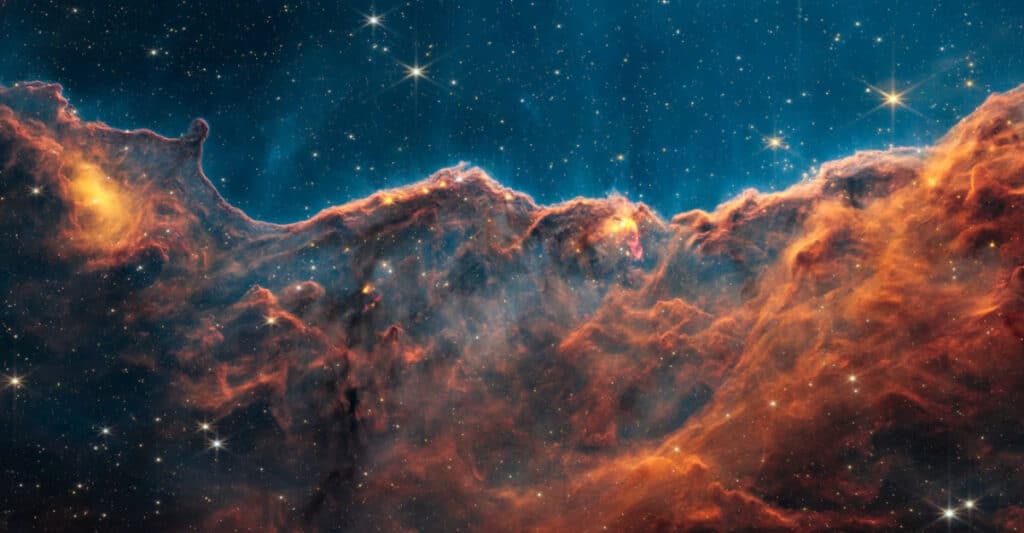
The Carina Nebula, a stellar nursery in our galaxy. © NASA, ESA, CSA, STScI
In Y1, gas and dust are so intensely heated that they move faster and clump together more readily, creating a restless and highly dynamic cosmic environment.
A clue to solving a long-standing paradox?
Researchers are now trying to determine how representative Y1 is of the early Universe. While it appears exceptionally active, it’s possible that many similar galaxies exist nearby and simply haven’t been detected yet.
This discovery may also help resolve a lingering mystery. Previous research suggested that some early galaxies contained far too much dust for their age, since dust typically forms after stars have lived out their lives and exploded.
One explanation could be that observations were misleading. A small amount of extremely hot dust—like that found in Y1—can produce the same signal as a much larger amount of cooler dust. And that may be exactly what’s happening in these extreme corners of the early galaxy landscape.

Hugo Ruher
Science journalist
Science journalist, I am above all passionate about space, which is what inspired me to pursue this specialty. Drawn to science in general, I also closely follow news related to the environment and technology.
After earning a degree from Sciences Po Toulouse, I began working in radio, covering general news, international issues, and even local problems. At the same time, I started a career as a science journalist, first focusing on space and later on environmental topics.
Making complex information simple
A large part of my work involves reading scientific studies published in various journals, texts that are often complex or downright indigestible! My goal is to extract information from them and make it accessible to a broader, non-expert audience. This ambition is what truly drives me.
This path has led me to write for teen magazines like Cosinus, highly specialized publications such as Industrie & Technologies, as well as more mainstream outlets like Numerama or Le Monde.
In addition to that, I also sometimes write about topics that are a bit more “lightweight.” The digital world, ranging from the use of social media to AI, and even the culture around video games—are areas that I find fascinating and worth covering with a serious approach.