
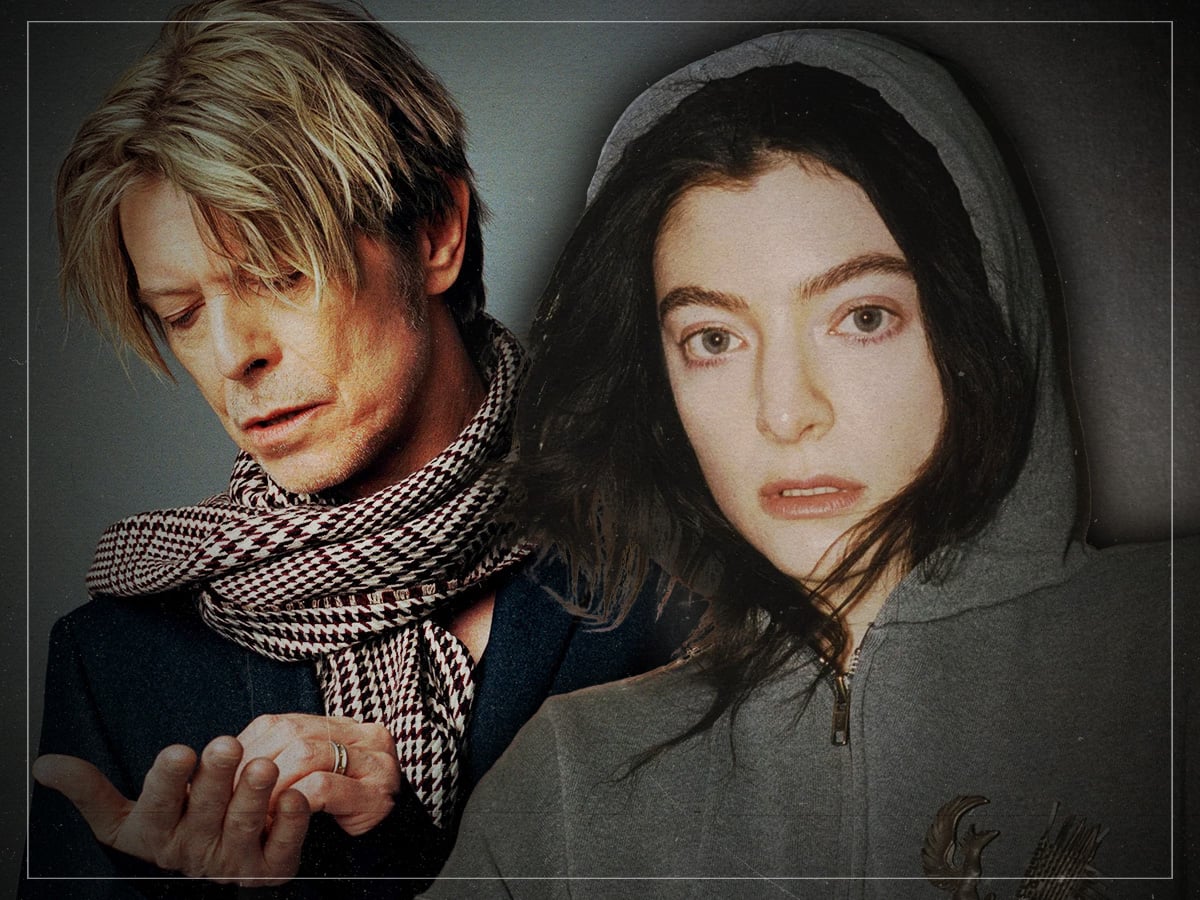
(Credits: Far Out / The David Bowie Archive / Sukita / Thistle Brown)
Fri 9 January 2026 4:00, UK
Thinking about the fact that David Bowie died a decade ago now, it really puts things in perspective as to how much things have changed.
If you were to take Gary Oldman’s word for it, the world has gone to “shit” since Bowie departed. And while this might certainly be true in a social and political context, it doesn’t really account for the sonic timeline of the past ten years. After all, without making this too dark a suggestion, modern thought circles would say that 2016, the year Bowie died, was arguably the best in recent music history.
But nevertheless, as time seemed to stand still in those early months of the year and the world reeled after Bowie suddenly departed, there was no way of knowing that the best was yet to come. Only a beacon offered up by the Starman himself provided some sense of light amid the bleakness, the fledgling fluorescence of a woman he called “the future of music”: Lorde.
Back then, Lorde was just 19 years old when she took to the stage at the Brits in February 2016 and performed one of the finest Bowie covers ever made with her version of ‘Life on Mars?’. She may have already had a growing teen pop following, but suddenly, the beady and scrutinising eyes of the rock music masses turned to inspect their latest custodian. With hindsight, it was the moment that truly made her.
What happened next, with the champagne sublimeness of Melodrama the following year cementing her as an electro-pop powerhouse, meant that, whether she liked it or not, Lorde was slapped with the label of being Bowie’s crystal ball protégé. It didn’t matter that she was a different person, with a different mind and a different genre – she would always be the artist under the thumb of his legacy.
There’s no denying that the Bowie seal of approval has benefited Lorde in various ways that many other artists would be jealous of. It rocketed her already rising status exponentially, and there’s a tacit understanding between the rock diehards and the pop snobs that she’s more immune to dismissal because of it than most.
She has never spoken more effusively about Bowie than in the wake of his passing, paying tribute the day after the news broke by saying “He was a piece of bright pleated silk we could stretch out or fold up small inside ourselves when we needed to,” and that meeting him made her embrace her “spiky strangeness”. But since then, it seems like she needed to move on.
This is not to say that Lorde is somehow ungrateful or resentful of Bowie’s leadership and influence on her life, but she would not be wrong for sometimes wanting to break free from the shackles of the tag. When the weight of such an effervescent artist sits upon you, it can be an act of creative oxygen starvation when every move is chalked up to parallel your hero.
You can’t help but feel as if the extensive ruminations Lorde has undergone in the past few years have all played a part in this reckoning process, where the approval of Bowie is no longer her sole calling card but just a mere chapter near the beginning of the story. With her most recent album Virgin ending in the not-so-subtly named ‘David’, it was not just a symbol of the underdog triumphing over the master but an emphatic charge into the next phase of her artistic life.
Related Topics