
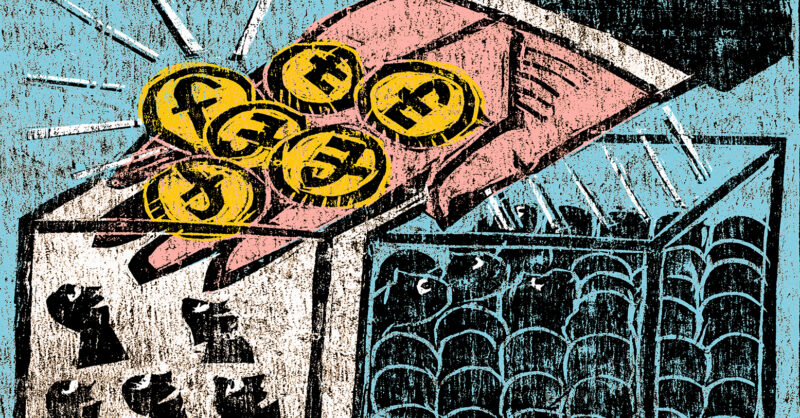
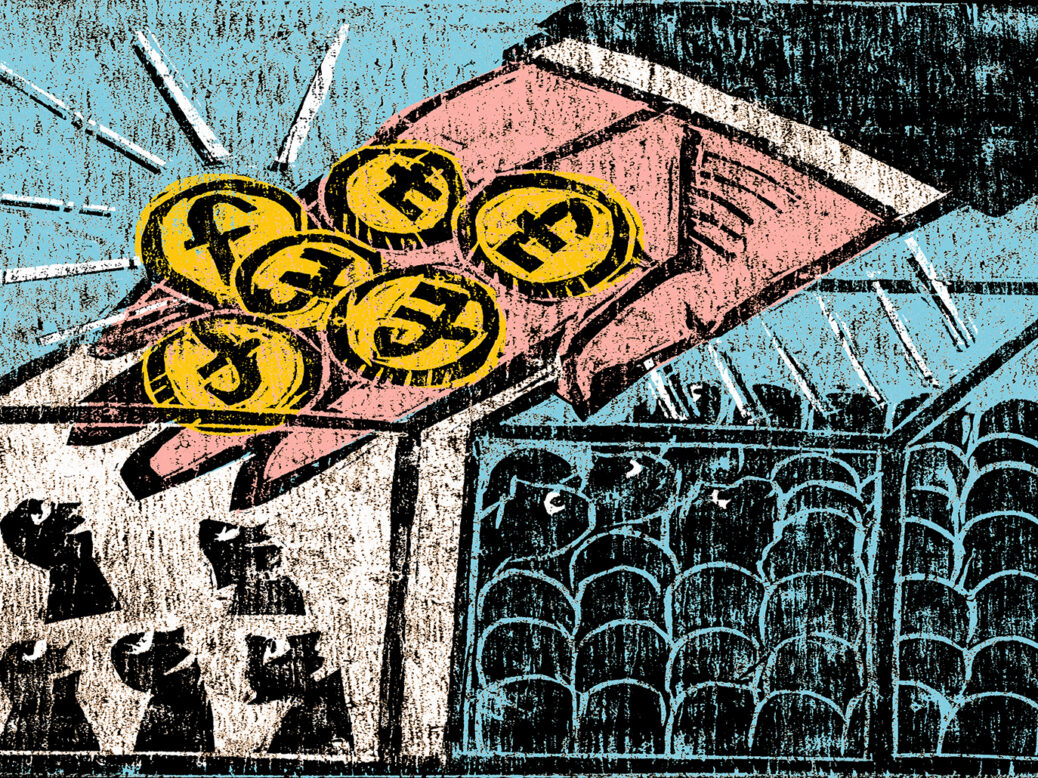
Illustration by Daniel Pudles / Ikon Images
After more than a decade of economic stagnation, it is no wonder that British progressives are reaching for new language to talk about growth. Borrowed from the eponymous American bestseller, words like “abundance” have begun to replace the tired vocabulary of fiscal restraint and managed decline. They promise a future where politics is no longer a fight over scraps; where the state builds at scale; and where growth is a reality, not a pipe dream. But, beneath the optimism sits a harder question Britain has yet to answer: will people ever believe the economy can deliver for them?
We have all heard the promises before. Again and again, voters were told the economy was improving, only to see wages stagnate, public services fray and insecurity fester. Growth, as a word, has lost credibility. And there is little evidence that if we were to somehow attain the growth rates seen only in our wildest dreams, like those of the United States, voters would feel any better off. Americans certainly don’t. Any serious growth agenda, therefore, has to start with a reality British voters can recognise, rather than a theory imported from elsewhere.
“Abundance”, as it is increasingly used, carries a distinctly American outlook of build more, regulate less and don’t worry about external constraints. Inherently, it has nothing to say about trading relationships with the EU, leading the theory’s British proponents to argue we can basically ignore this aspect of our economy all together. And it downplays the vital economic and political role of the human element of growth, in favour of an infrastructure-first focus.
Proponents are right, of course, in noting Brexit is not the only reason Britain’s economy has struggled. Domestic reform matters enormously: planning, infrastructure and regulation all need attention. But treating closer alignment with the EU as a distraction, misunderstands how growth constraints operate in the real world. Growth is cumulative. A long-term drop of 6 per cent in GDP simply doesn’t show up neatly in any single year’s data. Instead decline compounds over time, meaning investment decisions are postponed or diverted elsewhere. So productivity weakens and wages rise slowly. Confidence drains from the system. Each effect reinforces the next, leaving the economy smaller, weaker and more fragile.

New year, new read. Save 40% off an annual subscription this January.
The EU is not the silver bullet solution, but it is the highest-return lever available to any British government serious about growth. Closer alignment has a compounding effect, just like growth: it lifts the effectiveness of almost every other growth policy. Planning reform, skills investment, industrial strategy and infrastructure spending all deliver more when firms can trade, hire and invest with fewer barriers. Compared to comparatively small-scale tweaks, closer EU alignment offers a huge structural shift, creating the conditions for reforms to actually work. Without improving our relationship with our largest trading partner, it is simply not credible to talk about rebuilding long-term investment and business confidence.
We also cannot underestimate how much ground has already shifted. Last year’s reset showed that Britain does not face a binary choice between full membership and isolation. The Government demonstrated that it is possible to cherrypick access to parts of the single market. It secured cooperation on energy, sanitary and other practical measures, whilst avoiding freedom of movement and European Court of Justice oversight. The result is a kind of “Swiss cheese” model – close to the market, but outside the union; access, but with holes. It is imperfect, but it proves that alignment can be pragmatic.
Focusing on our most important trading relationship isn’t living in the past, it’s living with reality. Those who stress we should turn our attention to emulating the American economy ignore a critical fact: Americans are just as frustrated with their economy as Brits. Despite years of headline growth, the dominant political mood in the US is defined by “affordability”. Housing, healthcare and childcare costs have eaten away at any sense of progress. Joe Biden was widely perceived to have presided over economic failure, while Donald Trump’s polling dipped sharply when tariffs pushed prices up. Growth figures alone have not delivered political legitimacy. In fact, they rarely do.
Growth debates tend to obsess over things – houses built, jobs created, GDP points gained. But voters care about people. They want to know whether effort is rewarded, whether contribution is recognised and whether they have a stake in the economy. This cannot be tackled by infrastructure policy alone, nor the cowboy politics of the US.
With the UK economy increasingly exposed to global shocks, the gains from even well-designed domestic reforms can be wiped out almost overnight. Without addressing the structural drag left by Brexit and the insecurity people face, growth will always feel fragile. Infrastructure projects and housebuilding programmes may be economically sound, but people are not infinitely patient. Nor is it innate in their minds that a new building boom immediately improves their day-to-day lives. Without a political narrative that explains why growth will be different this time – and who it is for – reform runs out of road. The narrative is not a nice-to-have; it is what creates the space for reform to happen at all.
Good growth starts from a simple premise: work hard, contribute and you will get something back in return. This means a sense of agency, security and stake – as well as higher wages and new qualifications. Fundamentally, people feel growth when they recognise themselves in the story being told about the economy, and when they are a part of its direction of travel. Too many American-style narratives assume a narrow class of winners, suggesting the state should back those already best placed to thrive.
But inequality like this is bad for innovation and, in turn, bad for growth. Innovation blooms on the competition of ideas – an engineering apprentice has as much a part to play as a Cambridge PhD, just as a kid growing up in a council house has as much to offer as an Etonian with every chance in life. This is fundamental to progressive politics, and if it doesn’t flow into growth policy we will fail economically as well as politically.
This means shifting our attention towards the things people experience most directly. Because, at the end of the day, the Government could do everything right on paper and still not get solid growth. By focusing on policies that have the potential to grow the economy while giving individuals the chance to succeed allows for public by-in.
Growth becomes real to people not when GDP ticks up, but when someone can retrain to get a better job, get to work on reliable transport, see a GP before a condition becomes a crisis and access opportunities that have been lost over the past decade. These are not soft priorities; they are the foundations of progressive politics. An economy where people are healthy, mobile and skilled is one where ideas circulate, risks are taken and productivity improves. Stability matters here too. A closer relationship with the EU provides the economic predictability that allows these systems to function – giving employers the confidence to invest in people and individuals the ability to invest in themselves. Put simply, good growth is not about copying American hype, but about rebuilding the everyday conditions that allow more people to contribute to the economy in the first place.
The politics of growth needs a moral centre, not just an economic theory, nor a trendy new vibe. “Abundance” risks becoming the latest phrase of the centre-left that is lost in translation across the Atlantic. Without addressing the tangibility, urgency and security that people need now, progressives risk looking distant and out of touch. Growth that people cannot feel, trust or participate in, will never defeat the politics of populism.
[Further reading: Would net-zero migration make Britain richer or poorer?]
Content from our partners