
T20 cricket has always been a distillation of the sport’s biggest virtues, and some of its biggest vices. On Sunday, as Sri Lanka and Pakistan took the field after a long rain delay, the game was reduced to just 12 overs a side, at risk of turning into a manic version of itself.The outfield was slippery, and the ball hard to grip. Big runs were expected, but the way they came was unpredictable. Most batters struggled on a slow, gripping pitch. Two stood out: Dasun Shanaka (34 off 9) and Salman Agha (45 off 12). Through this encounter, both sides gained clarity about the best versions of their captains.Shanaka promoted himself to No. 6, up from No. 8 in the first T20I. He has batted at six most often (55 innings), but also floated through the order as an allrounder, with another 48 innings at Nos. 5, 7, and 8.Agha also moved up one spot to No. 3, in Babar Azam’s absence. He usually walks in at No. 4 (20 innings) and No. 5 (10). He came into the series under growing criticism: he played 32 T20Is last year, scoring at an average of 26.04 and a strike rate of 115.31, often getting stuck at the crease.
Sunday might have been more of the same, except the weather turned T20 cricket closer to T10. From the start, there were wild variations in line and length, slippery seams, slogs, wides, edges, and misses. Shanaka’s entry in the first innings, however, smoothed the action in the middle.

Dasun Shanaka blasted 34 off just nine deliveries•AFP/Getty Images
With the surface gripping the deliveries after pitching, both their pace and trajectory became harder and harder for Sri Lanka’s batters to deal with. Shanaka walked in at 100 for 4, with just 19 balls left in the innings.
Tall figures often loom over other cricketers on television, but what stood out on Sunday was the stillness in Shanaka’s stance. His height gave him reach when he wanted it, otherwise he stayed deep in the crease giving himself that extra half second to react to the ball. As a result, he showed better timing than anyone else; most batters were late on deliveries when playing deep, while others shuffling around to manufacture room often found the ball climbing on them.
Even as Faheem Ashraf and Mohammad Wasim tried to cramp him for room, Shanaka’s long levers and quick hands met the ball early, enabling clean swings through the line. He mostly hit down the ground or through the off side. By the final over, off Wasim, sixes rained at the Rangiri Dambulla. Three back-to-back.
His power, however, came not just from his hitting arc but from keeping his head still and letting the rest of his body follow. Unlike others trying to reach away from their bodies, he remained balanced.
On surfaces where variations in pace and wide lines are key to keeping death overs tight – as will be the case in Pallekele and Colombo during the World Cup next month – Shanaka may have found the way he can best contribute.
A condensed game freed him up to showcase the big-hitting technique he had been refining. Shanaka said after the match: “If I can get going, every team member can play their own roles. Even in practice, I was hitting well. Today was a good day to showcase it.”
He had hit five sixes in nine balls by the time he was out. His job was done, 34 off 9, at a strike rate of 377.77. The captain had taken his team to a mammoth 160 for 6.
Salman Agha’s 45 went in vain•AFP/Getty Images
Agha walked in during the second over of the chase. He faced 12 of the next 14 deliveries. The sequence read like a kid going on a lucky run in book cricket: 4, 6, 4, 3, 2, 4, 2, 4, 6, 4, 6 and out. There was nothing juvenile about his batting, though; for the first time, he seemed like a frontbencher in his own team, which had seen plenty of success without significant contributions from him.
Batters would struggle after he was gone, and Pakistan would implode at the death to fall behind and lose by 14 runs. For the duration Agha was at the crease, the match and all its wider contexts took a back seat. Just like it had when his Sri Lankan counterpart was going all guns.
Both players have, at times, seemed out of place with the responsibilities put upon them. Agha having to bat quick when it doesn’t seem natural for him. Shanaka dropped as captain in 2023 and now having to lead them again, on short notice, heading into a World Cup. Watching them come off may matter more the result.
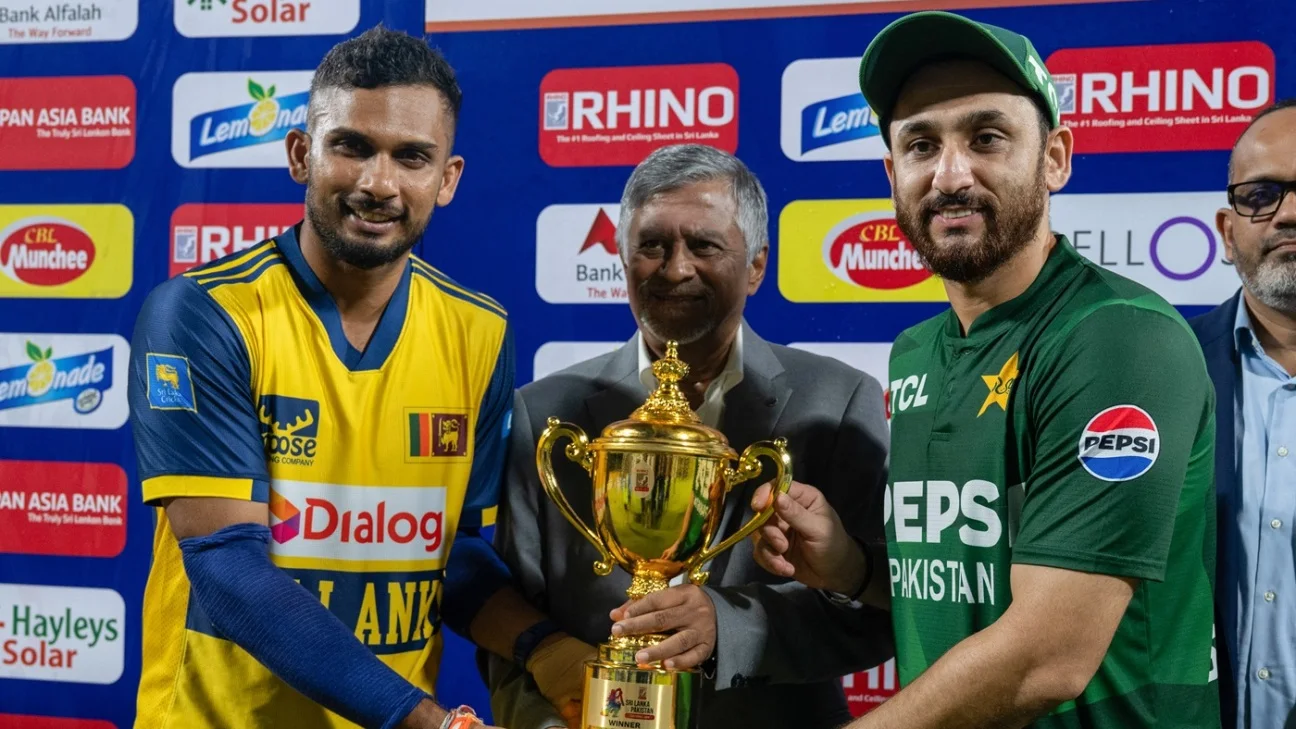
At the post-match ceremony, Agha praised his opposite number: “[Shanaka] is a very good hitter of the ball, and whenever he gets going, he can destroy any bowling, and that’s what he did to us. If I would have batted 3 or 4 overs, it would have been a closer game.”
For the time he was there though, Agha was a man freed from the psychological shackles of guiding his team through the muddy middle overs. Crucially, he shared the same still head and stance as Shanaka. What he lacked in height, he made up for by skipping around the crease, to avoid being cramped on the stumps.
Agha’s most impressive shot came just before his dismissal, off Matheesha Pathirana, whose slingers baffled batters all night. He glided into position, down on his knees, and scooped a rising delivery over fine leg. This shot showed him at his best, hyper-aware of the match’s constraints – it was the final over of the powerplay and every ball had to go.
He got out attempting the same shot next ball, one six short of Yuvraj Singh‘s fastest fifty record. His 45 off 12 left Pakistan 60 for 1 after 3.4 overs. But neither the loss nor the missed record will define Agha. The clarity he found in trusting his strokeplay might.
Abhijato Sensarma is a sub-editor at ESPNcricinfo