

Britain has been forced to reassure the United States and other intelligence partners that no sensitive government data is transmitted through cables next to China’s planned mega-embassy, ahead of its expected approval.
Sir Keir Starmer is poised to approve a supersized Chinese embassy in the next week despite security concerns. The embassy will be given the green light after MI5 and MI6 did not raise any formal objections to the plans, and the decision will be announced before the prime minister visits Beijing at the end of this month.
However, Britain’s allies have needed assurances that they will not be put at risk.
The Times has been told by multiple sources that Britain’s embassy in Washington DC briefed the US house committee on foreign affairs to assuage concerns about what information China might be able to access.
Another insider said that the US administration had not yet decided how it was going to react to permission being granted for Beijing to take over Royal Mint Court, near the Tower of London.
The site is alongside some of Britain’s most sensitive communications cables, and while allies have been told no sensitive government data is carried, the cables transmit financial data to the City of London as well as email and messaging traffic for millions of internet users.
• Realpolitik rules but Britain makes it too easy for China
Luke de Pulford, the executive director of the Inter-Parliamentary Alliance on China, told The Times: “It shouldn’t be forgotten that the government initially denied that the cables existed, and sought to discredit the journalists working to expose the story.
“This has been a case study in government obfuscation over an issue of crucial importance, which does not just impact the UK’s own national security but that of our closest allies.”
Iain Duncan Smith criticised the government for “lying about the nature of the communications cabling”
The Sunday Times previously revealed that the White House had warned Downing Street against allowing the plans to go ahead.
The White House was “deeply concerned” by the plan to approve the embassy, the Daily Telegraph reported on Tuesday evening, with a senior administration official telling the newspaper it feared “adversaries exploiting the critical infrastructure of our closest allies”.
John Moolenaar, the chairman of the US House of Representatives’ select committee on China, said: “The CCP is a threat to the UK, a Five Eyes intelligence partner, and free people everywhere.“
It is understood that there are concerns about cybersecurity and whether financial or infrastructure data could be accessed. However officials have accepted that there is a “political reality” that the embassy will go ahead.
The deadline for a decision is January 20. On Tuesday some of Starmer’s own MPs warned him against approving the plans.
Sarah Champion, the Labour MP for Rotherham who chairs the Commons international development committee, said: “Multiple government agencies and government departments have raised concerns about this mega-embassy.
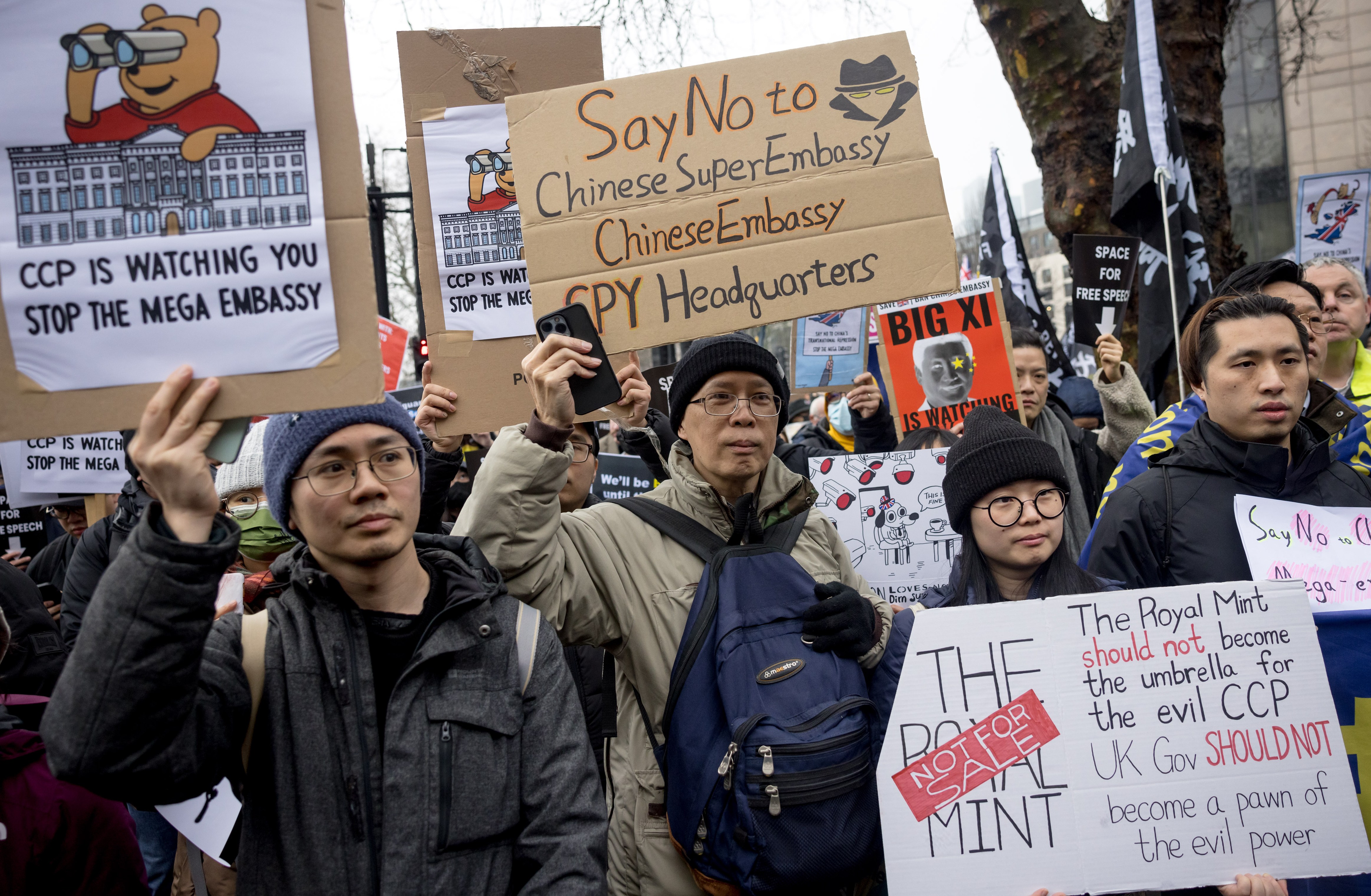
Protesters outside the Royal Mint site in February 2025
JACK TAYLOR FOR THE SUNDAY TIMES
“Our international partners have raised concerns about it. Every security briefing I’ve had identifies China as a hostile state to the UK. I am in no doubt this mega-embassy should not be allowed to go ahead.”
• Starmer must broach human rights abuses and spying on China visit
Alex Sobel, the Labour MP for Leeds Central & Headingley, added: “The Chinese state undertakes considerable transnational repression against the Chinese diaspora in the United Kingdom, much of it co-ordinated out of the existing Chinese embassy.
“The new super-embassy is a real threat to Hongkongers, Uighurs and other members of the Chinese diaspora who do not toe the Beijing party line.”
Others including Emily Darlington, the MP for Milton Keynes Central, James Naish, the MP for Rushcliffe, and Mark Sewards, the MP for Leeds South West & Morley, wrote to Steve Reed, the environment and housing secretary who is expected to announce the decision, urging the government not to approve the embassy.

Alex Sobel MP said the embassy poses a “real threat”
HOUSE OF COMMONS
Downing Street believes that consolidating China’s diplomatic premises on to a single site has security advantages.
However, Alicia Kearns, the shadow home office minister, said: “We know now that they plan to demolish the wall between the cables and their embassy. Cables on which our economy is dependent. Cables carrying millions of British people’s emails and financial data, and access that would give the Chinese Communist Party a launchpad for economic warfare against our nation.”
Plans for the site include 208 secret rooms and a hidden chamber, and Kearns said: “The government can claim today that they had no idea about these secret rooms, and we will take them at that word. But they cannot now say they have no power to protect us.
“Protect our economy, protect the British people, deny the Chinese Communist Party their embassy.”
Matthew Pennycook, the planning minister, said it would be inappropriate for him to comment on a live case.
He said: “The government does not provide a running commentary on planning casework decisions … and it would be particularly inappropriate to make any comment on material which has been received.”
He added: “Ministers will take all material planning considerations into account when the final decision is made, and ministers will inform the House of the decision accordingly.”
The government said: “National security is the first duty of this government and has been the core priority throughout this process. That is why the Home Office and Foreign Office worked closely across government, with policing, and other relevant partners, to ensure that any potential national security issues associated with this planning application have been considered and addressed.”
The Chinese embassy in London was contacted for comment.