
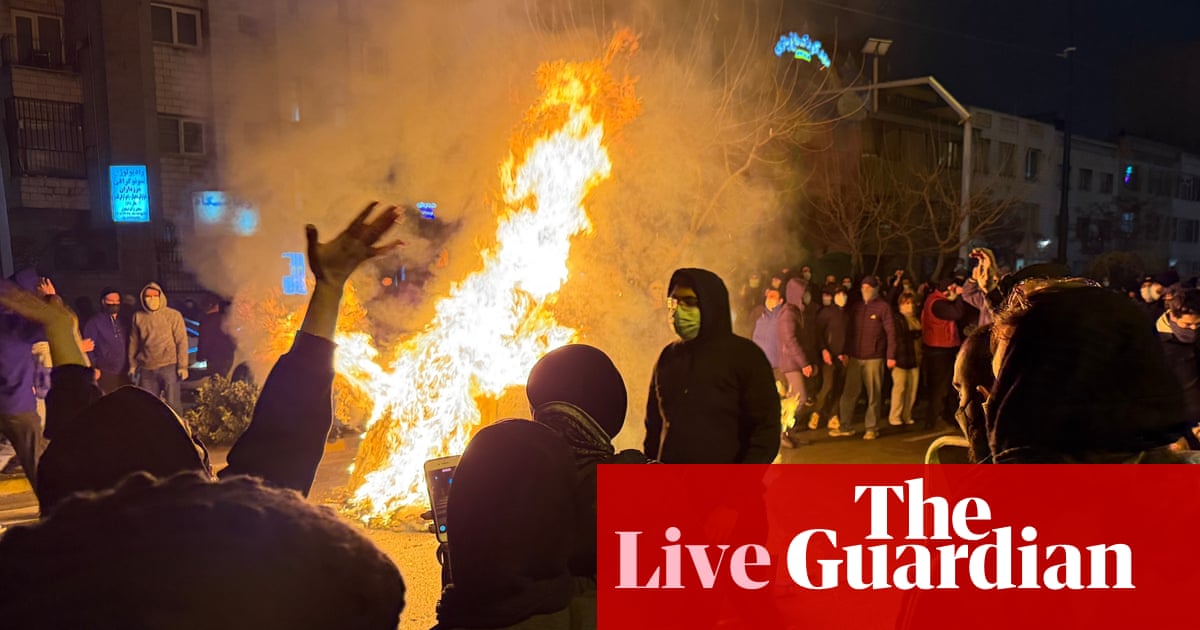
Iran judiciary chief vows fast trials for suspects arrested over protests
Agence France-Presse (AFP) has more on the comments made by Iran’s judiciary chief Gholamhossein Mohseni-Ejei, broadcast by state television.
“If a person burned someone, beheaded someone and set them on fire then we must do our work quickly,” Mohseni Ejei said on a visit to a prison holding protest detainees.
Iranian news agencies also quoted him as saying the trials should be held “in public” and said he had spent five hours in a prison in Tehran to examine the cases.
Rights groups say thousands have been arrested and fear the judiciary will make extensive use of capital punishment.
Updated at 02.36 EST
Key events
Show key events only
Please turn on JavaScript to use this feature
Amid an intense and ongoing communications blackout, France’s foreign minister said the country is considering sending Eutelsat satellite terminals to Iran to help provide internet services to locals.
Responding to a question in parliament, Jean-Noel Barrot said: “We are exploring all options, and the one you have mentioned is among them.”
In 2022, the Paris-based satellite operator accused Iran of jamming two of its satellites, something it said was “explicitly prohibited” by the International Telecommunication Union (ITU) Radio Regulations.
Amid increasing actual and threatened sanctions against Iran, our graphics team have produced this chart, showing the country’s major trading partners
Iranian families and individuals arrived in Turkey’s eastern province of Van through the Kapikoy border gate. Reuters reports that people were pulling luggage and other belongings with them as they made their way through the border gate and got on vehicles heading for nearby towns. Those asked to speak to media declined to do so, expressing fear of repercussions in Iran when they return.
Two diplomats have told Reuters there has been an increase in the numbers of people crossing from Iran to Turkey after several countries advised their citizens to leave.
However, a Turkish security official at the border said that the situation at the gate was not extraordinary, with no notable increase in the numbers arriving, but that developments there were being closely monitored.
A man walks after crossing from Iran to Turkey at the Kapikoy border gate, in Van province, Turkey Photograph: Ismet Mikailogullari/ReutersShareUK working with allies on further sanctions
The UK government is working with allies on further sanctions against the Iranian regime, the prime minister has said.
Speaking in parliament at the start of Prime Minister’s Questions, Keir Starmer said: “Can I start by condemning in the strongest possible terms the sickening repression and murder of protesters in Iran.
“The contrast between the courage of the Iranian people and the brutality of their desperate regime has never been clearer.
“We’ve called out this brutality face to face, we’re working with allies on further sanctions and doing all we can to protect UK nationals.”
Updated at 07.17 EST
German police said on Wednesday that two men had climbed over a fence into the Iranian embassy in Berlin grounds and torn down an Iranian flag. Both wanted to hoist two pre-Islamic Republic flags but failed, German news agency dpa reported, according to the Associated Press.
They left the grounds when guards used pepper spray and were detained on the sidewalk outside. The incident happened late on Tuesday.
A demonstrator holds an Iranian pre-Islamic Republic flag bearing the lion and sun emblem during a demonstration in support of protests in Iran, outside the Iranian embassy in Berlin. Photograph: Rouzbeh Fouladi/ZUMA Press Wire/ShutterstockShare
The Guardian’s graphic team have created a couple of visuals; one that shows where nationwide protests have taken place across Iran between 29 December 2025 and 13 January 2026, and another on Iran’s protest movement and how it has been affected by authorities shutting down the internet.
Graphic showing nationwide protests in Iran from 29 December 2025 to 13 January 2026.Graphic showing number of reported protests in Iran by protest size and how the internet shutdown has affected momentum.Share
John Duerden
Mehdi Taremi did what he does best. On Saturday, the Iranian striker turned inside the area and scored for Olympiakos, a well-taken eighth goal of the season for the 33-year-old that clinched a 2-0 win at Atromitos and a place at the top of the Greek Super League. Usually, millions of people in Iran follow every step of Taremi’s European career, one that took off with Porto and has settled in Piraeus via Milan, but not this time.
The ruling regime in Tehran has cut the internet and all communications, which meant that residents of the football-loving nation also missed the non-celebration that followed. “It actually has to do with the conditions in my country,” Taremi said.
There are problems between the people and the government. The people are always with us, and that’s why we are with them. I couldn’t celebrate in solidarity with the Iranian people. I know that Olympiakos fans would like me to be happy, but I don’t celebrate the goals, in solidarity with what the Iranian people are going through.
And what they are going through seems worse than at any time since the 1979 Islamic Revolution deposed the Shah and put Ayatollah Khomeini in power. Surging inflation and a collapsing currency have sparked major anti-government protests and unrest across Iran. The response has been brutal. The ruling regime is clinging on to power by dealing out death, more repression and an internet blackout that has lasted for days. WhatsApp messages remain with one tick, emails are undelivered and websites unreachable. For the millions of people outside the country with loved ones inside, there is fear and worry.
Mehdi Taremi is the latest player to receive threats from Iran’s regime after criticising the conditions in his home country. Photograph: Anadolu/Getty Images
Football has always occupied a central place in Iran, a country where the government, like many authoritarian regimes, is wary of the power of mass gatherings and their potential to turn political but is also ready to use success for its own ends. When Iran qualified for the 1998 World Cup, players were told to delay their return so celebrations could subside, and in a vital 2010 qualifier, several wore green armbands in support of the opposition leader Mir Hossein Mousavi during protests over a disputed election. Mahmoud Ahmadinejad, the declared winner, visibly tied himself to the team, visiting training sessions and lending his presidential plane for World Cup qualifiers, while at home most clubs remain closely linked, directly or indirectly, to the state.
India’s embassy in Tehran has urged all Indian nationals to leave Iran, citing what it called an “evolving situation” in the Islamic Republic.
The statement, posted on X, also advised Indian citizens to remain highly vigilant and avoid protest areas.
Russian foreign minister Sergei Lavrov said on Wednesday that Moscow needed to keep working with Iran to implement their bilateral agreements and that no other country could change the nature of ties between Russia and Iran.
Lavrov was speaking at a news conference in Moscow, reports Reuters. A senior Iranian official told the news agency on Wednesday that Tehran had warned neighbouring countries hosting US troops that it would retaliate against American bases if Washington carries out threats to intervene in protests in Iran.
Iran’s stockpile of missiles has increased since a 12-day war with Israel last year, Revolutionary Guards’ aerospace Cmdr Majid Mousavi said on Wednesday according to state media, after US President Donald Trump’s threats of intervention amid anti-government protests in Iran.
“We are at the peak of our readiness,” Mousavi was quoted as saying by state media, reports Reuters. He added that wartime damages had been repaired and output in various areas by the guards’ aerospace forces was higher than before June 2025.